.
Showing posts with label Suda 51. Show all posts
Sunday, August 23, 2015
Xbox 360 review: Shadows of the Damned
Shadows of the Damned is, in many ways, simpler in design than some of the more well-known Grasshopper Manufacture games. The story tells of Garcia Hotspur, a leather-jacket wearing and tattoo-decorated demon hunter who is brimming with hardened attitude, on a journey into the depths of hell to rescue the soul of his beloved Paula. Garcia is accompanied by Johnson, a demon who has renounced his hellish nature at the cost of losing his body and being reduced to a flaming skull. Johnson is both tour guide and weapon to Garcia, transforming from a simple torch to three different firearms – pistol, machine gun, and shotgun – each of which receives appropriate, fun and inventive upgrades as the plot progresses.
From the earliest moments of the game, the dynamic between Garcia and Johnson proves among Shadows of the Damned’s highest points. Johnson always has a timely quip to lend to the narrative, and even pokes fun at Garcia’s reading skills during one of the optional storybook segments which offers further exposition to the game’s handful of boss characters. Shadows of the Damned is less reliant on pop culture references than other Suda51 creations like No More Heroes or Lollipop Chainsaw, and the majority of humor therein is quite crude. As such, the delivery sometimes falls flat, but the game never shies away from a fast-paced and intense balls-to-the-wall presentation.
Shadows of the Damned presents a wonderfully cohesive vision of hell that strings together environments that are twisted mockeries of earthly planes within impossible spaces, while sprinkling in fairy tales of the boss characters’ falls to damnation. There are occasional, if not relatively small areas to explore or travel back to in search of an upgrade gem, but by and large, Shadows of the Damned follows a very linear progression through each of its stages. It does offer a solid variety of fun and wildly different gameplay elements that pop up from time to time, including a turret segment and a bowling minigame. The weak link among these is a side-scrolling shoot-‘em-‘up segment reminiscent of a particular stage in Grasshopper Manufacture’s 2D action platformer Black Knight Sword, but here, it feels not only awkwardly pasted in, but more of an annoying hurdle than a clever spin on the established familiar third-person shooter gameplay.
On the subject of the three firearms at Garcia’s disposal, they each bear grounded designs that become increasingly alien and appropriate given the game’s netherworld setting. Red gems upgrade the rate of fire, ammo capacity, reload speed, and so forth for each, as well as the quick-time melee responses for Johnson’s torch form. Each of the firearms performs well in taking down enemies that require particular strategies to be defeated, and overall, these three weapons handle in a manner that is equally balanced between familiar standards of the shooter genre and fresh gameplay variety, and are thus highly intuitive. Much as these guns do well at felling foes, they also serve to solve a number of short-lived but mildly thought-provoking puzzles.
Tunnels filled with shadowy mists that connect portions of some of the game’s levels, as well as moving floors and staircases, incorporate a dash of adventure gameplay. At times, ammo for particular weapons can be sparse, though Garcia can always count on a demon-human hybrid mutant with a hillbilly accent to offer up his wares at a small price at least once per level. The soundtrack is rockin’ from start to finish, with mellow industrial tunes reminiscent of Silent Hill dipping in frequently – fitting, not only due to the game’s narrative direction and themes, but also because the soundtrack was scored by Akira Yamoka.
Shadows of the Damned is not a particularly difficult game, nor is it a particularly lengthy one. There will be learning curves associated with chase sequences at a mere two or three junctures, but beyond those momentary hurdles, players should have no trouble blasting their way through the hordes of hell to reach Garcia’s beloved Paula. The boss fights each present a new strategy, and are enjoyable across the board, though they certainly do not leave as lasting an impression as the boss encounters in Grasshopper Manufacture’s action entries of No More Heroes or Killer is Dead. Perhaps Shadows of the Damned clocking in shy of the ten hour mark is just as well, given the rather straightforward tale that is spun along the way, and the moderate amount of replay value it offers.
My rating: 7.25 (out of 10)
Saturday, May 3, 2014
Gamecube review: Killer7
You may have gathered from my many reviews of Suda51’s games that I am a huge fan of his work. Much as I love No More Heroes and its sequel, I was acutely aware of the fact that most Suda51 fans held Killer7 to just as high a caliber. I recall seeing promo content for Killer7 before it ever released on the Gamecube via Nintendo Power and various websites, but never had the chance to play it in proper until recently. Whereas No More Heroes is an unapologetic satire on the action game genre as well as the video game industry at large, Killer7 combines horror and action elements in an on-rails shooter that involves clever puzzles, requires quick thinking and fast reflexes, and boasts a curious brand of dark psychedelic flair.
The Smith Syndicate, otherwise known as the Killer7, is made up of – you guessed it – seven core members. Garcian Smith is liason between the six assassins and their master, Harman Smith. In the event that one of the six assassins – Kevin, Dan, Kaede, Mask, Con, or Coyote – is killed during a mission, Garcian can retrieve their remains and bring them back to life. The catch, however is that Garcian must retread their steps into enemy-filled territory. Thus is the big gamble with retrieving a dead Smith – Garcian cannot be upgraded, and in the event that a mission does not require use of the Smith in question’s unique abilities, it may be wise to simply carry on with the remaining members of the syndicate.
Blood is the currency of Killer7, and is used to heal during a mission, required to utilize the unique abilities of each of the Smiths, and can be exchanged for upgrade points to boost the stats of the Smiths. Each Smith has a different skill set, ranging from Con’s speed in both mobility and firing rate, to Kaede’s long-distance scoped pistol, to Kevin’s throwing knives which negate any need to reload. However, each Smith has an offset to prevent any single one from becoming more powerful than the others. Con’s defensive capacities are practically nonexistent, and though Mask deSmith is built like a tank, the spread of his grenade launchers results in his gathering a lower-quality blood far more often than not. Kaede and Mask’s unique abilities often reveal hidden messages and passageways respectively, and are most helpful in solving puzzles. Coyote and Kevin’s abilities are most frequently used to access new areas of the map, while Con’s ability to hear specific sounds and determine the correct path off those sees the least use. Dan’s ability to charge up one Collateral Shot in order to take out enemy spawn points is used sparingly, but is practical nonetheless.
The enemies that the Killer7 face at every turn are monstrous humanoids known as Heaven’s Smiles – effectively walking time bombs with abilities that vary from one mission to the next. If a Heaven’s Smile gets too close to one of the Smiths, it will detonate and chisel away a decent portion of their health bar. Some varieties of Heaven’s Smiles are slow but capable of taking many hits, others are stationary but notably more lethal as ‘turret’ units. Some of the more dangerous Heaven’s Smiles, encountered later in the game, are designed to race toward players before they have much time to devise a countering strategy. While the game never feels cheap or frustratingly difficult, it certainly demands a unique learning curve given its style of gameplay, and a trial-and-error pattern is key to taking down some of the game’s most lethal enemies.
These Heaven’s Smiles are the binds that tie everything together, plot-wise. At the outset, Harman has an encounter with an old acquaintance named Kun Lan. Kun Lan has acquired the means to offer ordinary citizens the chance at becoming Heaven’s Smiles, and furthering his terrorist routine. Swept up in the rivalry of these two old men are political officials representing Japan and the U.S., as well as other radical idealists like one Ulmeyda. It’s a melting pot of cleverly-scripted characters with colorful attitudes that lean more toward the practical and realistic given the scenario at large, as opposed to No More Heroes’ more crazy and eccentric residents. Even with the M-rating slapped on the box, it should be noted that Killer7 is a thinking man’s game – not just because of the logic-based puzzles, but because of the story and setting’s emphasis on more adult themes like modern terror tactics, cultist followings, irregularities in space-time, geopolitics, and moral ambiguity.
Much like the more recent Killer is Dead, Killer7 utilizes a hyper cel-shaded art style, wherein whites are borderline-glaringly bright, and shadows are nearly pitch black. The animations and details of each character model are incredibly well-rendered, however, so it is thankfully not a case of the art style trumping the care put into bringing the Smith Syndicate to life. The soundtrack incorporates a number of industrial and techno tunes to flesh out its near-future setting, while also adding a dash of rock and classical string sounds to the mix. Some of the cutscenes opt for a modern anime approach, while the majority deliver story segments in small doses of grungy 2D digital animation.
Kiler7 will run players about fifteen hours or so on their first playthrough. Some levels are more time-consuming than others, as they may require the Smith Syndicate to retrace their steps in order to complete a puzzle that was impossible to overcome at an earlier point. Others host considerably more enemies, leading players to have their triggers ready to go at a moment’s notice. But even the first introductory level lacks a linear design. There is never a set order in which players must overcome the various challenges of each mission, rather the ultimate goal is to retrieve all the required Soul Shells rewarded from mastering puzzles and exploring the environment. The game does mark each puzzle, Soul Shell, and point of interest on the map screen, making retreading one’s steps a less tedious process, though the game will never state outright what needs to be done at each location.
However, clues can be purchased for an adequate amount of blood from the ghostly figure of Yoon-Hyoon and his luchador mask. Similarly, the bondage jumpsuit-bound individual known as Iwazaru offers tidbits on local enemy tactics in any given locale. Arguably the most interesting of these phantoms is Travis Bell, a young man who knows perhaps more about the picture at large than any of the Smiths. His knowledge of the Japan-U.S. political affairs and the associates Garcian occasionally meets with makes him a key part of unraveling the grander story.
While the seven Smiths are merely faces with separate weapon sets at the start of Killer7, they each have their time in the spotlight, and by the game’s final hours, each will have a distinct and rounded identity. Some of the Smiths are explored in greater detail through letters and key items found within missions, forcing some digging on the part of players. Others, like Dan and Mask, have fully-scripted cutscenes allotted to them. Upon completing the main game, the grueling challenge of Killer8 is unlocked, which grants players access to Harman Smith alongside the other six assassins.
Killer7 is a rare gem, unfortunately overlooked by many due to its limited exclusivity to the Gamecube and release late in the sixth console generation. Despite the fact that the game does see a couple of hiccups few and far between, there isn’t any one element that stands out as being significantly flawed. Killer7 is weird, no doubt, but that is standard of any Suda51 title. Killer7's unorthodox controls and general gameplay may seem a bit daunting at first, but by the time players complete the first mission, it should all feel very fluid and natural. Killer7 deals with some dark plot elements that are very relevant to this day and age, and the culmination of its mature storytelling, wild artistic vision, and crazy creative gameplay make it one of the best games I have experienced on Nintendo’s purple lunchbox console.
My rating: 10 (out of 10)
Sunday, November 17, 2013
DLC review: Killer is Dead - Smooth Operator pack
Included with each collector’s edition/launch day copy of Killer is Dead, the Smooth Operator pack provides players with another full-fledged mission to take on, as well as an extra gigolo mission and alternate costumes for both Vivienne and Mika. The costumes are purely for aesthetic purposes and hold no bearing on the outcome of the new mission or any others. The gigolo mission with vampire Betty is a bit more challenging than previous interactions with Koharu or Natlia, but is ultimately just as shallow in design. The real substance of the Smooth Operator pack comes from the extra mission, dubbed ‘Episode 51’, wherein Mondo travels to an old castle to seek revenge on a Wire-vampire hybrid at Betty’s request.
As with many of the main game combat missions, Episode 51 opens with a series of moving pictures as opposed to a full-blown cinematic sequence, which details how Betty, despite being a vampire, was bested by another vampire who infused his body with Wire material. After this quick backstory segment, the game shifts back to its usual hyper cel-shaded standard. While this DLC pack still basically looks as good as anything in the main game, the fact that Mondo is sent to explore an ancient castle nestled within a dark forest gives it a very distinct aesthetic that is both fresh and familiar when compared to the Area 51-inspired base where Mondo fought Giant Head or David’s lavish mansion on the moon.
The setting also proves the most challenging to see in, at times, with Mondo needing to scour the dungeon for torches to light his way. Even the most brightly-lit portions of the castle still look dim in contrast to other levels, which certainly aids in perpetuating a classic monster movie vibe, but simultaneously leads to Mondo bumping into walls as well as the occatsional retracing of steps. Typical gameplay is broken up with the inclusion of a manned turret section and notable integration of both Mika and Bryan into the narrative. Aside from a brief appearance from Mondo’s unicorn friend, Episode 51 has practically no ties to the main storyline of Killer is Dead, and as a result, can be played at nearly any time once it has been installed.
Episode 51 offers a decent challenge factor while providing significant rewards in the forms of money and ore, and can prove a rather enjoyable means to boost stats and abilities. The time it will take to complete this DLC mission is pretty typical of the earliest up to the mid-game missions – not nearly as lengthy as Mondo’s storming Hamada Yama’s hideout, but comparable to his first visit to David’s mansion. With all the attention to detail and overall production quality of Episode 51, it certainly feels like a mission that was originally intended to be released as part of the full game.
My rating: 7 (out of 10)*
*(rating applies solely to downloadable content, not its inclusion with the content on the original game disc or other downloadable content)
As with many of the main game combat missions, Episode 51 opens with a series of moving pictures as opposed to a full-blown cinematic sequence, which details how Betty, despite being a vampire, was bested by another vampire who infused his body with Wire material. After this quick backstory segment, the game shifts back to its usual hyper cel-shaded standard. While this DLC pack still basically looks as good as anything in the main game, the fact that Mondo is sent to explore an ancient castle nestled within a dark forest gives it a very distinct aesthetic that is both fresh and familiar when compared to the Area 51-inspired base where Mondo fought Giant Head or David’s lavish mansion on the moon.
The setting also proves the most challenging to see in, at times, with Mondo needing to scour the dungeon for torches to light his way. Even the most brightly-lit portions of the castle still look dim in contrast to other levels, which certainly aids in perpetuating a classic monster movie vibe, but simultaneously leads to Mondo bumping into walls as well as the occatsional retracing of steps. Typical gameplay is broken up with the inclusion of a manned turret section and notable integration of both Mika and Bryan into the narrative. Aside from a brief appearance from Mondo’s unicorn friend, Episode 51 has practically no ties to the main storyline of Killer is Dead, and as a result, can be played at nearly any time once it has been installed.
Episode 51 offers a decent challenge factor while providing significant rewards in the forms of money and ore, and can prove a rather enjoyable means to boost stats and abilities. The time it will take to complete this DLC mission is pretty typical of the earliest up to the mid-game missions – not nearly as lengthy as Mondo’s storming Hamada Yama’s hideout, but comparable to his first visit to David’s mansion. With all the attention to detail and overall production quality of Episode 51, it certainly feels like a mission that was originally intended to be released as part of the full game.
My rating: 7 (out of 10)*
*(rating applies solely to downloadable content, not its inclusion with the content on the original game disc or other downloadable content)
Wednesday, November 13, 2013
Xbox 360 review: Killer is Dead
A government agent who operates as a sword-for-hire to various clients, Mondo Zappa is a man largely shrouded in mystery from the outset of Killer is Dead. From the earliest missions, it is made clear that he is the successor to his bureau’s former top man, but it isn’t long before the story pans out to make way for the larger picture. After a few missions that allow players to become accommodated with the control scheme and highly-fluid, smooth-as-hell gameplay style of Killer is Dead, Mondo makes a visit to the moon where he briefly clashes with a man named David. David apparently usurped command of the dark side of the moon from a woman named Moon River, and though he bests Mondo during their first meeting, he remains present throughout the remainder of the game, influencing the beasts and machines Mondo will square off against in locations like technologically marvelous skyscrapers, steam train cars, and even within Mondo’s own dreams.
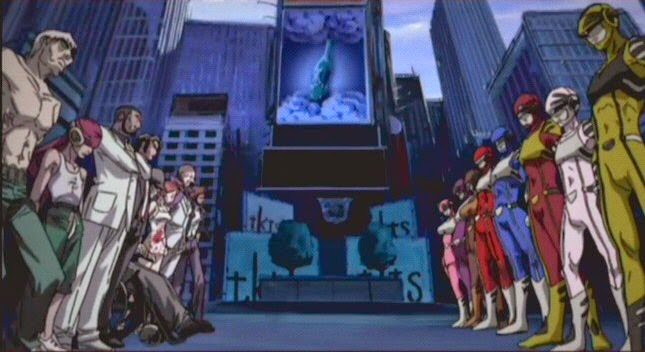
Killer is Dead’s artistic style is heavily influenced by a previous Suda51 hit, Killer7. Killer is Dead is hyper cel-shaded to the point where people and objects obscured by shadows appear as completely black with little more than a vague outline defining them, allowing Mondo’s red eyes or David’s golden robes to glow and clash distinctly. Killer is Dead may run on the Unreal Engine, but its graphical direction prevents the technology from looking as obviously aged as it did in Lollipop Chainsaw. In fact, Killer is Dead is both one of the most visually loaded and visually impressive titles of 2013.
The story is more single-minded in its focus than other Grasshopper Manufacture titles. While Mondo and his allies will take on all manner of assassination gigs across the globe, David’s influence remains a constant pillar that reminds players of their ultimate endgame goal. The pacing during the game’s first half is a tad slow, but it never feels sluggish. Rather, it allots time to emphasize the themes and symbolism in Killer is Dead, which include a great number of traditional Japanese folklore elements, the moon, the Earth, and the sun as astral energies, the reliance people have on blood, and the contrast of technology and humanity, to name but a few. As with No More Heroes and Black Knight Sword, there is a decent amount of information relevant to the overarching story that is not explicitly stated, but can still be pieced together with hints dropped by NPCs and symbols associated with some of the characters. It takes around ten hours to reach the finale on a normal difficulty setting, and the payoff is incredible.
In truth, Mondo Zappa is practically a complete inversion of NMH’s Travis Touchdown. Both characters break the fourth wall from time to time, though Mondo is significantly less talkative and carries himself with a professional demeanor. While Travis bumbled through all of his romantic pursuits, Mondo has multiple women swooning over him, and can win their affection in gigolo missions where he presents them with presents in order to fill up an affection meter. These sections, though optional, must be completed at least a couple of times in order to acquire the freeze shooter and drill subweapons. The affection meter will increase more rapidly if Mondo ogles the bodies of these ladies instead of their faces, but if they catch Mondo’s vision straying south, their own meter - which gauges how impressed they are with the suave assassin - will dwindle. These gigolo missions are incredibly simple in design, and while they are not terribly challenging, they feel clunky, as if they were stapled on to the experience late in development. Suda51 games are known for frequently incorporating a high degree of sexuality in character designs as well as their interactions, but the gigolo missions are flat out lazy – there’s no meaningful end result, other than receiving the basic subweapon, and certainly no reason to return to the gigolo missions later on, as the freeze shooter and drill can be upgraded with ore at any time from the pause screen just like Mondo’s healing factor, katana attacks, guard break, and so on.
Whereas both No More Heroes titles played largely as action games with adventure elements worked into the overworld of Santa Destroy and portions of the combat-heavy levels, Killer is Dead plays as pure an action experience as Devil May Cry or Bayonetta. Mondo can chain combos by slashing his katana, performing a guard break with his mechanical arm, or simply keep the meter active by firing his cannon attachment at foes. The more damage Mondo inflicts on enemies, the more blood he is rewarded, which can be used as cannon ammunition, ‘adrenaline rush’ insta-kills on weak or heavily wounded Wires, and even to replenish his health. Finishing off enemies after the combo meter has exceeded thirty consecutive hits will result in a brief freeze-frame for each enemy slain, offering players free choice of one of four rewards – those being blood, ore (used to upgrade Mondo’s stats and weapon capabilities), wire synapses (which restore Mondo’s physical health), or health gems (which increase his health bar).
Speaking of upgrades, Killer is Dead does well to prevent the game from becoming too easy too quickly. The cheapest upgrades push some basic improvements to Mondo’s offensive capabilities, while the one that require the most ore will allow him to automatically heal at a gradual pace over time or remove the limiter on his katana, allowing combo chains to be achieved more easily. Rarely do these upgrades improve his overall strength or defensive capabilities, however. To improve Mondo’s health or blood meters, one must gather the relevant replenishing items within each level, rewarding players who do a little bit of exploring.
The game’s dodge mechanic is forgiving to just the right degree – if an enemy lunges toward Mondo, there should be ample time for players to press the right button and then counter said foe, and any mistakes after the first hour’s learning curve are on the player exclusively. The game does well to keep the camera at an angle that will provide an ideal view of the action and other nearby foes, though it is quick and easy enough to adjust while in the heat of battle. Also, the more combos Mondo has chained together, the faster he will move and attack, and the game accounts for this wild and loose progression by having him automatically block enemy fire or simply not taking damage that would upset the combo chain once it has gone upwards of fifty or so.
The variety in level design is flat-out brilliant. Though some levels may be completed more quickly than others, all of the main game missions feel as though they have seen plenty of time and care from the development team. Little additions like a piano staircase that has a different note associated with each individual step and added puzzle elements that open secret rooms go a long way in rounding out the experience. Outside of the main game, players can revisit portions of previously completed levels in order to try their hand at various challenges, some of which put Mondo in the sidecar of Vivienne’s motorcycle or behind a turret, while others simply ask that he slay a certain number of enemies within a set time limit. The most difficult challenge missions come from Scarlett, a nurse who can be found hidden within each of the main game missions. Tracking her down time and time again will unlock more challenges, and the criteria Scarlett lays out for Mondo certainly yield the biggest monetary rewards.
Travis Willingham, Johnny Yong Bosch, Tara Platt, and others lend their talents to the cast, and while Patrick Seitz’s soft-spoken and professional demeanor are performed very well, Liam O’Brien steals the show in every scene where villain David appears. Akira Yamaoka (of Silent Hill fame) adds a highly-creative blend of industrial, classical, and techno tunes to the mix. While Mondo and David are wonderfully inventive characters that beautifully contrast each other, the supporting characters are largely hit-or-miss with regards to their complexity and importance to the plot. Vivienne Squall does little more than remind everyone in the bureau that they need to be paid a hefty sum for each job, Mika’s annoying and childlike behavior gets old incredibly fast, while cyborg boss Brian provides some comic relief. The villains, though given notably less screen time than Mondo’s allies, are by and large quite memorable, both with regards to the visual representations and their attitudes/personalities.
Suda51 fans looking for a more goofy, bizarre romp in the vein of No More Heroes or Lollipop Chainsaw may find themselves a bit disappointed. Killer is Dead is no doubt a strange game, and very much a one-of-a-kind action experience, though it pushes a more serious story that is, at times, as dark in tone as the excessively-saturated cel-shaded shadows. It might not be a particularly long game, and it definitely has some oddities and pitfalls outside of the core gameplay. But for those looking to experience a curious culmination of Japanese folklore, cosmic mythos, and the smoothest gameplay Grasshopper Manufacture has delivered yet, Killer is Dead is an excellent choice.
My rating: 9 (out of 10)
Sunday, July 14, 2013
Top 10 Games of the Seventh Generation Consoles - #2: No More Heroes and No More Heroes 2: Desperate Struggle
While there have been plenty of solid sequels and revamps of classic titles on the seventh generation titles, few developers have dared to tread into brand-new territory. Few have dared to create something so bold as No More Heroes. Much as I love the Mass Effect sequels, Metroid Prime 3: Corruption, and the other games that found their way onto this list, they are all sequels or spiritual successors to previous releases. Though the No More Heroes titles do draw inspiration from contemporary hack-and-slash action titles and 8-bit arcade-y games, the culmination is a wonderful breath of fresh air, not just to the genre, but to video games as an entertainment medium.
Both the original No More Heroes and its sequel Desperate Struggle are (among other things) unapologetic – Travis Touchdown slices and dices his foes into bloody pools, spouting off vulgar one-liners during his moments of downtime that are equal parts awesome and silly. The original game defined a brand-new experience and was one of the earliest Wii titles to really nail the motion controls down by balancing those with a traditional button/joystick combo. While No More Heroes boasts many a colorful environment and memorable assassin, the sequel cleaned up the entire experienced, streamlining the overworld and amping up the combat just enough that it was more fast-paced without teetering into the realm of frenetic.
The sequel also saw a more focused, darker story – one of Travis seeking revenge – which still managed to balance the silly with the gritty. While the first game was more off-the-walls goofy, the references to Star Wars and Back to the Future therein seemed unorganized and random compared to the sequel’s mecha boss fight between robots inspired by anime Space Runaway Ideon and Gurren Lagann, or a narrow forest whose twisted dead trees and red night sky were an obvious nod to Capcom’s explosively popular Resident Evil 4. Instead of giving off the impression that the game was chock full of ideas that creator Suda51 thought were cool, NMH2 came across as more of a love letter – not only to the creative minds behind the works Suda was paying homage to, but to fans of the original NMH as well.
Personally, I am a bit partial to Desperate Struggle. It’s much easier to jump into, has a higher degree of replayability due to its time attack Death Match mode and general faster pacing. But I won’t deny that the boss fights in the original No More Heroes were some of the best I’ve experienced in any game. Being such a huge fan as I am of the Legend of Zelda series, that is the standard with which I compare the boss fights of any and all other video games, and it is incredibly rare that another title provides as consistently high-quality encounters. But the UAA ranking matches in the NMH games are truly something to behold – a brilliant mesh of flair and challenge that defines the core of the experience.
Sunday, February 17, 2013
Xbox 360 review: Lollipop Chainsaw
Following the formula of No More Heroes, Grasshopper Manufacture's Lollipop Chainsaw is equal parts violent hack-and-slash and comedic romp through the zombie-infested city of San Romero. Juliet Starling arrives at school on her eighteenth birthday to discover that an emo student named Swan has unleashed the armies of the undead. Juliet - born into a family of zombie hunters - fights her way through the sea of zombies until she finds her boyfriend Nick, who - attempting to protect Juliet - becomes infected himself. Very much in love with Nick, Juliet performs a magical spell that allows her to remove Nick's head and keep him alive, while his body cannot be saved. Chainsaw in-hand and Nick's decapitated head hanging from her belt, Juliet vows to undo Swan's work.
Juliet avoids typical blonde ditz clichés due to the fact that she is a Zombie Hunter and has a game plan in mind with each new peril she faces. Some of her behavior does come across as silly, but that is primarily a result of her innocent nature combined with her bloody line of work. These two opposing forces allow her to become a truly memorable protagonist, and quite a likeable one at that. Nick is a source of great humor as well, considering he is more or less along for the ride, and is well aware that he is by far the most normal and sane member fighting the undead - the rest of whom are all members of Juliet's family. He constantly quips about his lack of a body, but also acts as eyes in Juliet's blind spots, rooting her on as she dishes pain to the zombie masses.
The games' jokes and one-liners bounce back and forth between stupid and uninspired to rather clever set-ups. Some NPCs swear simply for the sake of reminding players that Lollipop Chainsaw is an M-rated game, while the majority of Juliet and Nick's conversations are as cutesy as they are awkward and entertaining. Each of the boss characters represents a different genre of music, with most bearing a resemblance to a specific famous musician. These character designs, as well as much of the dialogue, are far less subtle parodies than what Grasshopper Manufacture presented in No More Heroes. While Lollipop Chainsaw may not win any awards as a comedic work, the B-movie atmosphere is consistent and the game does not take itself too seriously, despite the writers seeming to think it is more cleverly-scripted at times than it actually is.
While the earliest levels take place in bubbly cheerleader/zombie hunter protagonist's high school, later stages explore the greater area surrounding the school. Most stages incorporate some sort of minigame element, though the core of the gameplay lies in pom-pom hits, chainsaw swings, and the resulting combos you can chain together. Certain attacks will be unlocked as part of the game's natural progression, but most will be unlocked through the in-game store by spending medals earned from zombie hunting. This allows for a significant degree of freedom, as players can effectively unlock new combos at their leisure, making each person's individual playthrough unique. The gameplay may not be as fluid or exciting as the likes of No More Heroes, but it certainly holds its own in following a similar formula to the combat system in games like Devil May Cry.
Nick's head can occasionally be attached to an empty zombie body to open new pathways for Juliet. Using these will prompt a sort of quick-time event that requires players to press specific buttons one after another. It's rather dull, and each of these Nick-on-a-headless-zombie sections must be completed to progress through the entirely-linear game. On the other hand, Juliet can collect Nick Tickets throughout the game which can be spent on a few different attacks that utilize Nick's head, from firing him out of a popper cannon, to spinning him around on a ribbon. These will cause a fair amount of damage to foes and some even grant Juliet temporary damage resistance, acting as an alternative to her other powerful attack that results from chaining enough kills and filling the chainsaw gauge. Once the chainsaw gauge is filled, Juliet can temporarily power up her swings and slashes, making them rainbow colored and briefly granting her invincibility. Decapitating three or more zombies at once rewards Juliet with a large sum of medals, and this is made much easier in her powered-up state.
While the fighting is largely repetitive, the game mixes the experience up by placing environmental barriers that Juliet must cut down, encouraging players to race across rooftops with the chainsaw dash ability, and placing Juliet within classic arcade games like Pong and Pac-Man. Each boss fight has multiple phases and distinguishes itself from the others very well. One element the whole experience seems to lack is something to properly connect the different stages. The story does well enough to explain why Juliet and Nick land on a farm and need to scale a skyscraper-sized arcade, but each level feels like it could have been expanded upon. The game only lasts around six hours, and while it does encourage multiple playthroughs for completionists, there seem to be a lot of missed opportunities on the part of the development team. The game also lacks much of a challenge factor. For fans of typical action hack-and-slash games, the normal difficulty setting will be a walk in the park, and even rookies of the genre will likely find the challenge at least a little underwhelming. Meanwhile, the harder difficulty settings do little more than restrict your stock of health-rejuvenating lollipops.
Graphically, the game looks okay - nothing more, nothing less. There is a subtle cel-shaded look that layers everything, adding to the comic book style the game tends to lean toward in its overall artistic presentation. While character models are well-animated, textures and character models themselves do not look particularly good when compared to many other games of this generation - due in large part to the aging of the Unreal Engine - and the game's brightly-colored environments do little to mask this visual shortcoming. On the other hand, the soundtrack is a standout part of the game's presentation. The original score is upbeat and action-oriented, while licensed tracks like Toni Basil's "Mickey", Dead or Alive's "You Spin Me Round (Like a Record)", and Skrillex's "Rock n' Roll (Will Take You to the Mountain)" are plain fun to listen to and add an extra level of pep and silliness to the cheerleader-driven narrative. Though few and far between, there are a handful of moments where the audio mixing becomes very unbalanced, and it is difficult to hear scripted dialogue over environmental noises.
There are ranking modes and plenty of unlockable costumes, but the core of the experience lies in playing through the story. A single playthrough of Lollipop Chainsaw will only last a few hours, which may be a deal breaker for some, especially when stacked up against its contemporaries. Fans of Grasshopper Manufacture and Suda51's previous work will no doubt feel at home, though they may not be laughing quite as hard nor as often as usual. Lollipop Chainsaw is fun, fast-paced, and the individual levels are well-developed. Unfortunately, the game lacks significant extra substance to land it a spot comparable to other games of its kind.
My rating: 7 (out of 10)
Saturday, January 19, 2013
Killer is Dead official trailer
A couple of days ago, some screens of the new Suda51 game Killer is Dead appeared on NeoGAF. As of yesterday, we now have a trailer showing off the gameplay and giving us a little taste of the characters and story. Based on what is presented here, it seems like some of the fan speculation that this game would be a spiritual sequel to both Killer 7 and No More Heroes is at least partially true. The story of lead protagonist Mondo Zappa appears to be more serious in nature than that of Travis Touchdown, but the way he wields his blade is similar to how Travis' handled his beam katana. Meanwhile, Mondo also fires rounds from an object on his left arm, seemingly a nod to Killer 7 heavily emphasizing shooting in its own gameplay. Killer is Dead's graphics are cel-shaded, much like the two aforementioned Suda51 titles, though the graphical quality is notably higher, which only makes sense, considering that Killer is Dead will be releasing for both the PS3 and Xbox 360. The end of this trailer teases at more footage to come, so hopefully we will learn about other characters and story elements in the coming months.
Monday, December 24, 2012
2012 Year in Review: Video Games
2012 was sort of a strange year for me with regards to gaming. My return to handheld gaming was triumphant, due in no small part to the latest addition to my console collection, the 3DS. But there were also a number of standard DS games that proved a lot of fun - in fact, most of them were handled better than most of the home console releases I played. I don't mean to say that all of the major 2012 releases were disappointing - Fall of Cybertron satisfied my inner Transformers geek while I was able to look past the hiccups in Resident Evil 6 to find a decent entry into what has quickly become one of my favorite gaming series in recent years. But when these and big-name releases like Halo 4 and Final Fantasy XIII-2 cannot impress me in the way that the fifth generation Pokémon games or the DS remake of Final Fantasy IV do, it's a peculiar scenario to say the least.
Super Mario 3D Land: An entertaining blend of side-scrolling and free-roam Mario games, 3D Land keeps players on their toes with clever level design and tactical approaches to enemies. The boss fights do become a bit redundant after a while, and the story is one very familiar to anyone who has played another Mario title. Still, it's one of the most polished of the early 3DS releases, and is the standard by which all future 3D platformers should be judged. My rating: 9.25
The Legend of Zelda: Ocarina of Time 3D: When dealing with a classic like Ocarina of Time, it's generally a good idea not to fix that which isn't broken. The game still plays like a dream, though the menus have been compressed and streamlined to make for easier access to Link's many items. The graphical update is very welcome and the 3D effects immerse you even more in the kingdom of Hyrule. Boss fights can be revisited at your leisure, while the bonus Master Quest mode can only be unlocked following a playthrough of the main story. My rating: 9
Final Fantasy XIII-2: This direct sequel to Final Fantasy XIII sees Lightning and company moved to the supporting cast in favor of granting the spotlight to Serah and Noel. The two protagonists travel through time and space, visiting areas both familiar and new, in order to correct the paradoxes caused by main villain Caius. The role of the third party member is filled by your choice of a variety of monsters, while Serah and Noel level up at a much faster rate than the cast of FFXIII. The presentation of the game is graphically gorgeous, while the soundtrack takes a lot of bold gambles. However, it is difficult to ignore the fact that Square Enix released what is essentially an incomplete game, as the ending feels like a kick to the crotch for anyone who played through both of the main games in the Fabula Nova Crystallis storyline. My rating: 8.25
Sonic CD (XBLA): One of the most difficult-to-find games in the entire series, Sonic CD has earned something of a cult following over the years. Time travel is introduced and players must utilize this new element if they wish to access the game's true 'good' ending. Level design designs avoid slow climbing sections that bogged down Sonic the Hedgehog 3 in favor of the high-speed thrills exhibited in the first two games. Sonic CD is host to one of the most kickin' soundtracks in the series, while the boss fights are less-than-spectacular. My rating: 8.75
Resident Evil Revelations: Perhaps the best release the series has had since Resident Evil 4, Resident Evil Revelations shows the competition the right way to make a handheld release that can do more than just hold its own against console retail releases. The cruise ship setting and host of enemies based off sea creatures makes for a perfect balance of survival-horror and action horror, an element of the Resident Evil series that has been widely criticized in recent years. The bonus Raid Mode is no Mercenaries Mode, but is still a welcome addition to an already fantastic single player experience. My rating: 9
Pokémon Black and White: A wonderful balance of elements new and old, the fifth generation Pokémon games include many a new Pokémon, each and every one of which has some practical use that can be incorporated into different strategies when building teams. The games offer a lot of freedom, but at the same require a decent amount of planning and strategy. That said, there is virtually no time required to spend grinding, assuming players maintain a balanced team. The gyms are a tad easy compared to previous entries in the series, while the Elite Four seen therein is perhaps its best incarnation. The Unova region is gorgeously rendered and though the animated Pokémon battles look rather pixelated, the games' graphics really push the DS to its limits. With N and Team Plasma's presence growing over the course of the game, Pokémon Black and White deliver one of the best stories in any of the core games in the series. My rating: 9.25
Sonic the Hedgehog 4: Episode I (XBLA): Though the world of Sonic 4: Episode I looks pretty good, the blue hedgehog's character model is a bit of an eyesore. The levels are hit or miss - though they all favor speed and action over slow-paced puzzle segments, two are very heavily inspired by levels from yesteryear. Lost Labyrinth and Mad Gear Zone are not only more inspired levels, they are also more fun to play through, incorporating gameplay elements that bring some welcome variety to the core mechanics of running, jumping, and lock-on attacks. The boss fights are decently challenging, though the fact that they are repeated at the end of the game seems unnecessary, since none of them are particularly noteworthy. My rating: 7.75
Metal Gear Solid HD Collection: Metal Gear Solid 2 may not have aged as well as other PS2 games, but Metal Gear Solid 3 is still as strong as ever. Meanwhile, Peace Walker's port from handheld to console is a bold undertaking that pays off very well. Through both its brilliant storytelling and engaging gameplay, the standards set forth by the Metal Gear Solid series are matched by few others to this day. This HD collection highlights some of the good moments to many of the greatest, and other companies would be wise to follow its formula when planning other HD collections. My rating: 9
Sonic the Hedgehog 4: Episode II (XBLA): Episode II fixes a number of problems that hindered Episode I. For starters, the presentation looks much better, with Sonic and Tails being rendered in new, full 3D models. The levels are more original and inspired, as are the boss fights, which include some gargantuan creations by Dr. Robotnik and a few face-offs against Metal Sonic. The game is largely a throwback to Sonic the Hedgehog 2, and this works to its advantage, with the bonus stages being more enjoyable and Sonic and Tails being able to utilize powerful combo moves. There game only lasts about an hour or two, and might fall short of the quality of some of the older side-scrolling Sonic titles, but it's still fun and a significant improvement over its predecessor. My rating: 8.25
DLC
- Sonic the Hedgehog 4: Episode Metal: 5.5
Halo: Combat Evolved Anniversary: Though it may not look quite as pretty as Halo: Reach, this update gives the original Xbox classic a welcome facelift. The ability to switch back and forth between old school and new school graphics is amusing for a brief while, though a few minutes spent with the original version's poor lighting and it's easy to see that the new visuals are superior in more ways than one. Taking notes from Halo 3, there are collectable skulls that can alter the experience and vague Terminal videos that tie to the events of Halo 4. Some of the multiplayer maps have been reimagined for use in Halo: Reach's multiplayer. Halo: Anniversary is a straightforward reimagining of the original - it doesn't beat around the bush, and plays exactly like it did back in 2001. My rating: 8
Super Street Fighter IV: 3D Edition: From the outset, players have free reign over the thirty five playable characters in Super Street Fighter IV: 3D Edition. The main game follows the traditional series of fights around the world, in locales like a snow-laden train yard and a bustling Indian marketplace. Character models look gorgeous, and players can switch between a dynamic over-the-shoulder camera angle or the traditional and far more practical side view. The final boss fight presents a solid challenge, and as a whole the difficulty settings are staggered quite nicely. Aside from completing the figurine collection, there isn't much replay value presented, save for the online mode. My rating: 8
Final Fantasy IV: I haven't played many of the core Final Fantasy games, but my experience with IV is easily the most positive of the bunch thus far. The ATB battle system balances new-school and old-school approaches to JRPG combat, while the overworld is big but not too big. The game is a reasonable length, offering up some sidequests but never really losing sight of the main storyline. The characters are wonderful and provide plentiful variation in your approaches to combat. My rating: 9.25
No More Heroes: A cult classic for the Wii, No More Heroes seamlessly integrates use of the traditional buttons and joystick with the Wiimote's motion controls. Travis Touchdown transforms from socially awkward otaku to champion of his own cause as he progresses from one assassin fight to the next. Travis' one-liners are consistently amusing and the game's atmosphere retains a balance between hardcore bloody action and off-the-wall comedy. The execution of the entire package is darn-near perfect, even with the side missions being necessary to progress to the next assassin, and No More Heroes stands out not just as one of the best Wii games, but as one of the best games of this generation of consoles. My rating: 9.5
Fallout: New Vegas: Offering more freedom in exploration than Fallout 3, New Vegas concerns itself less with good vs. bad karma and more with making allies and enemies. Completing quests aligned with one faction may bar access to quests with another faction, so you will have to choose your battles carefully. The wild west atmosphere and post-apocalyptic setting are a brilliant marriage, and the production value shines thanks to the voice acting talents of Felicia Day, Danny Trejo, and Matthew Perry. My rating: 8.75
DLC
- Dead Money: 6
- Honest Hearts: 8
- Old World Blues: 7
- Lonesome Road: 8.75
Transformers: Fall of Cybertron: This follow-up to the sleeper hit that was War for Cybertron continues the story of the Autobots and Decepticons in their most desperate of days as Cybertron is ravaged and depleted of resources. There are plenty of faces familiar to veteran fans of the franchise, though the story is a bit too heavily reliant on Generation 1 throwbacks. The already-great multiplayer experience of War for Cybertron remains largely untouched, and as a whole this is a worthy sequel to one of the most intriguing Transformers stories ever told. My rating: 8.5
Sonic Classic Collection: Perhaps the four most memorable and important Sonic games ever - Sonic the Hedgehog, Sonic the Hedgehog 2, Sonic the Hedgehog 3, and Sonic and Knuckles - are collected onto one cartridge for play anywhere. The screen size is rather limited, though the graphical quality looks decent enough. The second screen is used for nothing other than navigating the main menu, and bonus features are limited to some artwork of Sonic and friends from the early 1990s. As a whole, this is a decent collection of the big four Sonic titles, but it doesn't stack up to the original Genesis cartridge versions or more recent digital releases. My rating: 6.75
Jet Set Radio (XBLA): Originally released for SEGA's Dreamcast, Jet Set Radio is a bold title that combines inline skating, graffiti, cel-shaded graphics, and an eclectic soundtrack of hip-hop, technopop, and metal. The main gang known as the GGs recruit new members as they compete with rival gangs over control of the city of Tokyo-to, and eventually unravel the mystery of a group known as the Golden Rhinos. Emphasis lies primarily on tagging specific areas with graffiti, with tricks and combos being a secondary concern. Though some of the game's designs show its age, the graphical style holds up exceptionally well more than a decade after Jet Set Radio's initial release. Both the gameplay and soundtrack make for a one-of-a-kind experience. My rating: 7.5
The Legend of Zelda: Spirit Tracks: A Zelda game that dares to break a number of conventions that the series has long held onto, Spirit Tracks is a decent handheld successor to Wind Waker's formula. Set one hundred years after the events of Phantom Hourglass a new Link and a new Princess Zelda must stop Chancellor Cole from reviving the demon king who was sealed away by the Lokmos people ages ago. The dungeon layouts feel largely uninspired, though a couple of the later ones throw some interesting puzzle elements and creative items into the mix. The essence of the Wind Waker and Phantom Hourglass are retained, despite the fact that Link's vehicle of choice is a train and not a boat. My rating: 8.25
Resident Evil 6: Capcom balances horror elements new and old in what is possibly the longest entry into the Resident Evil series to date. Three campaigns make for three distinct play styles that are in keeping with the new-school action horror formula. The gameplay hits a few snags here and there, but is mostly a fluid experience. The writing is some of the strongest in a long while, with the cheesy one-liners kept to a bare minimum. Mercenaries mode suffers from a lack of stages, though the three presented on-disc display nice variation in size and layout. Though the major antagonists in RE6 don't rank anywhere close to the evil nature of past villains, the playable main characters present an entertaining perspective on the threat of a global bioterrorism outbreak. My rating: 8.5
Halo 4: A bold new story explores the ancient history of the Forerunners and Cortana's descent into rampancy, all of which places pressure on Master Chief as he races against time to defend humanity from the evils that lie within the shield world Requiem. The storytelling is great throughout, and for the first time, we get a sense of who John-117 really is beneath the Spartan helmet. Unfortunately, 343 Industries has decided to take the multiplayer down a route akin to Call of Duty, favoring loadouts that require players to gradually unlock better weapons and abilities. Firefight mode has been removed to include the lackluster Spartan Ops missions, while forge mode remains largely the same as it was in Halo: Reach. While the campaign is short, it makes great strides for securing the future of this new trilogy, though it is a shame that 343 Industries tries so hard to fix other elements that are far from broken. My rating: 7.5
Pokémon Black 2 and White 2: The first set of true sequel games in the franchise, Pokémon Black 2 and White 2 pick up two years after the end of Pokémon Black and White with a new protagonist and his childhood rival facing down remnants of Team Plasma. The gameplay is largely the same, though the Unova region has been expanded to allow for new areas to explore and for new gyms to challenge. The presence of N and the protagonist of Black/White version is felt throughout, as locals frequently reference their actions from two years prior. There is plenty offered in the post-game, from the option to challenge gym leaders from regions outside of Unova in the World Tournament to the ability to acquire shiny Pokémon in both the Black City and White Forest (depending on which version you are playing). Though legendary Pokémon more or less offer themselves up to be caught in scripted moments in the game, the gym leader battles are more challenging than last time around and the League Champion battle proves one of the most enjoyable in the entire series. My rating: 8.75
Liberation Maiden (3DS eShop): In a future where the evil Dominion forces have turned mainland Japan into a technological wasteland, the resistance fighters of New Japan's flying fortress have turned to their eyes to a young woman named Shoko Ozora and her flying mech suit to liberate the land and return it to its natural state. If the premise sounds a little like a cliché mecha anime, that's sort of the point. Liberation Maiden's presentation is very much that of an anime, with Shoko's Liberator mech suit spamming many a target as she maneuvers through their lines of fire, intent on destroying their giant pillars. The game is short and sweet, and certainly intense - anyone who wants to spend time on a few playthroughs on different difficulty settings can unlock concept art and elaboration of the story at large. My rating: 8
Kirby's Return to Dreamland: Return to Dreamland combines a presentation similar to that of Kirby 64: The Crystal Shards with gameplay akin to SNES-era Kirby. The control scheme is rather simple, with everything mapped to the Wiimote minus the Nunchuk. The stages bear similarities to past entries in the series, but still manage to distinguish themselves as new locales, with the later stages proving decently challenging. There isn't a whole lot new in Return to Dreamland, though the ability for friends to drop in/out on the fly is nice, and at the end of the day Nintendo is smart to adopt the plan of not fixing something that isn't broken. My rating: 9
Black Knight Sword (XBLA): As weird as any Suda51 game, Black Knight Sword is a throwback to old-school adventure platformers that utilizes a play with paper puppets as its means of presentation. The levels start off with heavy medieval and Greek fantasy inspirations, and eventual descend into nonsensical realms like a missile test range in the American West and an amusement park wherein there are giant slices of toast. The challenge factor is significant, and the game steers players to gradually progress through the different difficulty settings. Players are allowed to upgrade their abilities as they see fit, however, and can spend points on health, attack power, and extra lives. My rating: 8
Super Mario 3D Land: An entertaining blend of side-scrolling and free-roam Mario games, 3D Land keeps players on their toes with clever level design and tactical approaches to enemies. The boss fights do become a bit redundant after a while, and the story is one very familiar to anyone who has played another Mario title. Still, it's one of the most polished of the early 3DS releases, and is the standard by which all future 3D platformers should be judged. My rating: 9.25
The Legend of Zelda: Ocarina of Time 3D: When dealing with a classic like Ocarina of Time, it's generally a good idea not to fix that which isn't broken. The game still plays like a dream, though the menus have been compressed and streamlined to make for easier access to Link's many items. The graphical update is very welcome and the 3D effects immerse you even more in the kingdom of Hyrule. Boss fights can be revisited at your leisure, while the bonus Master Quest mode can only be unlocked following a playthrough of the main story. My rating: 9
Final Fantasy XIII-2: This direct sequel to Final Fantasy XIII sees Lightning and company moved to the supporting cast in favor of granting the spotlight to Serah and Noel. The two protagonists travel through time and space, visiting areas both familiar and new, in order to correct the paradoxes caused by main villain Caius. The role of the third party member is filled by your choice of a variety of monsters, while Serah and Noel level up at a much faster rate than the cast of FFXIII. The presentation of the game is graphically gorgeous, while the soundtrack takes a lot of bold gambles. However, it is difficult to ignore the fact that Square Enix released what is essentially an incomplete game, as the ending feels like a kick to the crotch for anyone who played through both of the main games in the Fabula Nova Crystallis storyline. My rating: 8.25
Sonic CD (XBLA): One of the most difficult-to-find games in the entire series, Sonic CD has earned something of a cult following over the years. Time travel is introduced and players must utilize this new element if they wish to access the game's true 'good' ending. Level design designs avoid slow climbing sections that bogged down Sonic the Hedgehog 3 in favor of the high-speed thrills exhibited in the first two games. Sonic CD is host to one of the most kickin' soundtracks in the series, while the boss fights are less-than-spectacular. My rating: 8.75
Resident Evil Revelations: Perhaps the best release the series has had since Resident Evil 4, Resident Evil Revelations shows the competition the right way to make a handheld release that can do more than just hold its own against console retail releases. The cruise ship setting and host of enemies based off sea creatures makes for a perfect balance of survival-horror and action horror, an element of the Resident Evil series that has been widely criticized in recent years. The bonus Raid Mode is no Mercenaries Mode, but is still a welcome addition to an already fantastic single player experience. My rating: 9
Pokémon Black and White: A wonderful balance of elements new and old, the fifth generation Pokémon games include many a new Pokémon, each and every one of which has some practical use that can be incorporated into different strategies when building teams. The games offer a lot of freedom, but at the same require a decent amount of planning and strategy. That said, there is virtually no time required to spend grinding, assuming players maintain a balanced team. The gyms are a tad easy compared to previous entries in the series, while the Elite Four seen therein is perhaps its best incarnation. The Unova region is gorgeously rendered and though the animated Pokémon battles look rather pixelated, the games' graphics really push the DS to its limits. With N and Team Plasma's presence growing over the course of the game, Pokémon Black and White deliver one of the best stories in any of the core games in the series. My rating: 9.25
Sonic the Hedgehog 4: Episode I (XBLA): Though the world of Sonic 4: Episode I looks pretty good, the blue hedgehog's character model is a bit of an eyesore. The levels are hit or miss - though they all favor speed and action over slow-paced puzzle segments, two are very heavily inspired by levels from yesteryear. Lost Labyrinth and Mad Gear Zone are not only more inspired levels, they are also more fun to play through, incorporating gameplay elements that bring some welcome variety to the core mechanics of running, jumping, and lock-on attacks. The boss fights are decently challenging, though the fact that they are repeated at the end of the game seems unnecessary, since none of them are particularly noteworthy. My rating: 7.75
Metal Gear Solid HD Collection: Metal Gear Solid 2 may not have aged as well as other PS2 games, but Metal Gear Solid 3 is still as strong as ever. Meanwhile, Peace Walker's port from handheld to console is a bold undertaking that pays off very well. Through both its brilliant storytelling and engaging gameplay, the standards set forth by the Metal Gear Solid series are matched by few others to this day. This HD collection highlights some of the good moments to many of the greatest, and other companies would be wise to follow its formula when planning other HD collections. My rating: 9
Sonic the Hedgehog 4: Episode II (XBLA): Episode II fixes a number of problems that hindered Episode I. For starters, the presentation looks much better, with Sonic and Tails being rendered in new, full 3D models. The levels are more original and inspired, as are the boss fights, which include some gargantuan creations by Dr. Robotnik and a few face-offs against Metal Sonic. The game is largely a throwback to Sonic the Hedgehog 2, and this works to its advantage, with the bonus stages being more enjoyable and Sonic and Tails being able to utilize powerful combo moves. There game only lasts about an hour or two, and might fall short of the quality of some of the older side-scrolling Sonic titles, but it's still fun and a significant improvement over its predecessor. My rating: 8.25
DLC
- Sonic the Hedgehog 4: Episode Metal: 5.5
Halo: Combat Evolved Anniversary: Though it may not look quite as pretty as Halo: Reach, this update gives the original Xbox classic a welcome facelift. The ability to switch back and forth between old school and new school graphics is amusing for a brief while, though a few minutes spent with the original version's poor lighting and it's easy to see that the new visuals are superior in more ways than one. Taking notes from Halo 3, there are collectable skulls that can alter the experience and vague Terminal videos that tie to the events of Halo 4. Some of the multiplayer maps have been reimagined for use in Halo: Reach's multiplayer. Halo: Anniversary is a straightforward reimagining of the original - it doesn't beat around the bush, and plays exactly like it did back in 2001. My rating: 8
Super Street Fighter IV: 3D Edition: From the outset, players have free reign over the thirty five playable characters in Super Street Fighter IV: 3D Edition. The main game follows the traditional series of fights around the world, in locales like a snow-laden train yard and a bustling Indian marketplace. Character models look gorgeous, and players can switch between a dynamic over-the-shoulder camera angle or the traditional and far more practical side view. The final boss fight presents a solid challenge, and as a whole the difficulty settings are staggered quite nicely. Aside from completing the figurine collection, there isn't much replay value presented, save for the online mode. My rating: 8
Final Fantasy IV: I haven't played many of the core Final Fantasy games, but my experience with IV is easily the most positive of the bunch thus far. The ATB battle system balances new-school and old-school approaches to JRPG combat, while the overworld is big but not too big. The game is a reasonable length, offering up some sidequests but never really losing sight of the main storyline. The characters are wonderful and provide plentiful variation in your approaches to combat. My rating: 9.25
No More Heroes: A cult classic for the Wii, No More Heroes seamlessly integrates use of the traditional buttons and joystick with the Wiimote's motion controls. Travis Touchdown transforms from socially awkward otaku to champion of his own cause as he progresses from one assassin fight to the next. Travis' one-liners are consistently amusing and the game's atmosphere retains a balance between hardcore bloody action and off-the-wall comedy. The execution of the entire package is darn-near perfect, even with the side missions being necessary to progress to the next assassin, and No More Heroes stands out not just as one of the best Wii games, but as one of the best games of this generation of consoles. My rating: 9.5
Fallout: New Vegas: Offering more freedom in exploration than Fallout 3, New Vegas concerns itself less with good vs. bad karma and more with making allies and enemies. Completing quests aligned with one faction may bar access to quests with another faction, so you will have to choose your battles carefully. The wild west atmosphere and post-apocalyptic setting are a brilliant marriage, and the production value shines thanks to the voice acting talents of Felicia Day, Danny Trejo, and Matthew Perry. My rating: 8.75
DLC
- Dead Money: 6
- Honest Hearts: 8
- Old World Blues: 7
- Lonesome Road: 8.75
Transformers: Fall of Cybertron: This follow-up to the sleeper hit that was War for Cybertron continues the story of the Autobots and Decepticons in their most desperate of days as Cybertron is ravaged and depleted of resources. There are plenty of faces familiar to veteran fans of the franchise, though the story is a bit too heavily reliant on Generation 1 throwbacks. The already-great multiplayer experience of War for Cybertron remains largely untouched, and as a whole this is a worthy sequel to one of the most intriguing Transformers stories ever told. My rating: 8.5
Sonic Classic Collection: Perhaps the four most memorable and important Sonic games ever - Sonic the Hedgehog, Sonic the Hedgehog 2, Sonic the Hedgehog 3, and Sonic and Knuckles - are collected onto one cartridge for play anywhere. The screen size is rather limited, though the graphical quality looks decent enough. The second screen is used for nothing other than navigating the main menu, and bonus features are limited to some artwork of Sonic and friends from the early 1990s. As a whole, this is a decent collection of the big four Sonic titles, but it doesn't stack up to the original Genesis cartridge versions or more recent digital releases. My rating: 6.75
Jet Set Radio (XBLA): Originally released for SEGA's Dreamcast, Jet Set Radio is a bold title that combines inline skating, graffiti, cel-shaded graphics, and an eclectic soundtrack of hip-hop, technopop, and metal. The main gang known as the GGs recruit new members as they compete with rival gangs over control of the city of Tokyo-to, and eventually unravel the mystery of a group known as the Golden Rhinos. Emphasis lies primarily on tagging specific areas with graffiti, with tricks and combos being a secondary concern. Though some of the game's designs show its age, the graphical style holds up exceptionally well more than a decade after Jet Set Radio's initial release. Both the gameplay and soundtrack make for a one-of-a-kind experience. My rating: 7.5
The Legend of Zelda: Spirit Tracks: A Zelda game that dares to break a number of conventions that the series has long held onto, Spirit Tracks is a decent handheld successor to Wind Waker's formula. Set one hundred years after the events of Phantom Hourglass a new Link and a new Princess Zelda must stop Chancellor Cole from reviving the demon king who was sealed away by the Lokmos people ages ago. The dungeon layouts feel largely uninspired, though a couple of the later ones throw some interesting puzzle elements and creative items into the mix. The essence of the Wind Waker and Phantom Hourglass are retained, despite the fact that Link's vehicle of choice is a train and not a boat. My rating: 8.25
Resident Evil 6: Capcom balances horror elements new and old in what is possibly the longest entry into the Resident Evil series to date. Three campaigns make for three distinct play styles that are in keeping with the new-school action horror formula. The gameplay hits a few snags here and there, but is mostly a fluid experience. The writing is some of the strongest in a long while, with the cheesy one-liners kept to a bare minimum. Mercenaries mode suffers from a lack of stages, though the three presented on-disc display nice variation in size and layout. Though the major antagonists in RE6 don't rank anywhere close to the evil nature of past villains, the playable main characters present an entertaining perspective on the threat of a global bioterrorism outbreak. My rating: 8.5
Halo 4: A bold new story explores the ancient history of the Forerunners and Cortana's descent into rampancy, all of which places pressure on Master Chief as he races against time to defend humanity from the evils that lie within the shield world Requiem. The storytelling is great throughout, and for the first time, we get a sense of who John-117 really is beneath the Spartan helmet. Unfortunately, 343 Industries has decided to take the multiplayer down a route akin to Call of Duty, favoring loadouts that require players to gradually unlock better weapons and abilities. Firefight mode has been removed to include the lackluster Spartan Ops missions, while forge mode remains largely the same as it was in Halo: Reach. While the campaign is short, it makes great strides for securing the future of this new trilogy, though it is a shame that 343 Industries tries so hard to fix other elements that are far from broken. My rating: 7.5
Pokémon Black 2 and White 2: The first set of true sequel games in the franchise, Pokémon Black 2 and White 2 pick up two years after the end of Pokémon Black and White with a new protagonist and his childhood rival facing down remnants of Team Plasma. The gameplay is largely the same, though the Unova region has been expanded to allow for new areas to explore and for new gyms to challenge. The presence of N and the protagonist of Black/White version is felt throughout, as locals frequently reference their actions from two years prior. There is plenty offered in the post-game, from the option to challenge gym leaders from regions outside of Unova in the World Tournament to the ability to acquire shiny Pokémon in both the Black City and White Forest (depending on which version you are playing). Though legendary Pokémon more or less offer themselves up to be caught in scripted moments in the game, the gym leader battles are more challenging than last time around and the League Champion battle proves one of the most enjoyable in the entire series. My rating: 8.75
Liberation Maiden (3DS eShop): In a future where the evil Dominion forces have turned mainland Japan into a technological wasteland, the resistance fighters of New Japan's flying fortress have turned to their eyes to a young woman named Shoko Ozora and her flying mech suit to liberate the land and return it to its natural state. If the premise sounds a little like a cliché mecha anime, that's sort of the point. Liberation Maiden's presentation is very much that of an anime, with Shoko's Liberator mech suit spamming many a target as she maneuvers through their lines of fire, intent on destroying their giant pillars. The game is short and sweet, and certainly intense - anyone who wants to spend time on a few playthroughs on different difficulty settings can unlock concept art and elaboration of the story at large. My rating: 8
Kirby's Return to Dreamland: Return to Dreamland combines a presentation similar to that of Kirby 64: The Crystal Shards with gameplay akin to SNES-era Kirby. The control scheme is rather simple, with everything mapped to the Wiimote minus the Nunchuk. The stages bear similarities to past entries in the series, but still manage to distinguish themselves as new locales, with the later stages proving decently challenging. There isn't a whole lot new in Return to Dreamland, though the ability for friends to drop in/out on the fly is nice, and at the end of the day Nintendo is smart to adopt the plan of not fixing something that isn't broken. My rating: 9
Black Knight Sword (XBLA): As weird as any Suda51 game, Black Knight Sword is a throwback to old-school adventure platformers that utilizes a play with paper puppets as its means of presentation. The levels start off with heavy medieval and Greek fantasy inspirations, and eventual descend into nonsensical realms like a missile test range in the American West and an amusement park wherein there are giant slices of toast. The challenge factor is significant, and the game steers players to gradually progress through the different difficulty settings. Players are allowed to upgrade their abilities as they see fit, however, and can spend points on health, attack power, and extra lives. My rating: 8
Labels:
3DS,
Fallout: New Vegas,
Final Fantasy IV,
Final Fantasy XIII-2,
Halo,
Kirby,
Mario,
Metal Gear Solid,
Pokemon,
Resident Evil,
Sonic,
Suda 51,
Super Street Fighter IV: 3D Edition,
video games,
year in review
XBLA review: Black Knight Sword
From the mind of Suda51 comes another quirky release, this one a throwback to old-school platforming adventure games. Black Knight Sword follows the titular character and the spirit of his blade known as Black Hellebore as they venture through five different stages, confronting the forces of the White Princess. The presentation is that of a play, with the narrator reading poetic lines to preface each stage and the character models and enemies appearing as paper puppets - to be frank, the artistic direction is not so unlike the animated sequences of the Monty Python films.
Each stage that the Black Knight journeys through proves wackier than the last, with the first two stages apparently inspired largely by medieval and Greek fantasy. Later stages include motorcycle gangs and a missile launch site in the American west, and one part of the game even switches to a side-scrolling shooter akin to Gradius, except that the Black Knight is mounted on the back of a giant chicken. With regards to the core gameplay, the Black Knight's attacks are rather limited at the start of the adventure, though he can spend hearts he collects from fallen foes to earn a larger health meter, imbue Black Hellebore with greater power, or buy an extra life. At the end of each stage, the Black Knight will learn a new attack, though some of these prove far more useful than others, given the nature of enemies on any given stage. Also, the order in which the Black Knight receives these seems somewhat backwards.
The degree of challenge the game dishes out is significant - it isn't downright impossible, but it does follow a tradition long-since abandoned by contemporary platformers. While you are able to start the game on any difficulty setting the moment you begin playing, the game encourages multiple playthroughs, with the easiest means of acquiring better health and offensive measures coming from a playthrough of easy difficulty, then normal, and finally hard. Another archaic element is the lack of an autosave feature - players must pause the game and manually save, though they will pick up the game from whatever most recent checkpoint they have reached on a given stage.
Different enemies require different tactics, and there are a couple of recurring miniboss encounters. While these are moderately challenging, the end-level boss fights are truly the highlights of all the combat scenarios, as they allow the Black Knight to make the most use of both his traditional attacks and magic via Black Hellebore. Cat's Head Grass acts as a collectible, with a few hidden in each stage. Beyond the main game is a challenge mode and arcade mode, upping the replay value a notch or two. Black Knight Sword is clearly aimed at fans of rigorous old-school platformers, and as long as those gamers don't mind the moderately bizarre presentation, they should find the few hours spent with the Black Knight and Black Hellebore quite enjoyable.
My rating 8 (out of 10)
Sunday, November 25, 2012
3DS eShop review: Liberation Maiden
One hundred years in the future, the entirety of mainland Japan has been transformed into a mechanical dystopia. The humans who resist the antagonistic Dominion forces have set up an aerial base from which they plan to launch the Liberator Kamui - their flying mech suit - and take the fight to the Dominion in order to restore Japan's natural plant life. However, they need a pilot, and so they vote to determine the next president of New Japan. After all the votes have been tallied, the responsibility of being Japan's savior falls upon the shoulders of Shoko Ozora, a young woman who perfectly fits the bill of the heavily anime-inspired plot and artistic direction realized in Liberation Maiden.
The gameplay requires you to stay alert and mobile at all times. There are many enemies scattered about any given level, and they increase in both numbers and strength as the game progresses. The touch screen is used to move the lock-on cursor about the top screen, and releasing it fires missiles from the Kamui. Chaining more attacks in a single strike grants you a higher score. Should you wish to zero in on a specific area or a handful of targets, you can enter a strafing mode by simply holding down the left trigger button. Boss encounters against giant pillars take on a similar format, with Shoko and the Kamui moving left, right, up and down, but not having the ability to free-roam as in the majority of the levels leading up to these.
Enemies are nicely varied, with some tank-like vehicles having very limited range, ships having the capability to launch long-range lock-on missiles, and tall dish-shaped towers that can fire lasers. Attacking multiple targets is simple, though some are capable of taking a much greater beating than others. Should you wish to quickly dispatch all the enemies in the immediate vicinity, chaining enough kills will allot you momentary use of a projectile sword, which will impact with the ground and send out a powerful shockwave. However, when it comes to boss fights, the best strategy is still learning their behavioral patterns/weaknesses before proceeding to spam them with the Kamui's arsenal.
The soundtrack is comprised of a few techno and rock tracks that range from a grungy industrial style to exciting, upbeat, and borderline-J-pop. Graphically, the game might not be the prettiest that the 3DS has to offer, but it certainly looks the part of a traditional mecha title. Exaggerated lighting effects, weather, and environment designs do well to cultivate an atmosphere that combines traditional representation of Japan with hyper-futuristic elements. Shoko's Kamui is sleek, whereas the Dominion forces are blocky and explicitly mechanical in design. Character models are wonderfully drawn for the few brief anime cutscenes they appear in. Completing any stage unlocks it for a challenge mode, and satisfying specific requirements in-game unlocks artwork, cutscenes, and an expanded backstory to the events of Liberation Maiden. The game is short but sweet, requiring only a few hours to complete the story mode. That said, Liberation Maiden is easily one of the most original titles on the 3DS eShop to date.
My rating: 8 (out of 10)
Labels:
3DS,
eShop,
game review,
Level 5,
Liberation Maiden,
mecha,
sci-fi,
Suda 51
Thursday, November 15, 2012
Top 5 No More Heroes Boss Fights
The No More Heroes series is full of phenomenal boss fights. Really, that is a large part of why the series has such an established cult-following. I love both of the games and the assassins Travis faces throughout them, but as this is a top five list, I can only include my very favorites from the lot. Let the bloodshed begin!
#5 - Margaret Moonlight: The fight against Margaret is largely a test of your ability to adjust your strategy on-the-fly. When she's at a distance, she'll hit you hard with shells from her guns. Blocking these will quickly deplete the charge of Travis' beam katana, and he will have to find some cover in order to recharge. The catch is that the surrounding environment is destructible, and Margaret will continue moving about. When Travis does manage to get close enough to land some direct hits with his beam katana, Margaret goes on the defensive, blocking strikes and then performing flips to not only dish some damage Travis' way but also to knock him back a fair distance, which will allow her to once again fire upon him.
#4 - Jeane: Though not officially ranked with the UAA, Jeane puts up one of the best fights of anyone between the two No More Heroes titles. Because a fight is exclusively what the boss encounter with Jeane is all about - she uses her endurance to kick, punch, and dodge Travis' beam katana. The fight can last a decent amount of time, due simply to the fact that her later attacks are carried out in rapid succession. Jeane knows exactly what she is getting herself into the moment she interrupts Travis' exchange with Dark Star, and is prepared to go all-out, giving Travis the fight of his life.
#3 - Holly Summers: A lethal beauty, Holly relies on explosives and the art of deception to try and best Travis. Approaching her will lead Travis to fall into a pit... time and time again. If he does not climb out quickly enough, he will get an up-close-and-personal visit from a hand grenade. When Holly loses this advantage, she launches a barrage of missiles Travis' way, forcing him to duck and roll one way or the other, and subsequently providing Holly time to either move or draw forth her shovel for close-quarters combat.
#2 - Harvey Moiseiwitsch Volodarrskii: Flashy, flamboyant - some might even say fabulous - Harvey uses his mastery of theatrics and magic to mess with both Travis and the player. He regularly performs disappearing acts, inverts both the stage and Wiimote controls, and deals some damage to Travis by trapping him inside a box. The encounter is very much unorthodox, but the quirky theatrical immersion it presents proves far more entertaining than frustrating.
#1 - Alice Twilight: There are a few fights, like those against Skelter Helter and Ryuji, that pit Travis against another beam katana-wielding foe. But both of those assassins rely rather heavily on ranged attacks - the former with his gun and the latter with his summoned dragon. Alice Twilight provides the closest thing Travis gets to a real one-on-one battle between two masters of the beam katana. Yes, there was that battle with Henry at the end of the original No More Heroes, but considering it is a post-game treat and insanely difficult, I don't feel it has the same qualifications as most other boss fights. Kimmy Howell used a dual-bladed beam katana, but she was a silly schoolgirl who thought she was stronger than she truly was.
Alice Twilight, on the other hand, knows exactly what she is getting herself into the moment Travis arrives to challenge her. She knows her strengths and weaknesses, and though she can launch her blades a short distance, she plays a mostly defensive game, hoping to lure Travis in and then dropping down to strike at him. Her arsenal is simple, but effective, and looks radical to boot.
#5 - Margaret Moonlight: The fight against Margaret is largely a test of your ability to adjust your strategy on-the-fly. When she's at a distance, she'll hit you hard with shells from her guns. Blocking these will quickly deplete the charge of Travis' beam katana, and he will have to find some cover in order to recharge. The catch is that the surrounding environment is destructible, and Margaret will continue moving about. When Travis does manage to get close enough to land some direct hits with his beam katana, Margaret goes on the defensive, blocking strikes and then performing flips to not only dish some damage Travis' way but also to knock him back a fair distance, which will allow her to once again fire upon him.
#4 - Jeane: Though not officially ranked with the UAA, Jeane puts up one of the best fights of anyone between the two No More Heroes titles. Because a fight is exclusively what the boss encounter with Jeane is all about - she uses her endurance to kick, punch, and dodge Travis' beam katana. The fight can last a decent amount of time, due simply to the fact that her later attacks are carried out in rapid succession. Jeane knows exactly what she is getting herself into the moment she interrupts Travis' exchange with Dark Star, and is prepared to go all-out, giving Travis the fight of his life.
#3 - Holly Summers: A lethal beauty, Holly relies on explosives and the art of deception to try and best Travis. Approaching her will lead Travis to fall into a pit... time and time again. If he does not climb out quickly enough, he will get an up-close-and-personal visit from a hand grenade. When Holly loses this advantage, she launches a barrage of missiles Travis' way, forcing him to duck and roll one way or the other, and subsequently providing Holly time to either move or draw forth her shovel for close-quarters combat.
#2 - Harvey Moiseiwitsch Volodarrskii: Flashy, flamboyant - some might even say fabulous - Harvey uses his mastery of theatrics and magic to mess with both Travis and the player. He regularly performs disappearing acts, inverts both the stage and Wiimote controls, and deals some damage to Travis by trapping him inside a box. The encounter is very much unorthodox, but the quirky theatrical immersion it presents proves far more entertaining than frustrating.
#1 - Alice Twilight: There are a few fights, like those against Skelter Helter and Ryuji, that pit Travis against another beam katana-wielding foe. But both of those assassins rely rather heavily on ranged attacks - the former with his gun and the latter with his summoned dragon. Alice Twilight provides the closest thing Travis gets to a real one-on-one battle between two masters of the beam katana. Yes, there was that battle with Henry at the end of the original No More Heroes, but considering it is a post-game treat and insanely difficult, I don't feel it has the same qualifications as most other boss fights. Kimmy Howell used a dual-bladed beam katana, but she was a silly schoolgirl who thought she was stronger than she truly was.
Alice Twilight, on the other hand, knows exactly what she is getting herself into the moment Travis arrives to challenge her. She knows her strengths and weaknesses, and though she can launch her blades a short distance, she plays a mostly defensive game, hoping to lure Travis in and then dropping down to strike at him. Her arsenal is simple, but effective, and looks radical to boot.
Saturday, July 14, 2012
Wii review: No More Heroes
Travis Touchdown is a socially awkward otaku who just happens to have some serious skill wielding a beam katana. After blowing all of his money at the bar one night, he decides to take up the offer presented by Sylvia Christel to enter the United Assassin's Association. Travis has two goals in mind: become the number one ranked assassin in Santa Destroy, and get Sylvia in bed with him. After defeating Helter Skelter, Travis is qualified to challenge the remaining ten assassins, each of whom utilizes a different style of combat.
No More Heroes plays out as sort of a "greatest hits" series of boss fights. Each boss is preceded by a short level wherein Travis must take down weaker henchmen. As the game progresses, these areas become longer and the henchmen become stronger, equipping themselves with blunt objects and firearms. When it comes to the actual boss fights, though, the game does not disappoint. Some of the other assassin's use a more straightforward approach, while others utilize their environment. Some are able to use ranged attack, while others prove deadly at close-quarters. Each of the boss characters is quite well-developed and carries a strong presence - fights against Destroyman, Bad Girl, and Harvey Moiseiwitsch Volodarskii will be just as memorable as their names.
The pace does slow down in-between boss fights, as Travis must earn enough money to qualify to enter each. At first, Travis is only able to access side jobs that range from collecting coconuts to mowing lawns to picking up trash. And while those descriptions don't sound particularly enticing, the way the game utilizes the motion controls makes them mildly entertaining. The fact that each side job only lasts a brief while keeps them from getting stale too quickly.
After properly completing a side job, Travis' employer will inform him that there are assassination gigs accessible at various locales in Santa Destroy. The first few prove incredibly straightforward - either kill a specific target or take out everyone in the area. Later assassination missions will add further restrictions, like taking out a line of enemies by hitting a baseball at them with your beam katana or only using wrestling moves. The more strict the rules of an assassination mission, the more money Travis will earn. After a few times running the routine of side job-assassination mission-boss fight, it's easy to pin down a rhythm to quickly earn the required funds.
Aside from putting his money toward the next fight, Travis can visit a number of locales around Santa Destroy. At Area 51, Travis can pick up some new clothes, and at Thunder Ryu's gym he can pay for lessons to improve his physical stats. Travis can also visit the lab of Dr. Naomi, a woman who develops new models of beam katanas. Back at Travis' motel room, he can kill time playing the game-within-a-game known as Bizarre Jelly, help his overweight cat exercise, swap the models of beam katanas he has amassed, and save the game by sitting on the toilet.
The first time Travis sits down on the toilet is only the tip of the iceberg when it comes to this game's unique sense of style. It's chock full of humor, from references to other video games and anime, to Travis occasionally breaking the fourth wall. Character designs and environments are bright and colorful, while the soundtrack is an awesome culmination of techno, rock, chiptune, and even a few metal songs.
The motion controls are worked into nearly every nook and cranny of the experience. Swinging the Wiimote lets Travis strike with his beam katana, wiggling it back and forth will recharge it when his batteries are low, and a combination of the Wiimote and Nunchuk allows him to take down enemies with a variety of wrestling maneuvers. In the event that Travis locks swords with his opponent, a prompt will appear indicating the Wiimote be spun in a certain direction in order to gain the upper hand. When Travis reduces the health bar of one enemy to zero, a prompt will appear indicating he swing either vertically or horizontally. This attack can take out not only the main enemy being targeted, but also those nearby. Each time Travis gets a kill, a small slot machine will roll at the bottom of the screen, with a winning combo granting Travis brief use of a handful of powered-up attacks.
The Wiimote will need to be tilted from side to side in order to steer the lawnmower, and back-and-forth motions with the Wiimote and Nunchuck will help Travis exercise. Only when Travis is driving his futuristic motorcycle around town does the game suffer from less-than-spectacular controls. Sometimes the bike will boost with only a small amount of acceleration applied, and bumping into practically anything and everything will send Travis flying out of his seat. Navigating Santa Destroy is easy enough - the map is only so large. But there isn't much interesting to look at outside of the key locales.
The story does not take itself too seriously, but develops at a steady pace that allows players to gain a better understanding of who Travis Touchdown is and how his character evolves from the moment he sets out to become number one to the moment he enters the final boss fight. The side jobs are a bit lackluster, and the transition from fast and intense boss fight to slow and careful work proves a bit of an annoyance at first. That said, the boss fights are outstanding - as varied and as enjoyable as something like The Legend of Zelda series could dish out. No More Heroes is one wild ride - an incredible gaming experience that is also beautifully creative. The unique blend of action and style Suda 51 brings forth in No More Heroes leads it to be as much of a video game as it is a work of art.
My rating: 9.5 (out of 10)
Subscribe to:
Posts (Atom)