.

.
Showing posts with label No More Heroes. Show all posts

Sunday, July 14, 2013

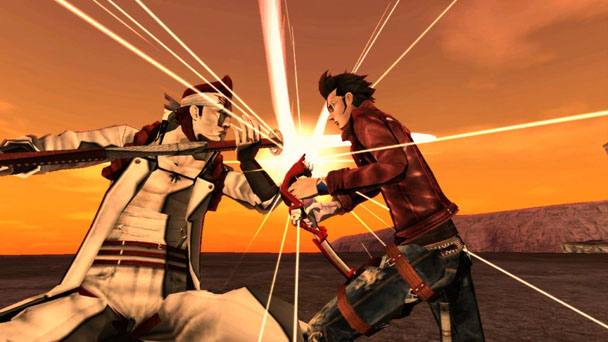
Top 10 Games of the Seventh Generation Consoles - #2: No More Heroes and No More Heroes 2: Desperate Struggle


While there have been plenty of solid sequels and revamps of classic titles on the seventh generation titles, few developers have dared to tread into brand-new territory. Few have dared to create something so bold as No More Heroes. Much as I love the Mass Effect sequels, Metroid Prime 3: Corruption, and the other games that found their way onto this list, they are all sequels or spiritual successors to previous releases. Though the No More Heroes titles do draw inspiration from contemporary hack-and-slash action titles and 8-bit arcade-y games, the culmination is a wonderful breath of fresh air, not just to the genre, but to video games as an entertainment medium.

Both the original No More Heroes and its sequel Desperate Struggle are (among other things) unapologetic – Travis Touchdown slices and dices his foes into bloody pools, spouting off vulgar one-liners during his moments of downtime that are equal parts awesome and silly. The original game defined a brand-new experience and was one of the earliest Wii titles to really nail the motion controls down by balancing those with a traditional button/joystick combo. While No More Heroes boasts many a colorful environment and memorable assassin, the sequel cleaned up the entire experienced, streamlining the overworld and amping up the combat just enough that it was more fast-paced without teetering into the realm of frenetic.

The sequel also saw a more focused, darker story – one of Travis seeking revenge – which still managed to balance the silly with the gritty. While the first game was more off-the-walls goofy, the references to Star Wars and Back to the Future therein seemed unorganized and random compared to the sequel’s mecha boss fight between robots inspired by anime Space Runaway Ideon and Gurren Lagann, or a narrow forest whose twisted dead trees and red night sky were an obvious nod to Capcom’s explosively popular Resident Evil 4. Instead of giving off the impression that the game was chock full of ideas that creator Suda51 thought were cool, NMH2 came across as more of a love letter – not only to the creative minds behind the works Suda was paying homage to, but to fans of the original NMH as well.

Personally, I am a bit partial to Desperate Struggle. It’s much easier to jump into, has a higher degree of replayability due to its time attack Death Match mode and general faster pacing. But I won’t deny that the boss fights in the original No More Heroes were some of the best I’ve experienced in any game. Being such a huge fan as I am of the Legend of Zelda series, that is the standard with which I compare the boss fights of any and all other video games, and it is incredibly rare that another title provides as consistently high-quality encounters. But the UAA ranking matches in the NMH games are truly something to behold – a brilliant mesh of flair and challenge that defines the core of the experience.

Saturday, January 19, 2013

Killer is Dead official trailer

A couple of days ago, some screens of the new Suda51 game Killer is Dead appeared on NeoGAF. As of yesterday, we now have a trailer showing off the gameplay and giving us a little taste of the characters and story. Based on what is presented here, it seems like some of the fan speculation that this game would be a spiritual sequel to both Killer 7 and No More Heroes is at least partially true. The story of lead protagonist Mondo Zappa appears to be more serious in nature than that of Travis Touchdown, but the way he wields his blade is similar to how Travis' handled his beam katana. Meanwhile, Mondo also fires rounds from an object on his left arm, seemingly a nod to Killer 7 heavily emphasizing shooting in its own gameplay. Killer is Dead's graphics are cel-shaded, much like the two aforementioned Suda51 titles, though the graphical quality is notably higher, which only makes sense, considering that Killer is Dead will be releasing for both the PS3 and Xbox 360. The end of this trailer teases at more footage to come, so hopefully we will learn about other characters and story elements in the coming months.

Thursday, December 27, 2012

Top 5 Video Games of 2012


As with my previous top five game of the year lists, the following games are more a reflection of which titles I had the most fun with or felt were noteworthy for any number of reasons (gameplay, creativity, successfully catering to a certain genre, etc.). While these games do not exactly follow the ratings I ascribed to them, they follow more closely that some of the games I rated in years past, as each of these games earned ratings between 9 and 9.5. Also, any games that I had played in previous years were ineligible for making this list, unless they were a remake (in the case of the Metal Gear Solid: HD Collection, MGS2 and MGS3 were not eligible, but Peace Walker was in the running and came pretty close to earning a spot this list).

#5Super Mario 3D Land: I’m generally partial to 3D Mario games over the side-scrolling entries, probably because Super Mario 64 was one of my first outings with Nintendo’s leading mascot. Super Mario 3D Land presents a hybrid of these two gameplay styles. None of the stages are particularly long, but they all feel fully-realized and present plenty of variation in aesthetic style and obstacles/enemies. The boss fights are perhaps the only lackluster part of the experience, but the airship stages leading up to each are exciting enough. The post-game is incredibly expansive – effectively, the number of stages is doubled, and said bonus stages are rather intense. The use of 3D allows for greater depth perception throughout, while also making a few key stages very cinematic in delivery.

#4Final Fantasy IV: Though I never played Final Fantasy IV in its original SNES release (known stateside as Final Fantasy II), I felt right at home the moment I started my journey with Cecil, Kain, Rosa, and company. Final Fantasy IV takes advantage of the DS to present a cleaner vision of the game. The soundtrack has been gorgeously reorchestrated, while the characters are portrayed as semi-chibi. The boss fights are impressively rendered and some of the obstacles require unorthodox means to overcome them - this is a large part of why I enjoyed FFIV so much; it retains the 1990s-era degree of challenge. The cast is easily my favorite from any of the Final Fantasy titles I have played to date, the battle system is perfect, and the whole experience feels genuinely rewarding.

#3Resident Evil Revelations: It’s rare that a handheld sidestory will stack up to a major release in terms of quality, but Resident Evil Revelations is, in my opinion, the best RE title since Resident Evil 4. The cruise ship setting is sufficiently creepy, while the enemy designs draw from sea creatures and round out the horror side of the experience. The game plays like the more action-heavy entries in the series, but ammo is not nearly as abundant as it is in either RE5 or RE6, forcing you to be tactical and conservative when fighting enemies. Resident Evil Revelations blurs the lines between handheld and console games, offering up what is one of the most impressive experiences on the 3DS to date.

#2Pokémon Black and White: Much like with Heart Gold and Soul Silver, I love the way that Nintendo has made the Pokémon games more user-friendly over time. Each of the new types available has its own particular use, with some being highly-specialized and others being fairly rounded, but the element of strategy is still as prominent as ever. I really appreciated the fact that the game required practically no time grinding so that I could keep chugging along through the story (which, I might add, is the best I've found in the entire series). The gym battles certainly dish out a better challenge in Black 2 and White 2, but the Elite Four battles are among the most intense and exciting portions of the games. Though Nintendo and Game Freak's decision to make direct sequels ended up having beautiful results, Pokémon Black and White gain a marginal advantage over Black 2 and White 2.

#1No More Heroes: Though I fell in love with No More Heroes 2: Desperate Struggle back in 2010, I actually did not play the original No More Heroes in proper until this year. While there are a few differences in the way the two play, I consider them equal in quality – though the second has better pacing and does not require Travis to complete side jobs to progress to each new ranking fight, the fights and characters themselves tended to be more memorable in the first game. Travis’ development from socially awkward otaku who wants to be number one to his eventual understanding of the gravity of what being an assassin can mean is something that gradually unfolds, and is wonderfully scripted instead of being explicitly stated to players. The gameplay is a perfect balance of traditional joystick and buttons with motion controls, the soundtrack is phenomenal, and No More Heroes is easily one of the best games to come out for any of this generation’s consoles.

Thursday, November 15, 2012

Top 5 No More Heroes Boss Fights

The No More Heroes series is full of phenomenal boss fights. Really, that is a large part of why the series has such an established cult-following. I love both of the games and the assassins Travis faces throughout them, but as this is a top five list, I can only include my very favorites from the lot. Let the bloodshed begin!


#5 - Margaret Moonlight: The fight against Margaret is largely a test of your ability to adjust your strategy on-the-fly. When she's at a distance, she'll hit you hard with shells from her guns. Blocking these will quickly deplete the charge of Travis' beam katana, and he will have to find some cover in order to recharge. The catch is that the surrounding environment is destructible, and Margaret will continue moving about. When Travis does manage to get close enough to land some direct hits with his beam katana, Margaret goes on the defensive, blocking strikes and then performing flips to not only dish some damage Travis' way but also to knock him back a fair distance, which will allow her to once again fire upon him.


#4 - Jeane: Though not officially ranked with the UAA, Jeane puts up one of the best fights of anyone between the two No More Heroes titles. Because a fight is exclusively what the boss encounter with Jeane is all about - she uses her endurance to kick, punch, and dodge Travis' beam katana. The fight can last a decent amount of time, due simply to the fact that her later attacks are carried out in rapid succession. Jeane knows exactly what she is getting herself into the moment she interrupts Travis' exchange with Dark Star, and is prepared to go all-out, giving Travis the fight of his life.


#3 - Holly Summers: A lethal beauty, Holly relies on explosives and the art of deception to try and best Travis. Approaching her will lead Travis to fall into a pit... time and time again. If he does not climb out quickly enough, he will get an up-close-and-personal visit from a hand grenade. When Holly loses this advantage, she launches a barrage of missiles Travis' way, forcing him to duck and roll one way or the other, and subsequently providing Holly time to either move or draw forth her shovel for close-quarters combat.


#2 - Harvey Moiseiwitsch Volodarrskii: Flashy, flamboyant - some might even say fabulous - Harvey uses his mastery of theatrics and magic to mess with both Travis and the player. He regularly performs disappearing acts, inverts both the stage and Wiimote controls, and deals some damage to Travis by trapping him inside a box. The encounter is very much unorthodox, but the quirky theatrical immersion it presents proves far more entertaining than frustrating.


#1 - Alice Twilight: There are a few fights, like those against Skelter Helter and Ryuji, that pit Travis against another beam katana-wielding foe. But both of those assassins rely rather heavily on ranged attacks - the former with his gun and the latter with his summoned dragon. Alice Twilight provides the closest thing Travis gets to a real one-on-one battle between two masters of the beam katana. Yes, there was that battle with Henry at the end of the original No More Heroes, but considering it is a post-game treat and insanely difficult, I don't feel it has the same qualifications as most other boss fights. Kimmy Howell used a dual-bladed beam katana, but she was a silly schoolgirl who thought she was stronger than she truly was.

Alice Twilight, on the other hand, knows exactly what she is getting herself into the moment Travis arrives to challenge her. She knows her strengths and weaknesses, and though she can launch her blades a short distance, she plays a mostly defensive game, hoping to lure Travis in and then dropping down to strike at him. Her arsenal is simple, but effective, and looks radical to boot.

Saturday, July 14, 2012

Wii review: No More Heroes


Travis Touchdown is a socially awkward otaku who just happens to have some serious skill wielding a beam katana. After blowing all of his money at the bar one night, he decides to take up the offer presented by Sylvia Christel to enter the United Assassin's Association. Travis has two goals in mind: become the number one ranked assassin in Santa Destroy, and get Sylvia in bed with him. After defeating Helter Skelter, Travis is qualified to challenge the remaining ten assassins, each of whom utilizes a different style of combat.

No More Heroes plays out as sort of a "greatest hits" series of boss fights. Each boss is preceded by a short level wherein Travis must take down weaker henchmen. As the game progresses, these areas become longer and the henchmen become stronger, equipping themselves with blunt objects and firearms. When it comes to the actual boss fights, though, the game does not disappoint. Some of the other assassin's use a more straightforward approach, while others utilize their environment. Some are able to use ranged attack, while others prove deadly at close-quarters. Each of the boss characters is quite well-developed and carries a strong presence - fights against Destroyman, Bad Girl, and Harvey Moiseiwitsch Volodarskii will be just as memorable as their names.


The pace does slow down in-between boss fights, as Travis must earn enough money to qualify to enter each. At first, Travis is only able to access side jobs that range from collecting coconuts to mowing lawns to picking up trash. And while those descriptions don't sound particularly enticing, the way the game utilizes the motion controls makes them mildly entertaining. The fact that each side job only lasts a brief while keeps them from getting stale too quickly.

After properly completing a side job, Travis' employer will inform him that there are assassination gigs accessible at various locales in Santa Destroy. The first few prove incredibly straightforward - either kill a specific target or take out everyone in the area. Later assassination missions will add further restrictions, like taking out a line of enemies by hitting a baseball at them with your beam katana or only using wrestling moves. The more strict the rules of an assassination mission, the more money Travis will earn. After a few times running the routine of side job-assassination mission-boss fight, it's easy to pin down a rhythm to quickly earn the required funds.

Aside from putting his money toward the next fight, Travis can visit a number of locales around Santa Destroy. At Area 51, Travis can pick up some new clothes, and at Thunder Ryu's gym he can pay for lessons to improve his physical stats. Travis can also visit the lab of Dr. Naomi, a woman who develops new models of beam katanas. Back at Travis' motel room, he can kill time playing the game-within-a-game known as Bizarre Jelly, help his overweight cat exercise, swap the models of beam katanas he has amassed, and save the game by sitting on the toilet.

The first time Travis sits down on the toilet is only the tip of the iceberg when it comes to this game's unique sense of style. It's chock full of humor, from references to other video games and anime, to Travis occasionally breaking the fourth wall. Character designs and environments are bright and colorful, while the soundtrack is an awesome culmination of techno, rock, chiptune, and even a few metal songs.


The motion controls are worked into nearly every nook and cranny of the experience. Swinging the Wiimote lets Travis strike with his beam katana, wiggling it back and forth will recharge it when his batteries are low, and a combination of the Wiimote and Nunchuk allows him to take down enemies with a variety of wrestling maneuvers. In the event that Travis locks swords with his opponent, a prompt will appear indicating the Wiimote be spun in a certain direction in order to gain the upper hand. When Travis reduces the health bar of one enemy to zero, a prompt will appear indicating he swing either vertically or horizontally. This attack can take out not only the main enemy being targeted, but also those nearby. Each time Travis gets a kill, a small slot machine will roll at the bottom of the screen, with a winning combo granting Travis brief use of a handful of powered-up attacks.

The Wiimote will need to be tilted from side to side in order to steer the lawnmower, and back-and-forth motions with the Wiimote and Nunchuck will help Travis exercise. Only when Travis is driving his futuristic motorcycle around town does the game suffer from less-than-spectacular controls. Sometimes the bike will boost with only a small amount of acceleration applied, and bumping into practically anything and everything will send Travis flying out of his seat. Navigating Santa Destroy is easy enough - the map is only so large. But there isn't much interesting to look at outside of the key locales.

The story does not take itself too seriously, but develops at a steady pace that allows players to gain a better understanding of who Travis Touchdown is and how his character evolves from the moment he sets out to become number one to the moment he enters the final boss fight. The side jobs are a bit lackluster, and the transition from fast and intense boss fight to slow and careful work proves a bit of an annoyance at first. That said, the boss fights are outstanding - as varied and as enjoyable as something like The Legend of Zelda series could dish out. No More Heroes is one wild ride - an incredible gaming experience that is also beautifully creative. The unique blend of action and style Suda 51 brings forth in No More Heroes leads it to be as much of a video game as it is a work of art.

My rating: 9.5 (out of 10)

Wednesday, December 7, 2011

25 Days of Villains - #19: Jeane


When perusing the cast of characters in the No More Heroes games, it's difficult to classify most as villainous. Most fit the role of a warrior fighting for their own sense of justice, and even those who are in it for the money are more self-serving than evil. I tried my best to work an angle for Destroyman and Bad Girl, but neither seemed like they belonged on the list. Destroyman is cocky and kind of a tool, but those qualities plus a crotch laser cannon don't qualify him as a bad guy. Despite her name, Bad Girl's sadistic tendencies are a result of having seen through the veil of what the United Assassins Association has established (and lots of booze).

As such, there were only a few characters that really worked for the role of villain. Jasper Batt Jr. is an ironically lame final boss. Dark Star is questionable, but it doesn't really matter because before Travis gets a chance to fight him Dark Star is killed by the real villain of the first No More Heroes - Jeane. As Travis Touchdown's half-sister, she was once Travis' childhood love interest, before he knew their actual relation. Behind the scenes, the father of the two molested Jeane. Upon learning of this, Jeane's mother committed suicide, and these events eventually led Jeane to kill him and Travis' mother before Travis' very eyes.

Jeane is by no means guilty for all these circumstances turning out the way they did. She did, however, respond with excessive violence, which sparked a flame within Travis Touchdown. Jeane is responsible for Travis becoming an assassin, and indirectly responsible for all the people he killed in his climbing the ranks. Jeane proves a powerful opponent, using mixed martial arts as her medium of combat, as opposed to the many weapons most of the other assassins rely on. It's a surprisingly dark finale to a game that is largely satirical, but a fitting one just the same.

Boss theme:

Honestly, I feel like the entire soundtrack to No More Heroes is among the best of this generation's consoles. Jeane's theme is one of my favorite tracks, right up there with Bad Girl's, Destroyman's, and the game's main theme song.

Saturday, January 1, 2011

2010 Year in Review: Video Games

In my opinion, 2010 started out as a strong year for hardcore gamers, but fizzled out during the second half of the year with a number of predictable/monotonous mainstream releases. There were, however, a number of titles announced this past year that are slated for 2011 release that I am very much looking forward to playing. Each of the games mentioned in brief here are titles that I both played for the first time and reviewed earlier this year, so you can check out the more full and in-depth reviews at you leisure.

Bioshock 2: The first title was a hard act to follow, but despite my anxiousness for the release of 2K's sequel, it succeeded tremendously in carrying on the story of Rapture and further exploring the city and ideals of Andrew Ryan. Narrating the events through the eyes of Subject Delta, one of the first Big Daddies, the storytelling feels much more fluid even if the plot itself feels slightly less original than in the original Bioshock. A few tweaks here and there to the game mechanics might not have seemed necessary at first glance, but the gameplay benefits greatly from these. Throw in an online multiplayer mode that is as enjoyable as it is strategic and you've got a phenomenal sequel to what is quite possibly the best title released for this generation's consoles. My rating: 9.5

DLC
- Protector Trials: 9.0
- Minerva's Den: 8.0


No More Heroes 2: Desperate Struggle: Working out some kinks in the game mechanics from the first installment, Suda 51 has returned Travis Touchdown to the heat of battle. This time around, Travis isn't in it to win Sylvia - he's climbing the ranks of world-renowned assassins to seek revenge. There's a ton of blood, but it comes across as surprisingly cohesive with the overall art stlye of the game, and the soundtrack is fantastic to boot. Despite a few bumps along the way, Desperate Struggle is a blast to play and one of the best action-adventure titles for the Wii. My rating: 9.25

Dynasty Warriors Gundam: A hack-and-slash fest with Bandai's popular mecha series skinned over everything, this title is surprisingly enjoyable though not particularly deep. The gameplay is incredibly repetitive, but each pilot/Gundam has their own unique attacks, strengths, and weaknesses. The original story is creative, though a bit cheesy, while the classic battles reenacted from various series do a better job of wrapping players up in the experience. Dynasty Warriors Gundam isn't by any means fantastic, but it's one of the better Gundam games released in recent years. My rating: 7.25

Hydro Thunder Hurricane: Not much has changed in the overall feel of Hydro Thunder since the original was released years ago, and that's great news for veteran fans and newcomers alike. The game's controls are intuitive and players can advance through higher difficulty levels. The biggest selling point in terms of replay value, however, are the number of various gameplay modes available, including gauntlets, ring challenges, championship races, and online multiplayer. My rating: 9.0

Dragonball Z Budokai Tenkaichi 2: While the gameplay is fluid and responsive, the cutscenes in the story mode were cooked up in a quick and lazy manner. The difficulties in the story mode are incredibly unbalance, but nearly perfectly balanced in the duel and tournament modes. As with most fighting games, each character is granted his/her basic set of attacks, but there is enough variation throughout to keep things interesting. My rating: 7.75


Final Fantasy XIII: Easily the single best looking game I've ever seen, FFXIII manages to stack its gameplay and story high as well. The characters are an interesting group thrown together by circumstance, and while each player will have his/her favorite, every one of the characters (of both major and minor roles) plays an important part in the grand scheme of things. The paradigm shift system works flawlessly, though some character roles will be more important earlier in the game, and others more important later on. The game is incredibly long, but if players are patient and put the time into it, I think they'll find FFXIII to be a thoroughly enjoyable gaming experience. My rating: 9.5

Halo: Reach: Bungie's swan song to their most famous series is most full a package out of any of the Halo titles, and easily one of the best FPS games for this generation of consoles. Aside from a decent length campaign that pays homage in each level to it predecessors, gamers are given the online multiplayer that has made Halo so popular over the years, a more complete version of the firefight mode introduced in ODST, and nearly limitless options for creating maps in forge mode. The graphics are phenomenal, the soundtrack epic, and the voice acting top-notch. The level of customization in terms of the in-game SPARTANs and the various thumbstick/button layouts will cater to just about any player's personal preference. My rating: 9.25

Friday, May 21, 2010

Wii review: No More Heroes 2: Desperate Struggle


No More Heroes was a game that surprised many Wii owners as an M-rated slice-and-dice adventure game that actually had a decent story and kept players engaged with its vibrant visuals and varied boss battles. There were side missions to keep players entertained if they wanted to take a break from the main quest, and it made up for some of the absences in mature gaming on Nintendo’s previous system, the Gamecube. Though it wasn’t a blockbuster commercially, No More Heroes garnered enough praise from gamers to become a cult classic and thus a sequel was born. No More Heroes 2: Desperate Struggle hit the Wii in January of 2010 and showed some major improvements over the first title.

Travis Touchdown is back for more beam katana-based violence in the city of Santa Destroy, only this time he’ll have to face 51 opponents to reach the top ranking. While Sylvia promises Travis fame, he’s more interested in avenging the death of his friend Bishop and is ready to cut down anyone who stands in his way.

The game’s vulgar language and often sick humor fuel an otherwise cliché plot. But with each new point that unfolds, it quickly becomes apparent that each new area unlocked is meant to present with a parody of some other video game, film, or anime. Travis and Sylvia constantly poke fun at the story as it progresses, sometimes subtly, other times more forward and obvious, such as when Skelter Helter’s beheaded corpse delivers a foreboding message to Travis and he explains how said event is theoretically impossible. Travis even has to sit on the toilet in order for players to save the game.


The main game is incredibly fast-paced as Travis wields his beam katana through hordes of henchmen. Depending on the combination and angle of attacks, enemies will be killed through different slashes, impalments, and suplexes. This will sometimes reward Travis with health and battery power for his beam katana. If Travis builds up a streak of kills in a short period of time, he is able to take down the remaining enemies with his tiger attack. When hit repeatedly with attacks, Travis becomes dazed momentarily, but this can be enough for nearby enemies to deal significant damage to him and can be a bit of an annoyance at first. Assuming that players are able to get the hang of the controls and learn when to dodge, this can easily be avoided.

Accessing each new chapter of the game’s story is noted with a star on the overworld map of Santa Destroy. This map/menu allows players to quickly select which area they want to visit in order to upgrade weapons, participate in side missions, or continue Travis’ quest. After visiting each are, players are returned immediately to the overworld map to determine where they wish to travel next. It’s a simple but effective menu scheme, though it removes the ability for players to freely roam the streets of Santa Destroy.


Each boss battle requires a different plan of attack from the player in order to respond to both the enemy and the surrounding environment. When taking on other fighters such as Nathan Copeland and Dr. Letz Shake, players must traverse areas that are constantly moving and calculate their moves in order to avoid a swift defeat. In this regard the game can seem a bit frustrating at times, but it is only teaching the player through a trial-and-error process. The boss fights are still as fast-paced as the levels that precede them and incorporate variation on par with the boss fights of Legend of Zelda titles. From time to time, Suda 51 decides to switch the gameplay up on players to keep thing engaging. When Travis clashes swords with an opponent, the game will sometimes enter a short motion-based section where players must react by rapidly moving their Wii-mote in a circular motion. A few boss fights include multiple opponents at one time, and one fight even has Travis piloting a giant robot. There is also a portion of the game where Travis engages in a motorcycle duel prior to one of the boss battles, and the game shifts to a top-down view. However, given the small area in which the duel takes place and the wide turns the motorcycle must take, this section becomes incredibly frustrating.

Side missions allot players both character experience and money to spend on new weaponry and clothing. Many of these side missions switch over to retro 2D arcade-style gaming, and require Travis to accomplish tasks in a limited time. Most of the side missions are straightforward and rather entertaining, though not overly complex. There are a few however, that simply become aggravating, such as the burger-grilling minigame.

Players are not limited to playing only as Travis Touchdown, as they are able to play as both Shinobu and Henry for brief periods in the main game. Shinobu is much more agile and weaker defensively. Henry, on the other hand, is more defense-based and controls almost the same as Travis. For the sake of the story, the change in perspective is a nice addition, though the temporary change doesn’t bring anything new to the game’s mechanics.


The art style is simply stunning and I think the game’s atmosphere greatly benefits from the cel-shading. The blood, while plentiful when slicing and dicing enemies, doesn’t draw too much of the focus – far too often, hack n’ slash games will try to outdo their predecessors by including unnecessary gore and buckets of blood. This game does have bodies spewing fountains of the latter but it feels oddly more artistic than disgusting. The soundtrack is simply outstanding, drawing inspiration from a great variety of sound styles. The music that accompanies the various locales around Santa Destroy is more low-key, while each major level and boss fight has its own distinct theme, often heavy on the drums, synthesizer, and electric guitar.

It’s a ridiculous game with over-the-top action and plenty of violence. Blood and dirty humor are both plentiful and the art style simply fantastic. The broad array of characters and their individual quirks keeps things entertaining from start to finish. There are some shortcomings, but it is still an impressive sequel fitting of its predecessor’s accomplishments. There are a large number of changes in Desperate Struggle, and nearly all of them make the game far more fluid and enjoyable. It certainly won’t be everyone’s bag of chips, but No More Heroes 2 is a most creative and interesting spin on a familiar genre.

My rating: 9.25 (out of 10)
Related Posts Plugin for WordPress, Blogger...