.
Showing posts with label hack-and-slash. Show all posts
Monday, October 13, 2014
Wii U review: Hyrule Warriors
One of the more out-of-the-blue crossover announcements in recent E3 history was that of Hyrule Warriors, a Zelda-themed hack-and-slash in the vein of Dynasty Warriors and similarly developed by Koei Tecmo. As the game neared release, Nintendo began to trickle forth information about the various gameplay modes and playable characters, from the more famous Ocarina of Time and Twilight Princess allies to some of the series iconic villains. But it was never any secret that Hyrule Warriors would play more like a Dynasty Warriors title than any Zelda title – so the real question is, just how much like DW is the final product?
In truth, the answer is both a bit lengthy and complicated. At its core, the gameplay leans extremely heavily toward the Dynasty Warriors camp. Combos of Link’s swordslashing, Darunia’s hammer swings, and Fi’s graceful dancing are your primary means of cutting through a sea of enemies in order to capture bases and increase not only your army’s troop output, but their morale as well. Troops with a higher morale will perform better in battle, more offensively and defensively, and achieving this within a mission can leave you with a greater confidence that your CPU followers will have little trouble holding down the fort against enemy invaders while you scour the many sprawling maps for bonus materials or extra content hidden with Gold Skulltulas.
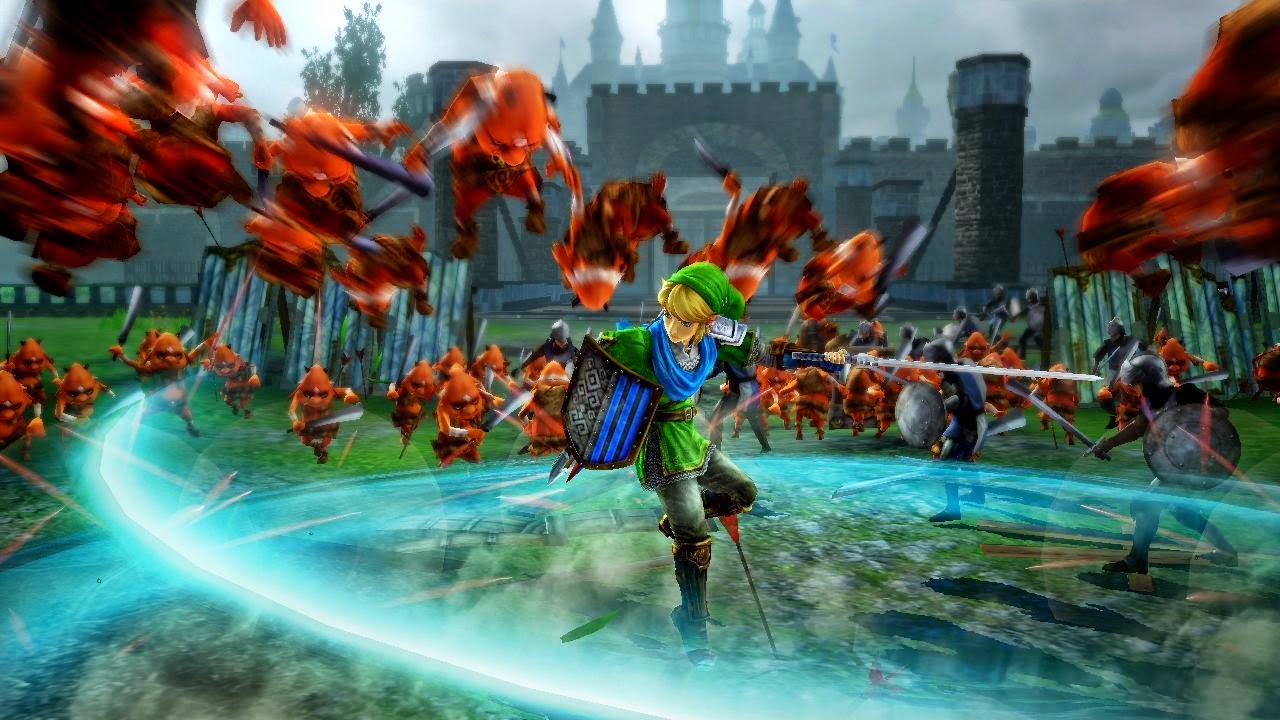
Striking down enough foes will fill up your special attack meter, which can then be unleashed against more of the ever-spawning Bokoblin, Moblin, or Stalchild forces to wipe out a great number of foes in one fell swoop. These special attacks can be great for speeding up the capture process when attempting to take over an enemy base. Each character also has a magic meter that, when full, can be activated in order to slow time for a brief period to inflict major damage to specialty troops and captains, as well as other CPU controlled characters. Since the magic meter is filled up with magic jars as per Legend of Zelda tradition, you will have to collect these from smashing jars within bases or hoping enemies drop them upon defeat. Magic jars are, however, one of the most rare drop items from enemies, so do not expect to reap the rewards of a full magic meter more than once or twice on most missions.
Also drawn from the Zelda franchise are the secondary weapons like the bow, bombs, boomerang, and hookshot, all of which can be used by any of the playable warriors, and all of which have surprisingly practical uses. The bow is reserved exclusively for ranged shots against poisonous Deku Babas and certain boss fights, while bombs can be used to thin out troops as well as discover secrets hidden behind cracked walls. The hookshot can give Link and company a shortcut to higher ground, or can be used to wrestle airborne foes to the ground, and the boomerang can be used to dizzy multiple foes with each toss. Each of these secondary weapons can receive temporary boosts in power and range thanks to another kind of item drop, which will indicate which item is to be granted the power boost before you grab it.
Speaking of boss fights, Hyrule Warriors features showdowns with classic monsters like Ghoma, King Dodongo, and Manhandla, all of which handle very similarly to their 2D and 3D incarnations in past Zelda adventures. While boss encounters are not present in each and every stage, they are certainly the highlights of the missions they are worked into. Specialty enemies like the Gibdo, Aeralfos, and Poes will still take damage from most any weapon, though each is considerably weaker to a different weapon in particular. When weakened, these enemies will momentarily display a defense meter above their heads – hit the meter enough times, and their defense will be broken, giving you a golden opportunity to inflict lot of damage, sometimes finishing them off altogether.
Upgrading character skills like health and attack damage results from the particular items you gain from fallen enemies. Meanwhile, weapons can be combined to carry over bonuses like increased damage from a particular combo or a health buffer to a weapon with a higher power and star rating (effectively the same weapon ranking system as in traditional Dynasty Warriors games). Most characters have a second or even third weapon that can be discovered along their journey through Hyrule, as well as a final, more powerful form of each of these weapons that can hold three different upgrades as opposed to just one. Different potions can be brewed to grant brief power boosts both offensively and defensively, though the most practical to carry in to battle will likely always be that which restores the majority of your character’s health. These can prove especially useful if you find yourself pinned in a corner and subsequently the victim of an onslaught of combo attacks from one of the enemy warriors.
While the plotlines of any given Zelda game have drawn heavy influence from European and western fantasy works, their tales have been largely universal, not identifying strictly with one culture or another. Frankly, it’s an approach that likely largely explains why the series has been so universally well-received for more than twenty-five years. The story mode of Hyrule Warriors does account for the divergent timelines of official Zelda lore, but falls outside of the canon, and is admitedlly simple in its aims. According to this spinoff game, there were forces capable of witnessing all versions of the tale of Link, Zelda, and the Triforce, but they were never meant to interfere in any way. When curiosity leads Cia, a mystic woman of this clan, to contemplate what it is that makes Link such a great and courageous hero, dark forces kept long at bay begin to take hold of her, influencing her ultimate decision to travel to the land of Hyrule and amass an army capable of challenging the kingdom.
Enter Zelda and Impa, who turn to Hyrule’s army and one blond swordsman in particular to defend the castle and surrounding fields. As the fighting escalates and both sides hatch plans to try and trump one another, the trio encounters Lana, a girl from the same clan as Cia, but who would seek to aid the warriors in attempting to halt Cia’s advance across Hyrule and convince her to return to her old ways. As Cia utilizes the Gate of Souls to draw power from many alternate versions of Hyrule, so too do Lana, Impa, and Link seek out the aid of Darunia, Midna, Fi, and other veteran Zelda characters. But while all this attacking, defending, and countering is occurring, other malevolent forces lie in wait.
Challenge mode throws players into singular scenarios with one main goal in mind before the end of the mission, but keeps things interesting by throwing new and unexpected minor challenges as things progress. More time-consuming is the adventure mode, which asks players to complete a series of specific challenges with certain restrictions in place, including time a ten minute time limit to defeat five-hundred enemies, a battle against some of the game’s stronger foes where all attacks (yours included) deal massive damage, and quiz games that will test players’ knowledge of enemy weaknesses. Adventure mode’s overworld map pays homage to the original NES Legend of Zelda, and players will collect candles, bombs, compasses, rafts, and more as they earn higher rankings on these various challenges, all of which can subsequently be used to uncover health upgrades for your unlocked warriors, as well as few of the playable characters.
With regards to these playable characters, the game draws twelve faces from across the Zelda series and introduces one newcomer in the form of Lana. Each of these warriors has a unique play style that utilizes similar button combos with greatly varying results. Midna can summon a fist from her helmet and hurl foes wildly about, Shiek can create a small damaging circle by playing the harp, and Ruto flips back and forth through pools of water that manifest in the most unlikely of locations. Despite the roster not being nearly as large as in most Dynasty Warriors games, Hyrule Warriors does well to cater to a variety of combat strategies while offering well-balanced offensive and defensive capabilities to each character. The creativity drawn from Ocarina of Time, Twilight Princess, Skyward Sword, and more is a wonderful way of catering to die-hard Zelda fans, though Lana’s moveset is a bit lackluster in its flash and flair when compared to nearly any other one of these iconic warriors.
Most of the playable characters look very similar to their original designs. Ghirahim retains a semi-cel-shaded overlay, Zant and Midna are bear more stark color patterns and intricate details, while Darunia and Ruto’s character models are the most simplistic of the bunch, as they hail from an older 3D era. Link, Impa, Zelda, and Ganondorf, meanwhile, all wear outfits that act as crossing points between Zelda and Dynasty Warriors - Link’s green tunic is subtly accented by a blue scarf, Zelda’s armor and dress a hybrid between her 2D and more recent appearances, and Impa’s clothing largely inspired by her counterpart in Skyward Sword, though appearing to hold some influence from Ocarina of Time as well. Ganondorf’s design, however, proves the most polarizing, as his long red hair, angular armor pieces, golden crown-like headpiece, and large jagged swords imply a more distinct eastern influence – somewhere between feudal Japan and Mongolian horde.
Hyrule Warriors also pays homage to its roots by incorporating many classic Zelda tunes infused with rock riffs and dark electronic sounds. While artistically the game may not be representative of the next proper installment in the Zelda franchise, seeing the land of Hyrule and all its denizens in full HD is most pleasing to the eyes. Hyrule Warriors hits a couple of snags in its design, largely resulting from the save system and respawn locations. It is possible to drop a save spot at any given time during a mission, though this is one of the few pointers the tutorial segments do not take time to explain, and given the generally fast-paced nature of any mission, it’s a feature that can effectively go ignored for an entire playthrough. Each time you complete an in-mission objective, however, the game automatically sets a checkpoint for you, which is typically quite convenient, save for instances when the game respawns you in front of an enemy warrior or boss character who spams you with combos that result in a death as sudden as your return to the fight. Hyrule Warriors is by no means a perfect game, not the most extensive one, but it does emphasize heavy arcade-style hack-and-slash design that delivers mindless fun without losing its identity as a proper crossover.
My rating: 8.25 (out of 10)
Sunday, February 17, 2013
Xbox 360 review: Lollipop Chainsaw
Following the formula of No More Heroes, Grasshopper Manufacture's Lollipop Chainsaw is equal parts violent hack-and-slash and comedic romp through the zombie-infested city of San Romero. Juliet Starling arrives at school on her eighteenth birthday to discover that an emo student named Swan has unleashed the armies of the undead. Juliet - born into a family of zombie hunters - fights her way through the sea of zombies until she finds her boyfriend Nick, who - attempting to protect Juliet - becomes infected himself. Very much in love with Nick, Juliet performs a magical spell that allows her to remove Nick's head and keep him alive, while his body cannot be saved. Chainsaw in-hand and Nick's decapitated head hanging from her belt, Juliet vows to undo Swan's work.
Juliet avoids typical blonde ditz clichés due to the fact that she is a Zombie Hunter and has a game plan in mind with each new peril she faces. Some of her behavior does come across as silly, but that is primarily a result of her innocent nature combined with her bloody line of work. These two opposing forces allow her to become a truly memorable protagonist, and quite a likeable one at that. Nick is a source of great humor as well, considering he is more or less along for the ride, and is well aware that he is by far the most normal and sane member fighting the undead - the rest of whom are all members of Juliet's family. He constantly quips about his lack of a body, but also acts as eyes in Juliet's blind spots, rooting her on as she dishes pain to the zombie masses.
The games' jokes and one-liners bounce back and forth between stupid and uninspired to rather clever set-ups. Some NPCs swear simply for the sake of reminding players that Lollipop Chainsaw is an M-rated game, while the majority of Juliet and Nick's conversations are as cutesy as they are awkward and entertaining. Each of the boss characters represents a different genre of music, with most bearing a resemblance to a specific famous musician. These character designs, as well as much of the dialogue, are far less subtle parodies than what Grasshopper Manufacture presented in No More Heroes. While Lollipop Chainsaw may not win any awards as a comedic work, the B-movie atmosphere is consistent and the game does not take itself too seriously, despite the writers seeming to think it is more cleverly-scripted at times than it actually is.
While the earliest levels take place in bubbly cheerleader/zombie hunter protagonist's high school, later stages explore the greater area surrounding the school. Most stages incorporate some sort of minigame element, though the core of the gameplay lies in pom-pom hits, chainsaw swings, and the resulting combos you can chain together. Certain attacks will be unlocked as part of the game's natural progression, but most will be unlocked through the in-game store by spending medals earned from zombie hunting. This allows for a significant degree of freedom, as players can effectively unlock new combos at their leisure, making each person's individual playthrough unique. The gameplay may not be as fluid or exciting as the likes of No More Heroes, but it certainly holds its own in following a similar formula to the combat system in games like Devil May Cry.
Nick's head can occasionally be attached to an empty zombie body to open new pathways for Juliet. Using these will prompt a sort of quick-time event that requires players to press specific buttons one after another. It's rather dull, and each of these Nick-on-a-headless-zombie sections must be completed to progress through the entirely-linear game. On the other hand, Juliet can collect Nick Tickets throughout the game which can be spent on a few different attacks that utilize Nick's head, from firing him out of a popper cannon, to spinning him around on a ribbon. These will cause a fair amount of damage to foes and some even grant Juliet temporary damage resistance, acting as an alternative to her other powerful attack that results from chaining enough kills and filling the chainsaw gauge. Once the chainsaw gauge is filled, Juliet can temporarily power up her swings and slashes, making them rainbow colored and briefly granting her invincibility. Decapitating three or more zombies at once rewards Juliet with a large sum of medals, and this is made much easier in her powered-up state.
While the fighting is largely repetitive, the game mixes the experience up by placing environmental barriers that Juliet must cut down, encouraging players to race across rooftops with the chainsaw dash ability, and placing Juliet within classic arcade games like Pong and Pac-Man. Each boss fight has multiple phases and distinguishes itself from the others very well. One element the whole experience seems to lack is something to properly connect the different stages. The story does well enough to explain why Juliet and Nick land on a farm and need to scale a skyscraper-sized arcade, but each level feels like it could have been expanded upon. The game only lasts around six hours, and while it does encourage multiple playthroughs for completionists, there seem to be a lot of missed opportunities on the part of the development team. The game also lacks much of a challenge factor. For fans of typical action hack-and-slash games, the normal difficulty setting will be a walk in the park, and even rookies of the genre will likely find the challenge at least a little underwhelming. Meanwhile, the harder difficulty settings do little more than restrict your stock of health-rejuvenating lollipops.
Graphically, the game looks okay - nothing more, nothing less. There is a subtle cel-shaded look that layers everything, adding to the comic book style the game tends to lean toward in its overall artistic presentation. While character models are well-animated, textures and character models themselves do not look particularly good when compared to many other games of this generation - due in large part to the aging of the Unreal Engine - and the game's brightly-colored environments do little to mask this visual shortcoming. On the other hand, the soundtrack is a standout part of the game's presentation. The original score is upbeat and action-oriented, while licensed tracks like Toni Basil's "Mickey", Dead or Alive's "You Spin Me Round (Like a Record)", and Skrillex's "Rock n' Roll (Will Take You to the Mountain)" are plain fun to listen to and add an extra level of pep and silliness to the cheerleader-driven narrative. Though few and far between, there are a handful of moments where the audio mixing becomes very unbalanced, and it is difficult to hear scripted dialogue over environmental noises.
There are ranking modes and plenty of unlockable costumes, but the core of the experience lies in playing through the story. A single playthrough of Lollipop Chainsaw will only last a few hours, which may be a deal breaker for some, especially when stacked up against its contemporaries. Fans of Grasshopper Manufacture and Suda51's previous work will no doubt feel at home, though they may not be laughing quite as hard nor as often as usual. Lollipop Chainsaw is fun, fast-paced, and the individual levels are well-developed. Unfortunately, the game lacks significant extra substance to land it a spot comparable to other games of its kind.
My rating: 7 (out of 10)
Saturday, July 14, 2012
Wii review: No More Heroes
Travis Touchdown is a socially awkward otaku who just happens to have some serious skill wielding a beam katana. After blowing all of his money at the bar one night, he decides to take up the offer presented by Sylvia Christel to enter the United Assassin's Association. Travis has two goals in mind: become the number one ranked assassin in Santa Destroy, and get Sylvia in bed with him. After defeating Helter Skelter, Travis is qualified to challenge the remaining ten assassins, each of whom utilizes a different style of combat.
No More Heroes plays out as sort of a "greatest hits" series of boss fights. Each boss is preceded by a short level wherein Travis must take down weaker henchmen. As the game progresses, these areas become longer and the henchmen become stronger, equipping themselves with blunt objects and firearms. When it comes to the actual boss fights, though, the game does not disappoint. Some of the other assassin's use a more straightforward approach, while others utilize their environment. Some are able to use ranged attack, while others prove deadly at close-quarters. Each of the boss characters is quite well-developed and carries a strong presence - fights against Destroyman, Bad Girl, and Harvey Moiseiwitsch Volodarskii will be just as memorable as their names.
The pace does slow down in-between boss fights, as Travis must earn enough money to qualify to enter each. At first, Travis is only able to access side jobs that range from collecting coconuts to mowing lawns to picking up trash. And while those descriptions don't sound particularly enticing, the way the game utilizes the motion controls makes them mildly entertaining. The fact that each side job only lasts a brief while keeps them from getting stale too quickly.
After properly completing a side job, Travis' employer will inform him that there are assassination gigs accessible at various locales in Santa Destroy. The first few prove incredibly straightforward - either kill a specific target or take out everyone in the area. Later assassination missions will add further restrictions, like taking out a line of enemies by hitting a baseball at them with your beam katana or only using wrestling moves. The more strict the rules of an assassination mission, the more money Travis will earn. After a few times running the routine of side job-assassination mission-boss fight, it's easy to pin down a rhythm to quickly earn the required funds.
Aside from putting his money toward the next fight, Travis can visit a number of locales around Santa Destroy. At Area 51, Travis can pick up some new clothes, and at Thunder Ryu's gym he can pay for lessons to improve his physical stats. Travis can also visit the lab of Dr. Naomi, a woman who develops new models of beam katanas. Back at Travis' motel room, he can kill time playing the game-within-a-game known as Bizarre Jelly, help his overweight cat exercise, swap the models of beam katanas he has amassed, and save the game by sitting on the toilet.
The first time Travis sits down on the toilet is only the tip of the iceberg when it comes to this game's unique sense of style. It's chock full of humor, from references to other video games and anime, to Travis occasionally breaking the fourth wall. Character designs and environments are bright and colorful, while the soundtrack is an awesome culmination of techno, rock, chiptune, and even a few metal songs.
The motion controls are worked into nearly every nook and cranny of the experience. Swinging the Wiimote lets Travis strike with his beam katana, wiggling it back and forth will recharge it when his batteries are low, and a combination of the Wiimote and Nunchuk allows him to take down enemies with a variety of wrestling maneuvers. In the event that Travis locks swords with his opponent, a prompt will appear indicating the Wiimote be spun in a certain direction in order to gain the upper hand. When Travis reduces the health bar of one enemy to zero, a prompt will appear indicating he swing either vertically or horizontally. This attack can take out not only the main enemy being targeted, but also those nearby. Each time Travis gets a kill, a small slot machine will roll at the bottom of the screen, with a winning combo granting Travis brief use of a handful of powered-up attacks.
The Wiimote will need to be tilted from side to side in order to steer the lawnmower, and back-and-forth motions with the Wiimote and Nunchuck will help Travis exercise. Only when Travis is driving his futuristic motorcycle around town does the game suffer from less-than-spectacular controls. Sometimes the bike will boost with only a small amount of acceleration applied, and bumping into practically anything and everything will send Travis flying out of his seat. Navigating Santa Destroy is easy enough - the map is only so large. But there isn't much interesting to look at outside of the key locales.
The story does not take itself too seriously, but develops at a steady pace that allows players to gain a better understanding of who Travis Touchdown is and how his character evolves from the moment he sets out to become number one to the moment he enters the final boss fight. The side jobs are a bit lackluster, and the transition from fast and intense boss fight to slow and careful work proves a bit of an annoyance at first. That said, the boss fights are outstanding - as varied and as enjoyable as something like The Legend of Zelda series could dish out. No More Heroes is one wild ride - an incredible gaming experience that is also beautifully creative. The unique blend of action and style Suda 51 brings forth in No More Heroes leads it to be as much of a video game as it is a work of art.
My rating: 9.5 (out of 10)
Tuesday, April 26, 2011
Xbox 360 review: Devil May Cry 4
My first introductions to Dante came from Marvel vs. Capcom 3 and the Devil May Cry anime series. Devil May Cry 4 is the first game in the series that I have played, and I apologize in advance for not having much familiarity with the gameplay of the previous titles. I have, however, glossed over the major events of the first three games, so my knowledge of the Devil May Cry story isn’t entirely limited.
The game begins with Nero, a young warrior who is something of a hero among the people of Fortuna. A member of the Order of the Sword, Nero is not as by-the-books as his adoptive brother Credo, utilizing a combination of sword and gun combat along with his demonic right arm. The intro sequence shows Nero fighting a small group of scarecrow enemies, but aside from these minor threats it seems his life in Fortuna is relatively peaceful one. That is, until a man in red appears and interrupts a sermon, killing Sanctus, the leader of the Order of the Sword. While civilians flee, Nero faces down this man in red (whose identity as Dante is anything but a mystery to players), but ultimately is unable to beat him.
Walking out into the streets of Fortuna, Nero discovers they have become overrun with enemies, and proceeds to cut through them until he eventually comes across a Hell Gate just a short distance outside of Fortuna, and faces down its fiery guardian demon, Berial. From there, Nero proceeds to Fortuna Castle, and – after some time snooping around – discovers that some of the members of the Order of the Sword have intentions of using various forms of demonic experimentation that Nero does not agree with. Realizing that the Order’s actions could spell doom for the citizens of Fortuna and those beyond its borders, Nero lets go of his attachment to the Order to try and stop them.
A hack-and-slash action game that shows obvious roots in classic arcade gameplay, Devil May Cry 4 has a rather sophisticated combat system. Players can purchase new combos for their three attack types as they progress and – used in the proper combinations – these will quickly net players higher combos, and subsequently higher rankings on each level.
While there are two difficulties unlocked from the outset – one for newcomers to the series and the other for veterans of the Devil May Cry titles – players are not able to swap back and forth at their leisure. This means that if a player reaches the midway point of the game on the easiest difficulty and then decides they want more of a challenge, they will not be able to immediately access that mission in the next highest difficulty setting. Instead, they will be required to replay all the missions leading up to that point on the higher difficulty setting. It can be a bit annoying for players who may not be all that well-acquainted with the genre and take their time in mastering combos. But for gamers who like a challenge and plan on sticking with this title for some time to come, this element certainly adds a lot of replay value.
Players should expect the main game to take less than ten hours to complete on any given difficulty. Different requirements concerning specific missions and difficulty settings allow players to access a variety of unlockables, ranging from an art gallery to a timeline of the events of the other Devil May Cry games. Four more modes of difficulty after the default ‘Human’ and ‘Devil Hunter’ modes are unlocked in sequential order.
Devil May Cry 4 breaks the mold of the previous three titles in that Dante does not take the lead role until about two-thirds of the way through the story’s events. Dante is invested in the Order and the events that eventually come to unfold in Fortuna, but these are kept under wraps for good reason and the decision to deliver the game’s narrative through two different lead characters not only keeps thing interesting but also helps to pace everything out. That said, when players do finally get to play as Dante they can expect to do a lot of backtracking through areas already visited as Nero. The change in control style and abilities does bring some much-needed variety to the game, but by the time it is introduced players will likely be so accustomed to Nero’s control scheme that it may feel awkward for the first hour or so as they adjust to Dante.
Dante’s relaxed and somewhat sarcastic nature throughout the entirety of the game is a welcome break from similar stories that try and take themselves too seriously. The creators of Devil May Cry 4 obviously know how outlandish their game can be at times and are willing to poke some fun at it, but not so much that they risk losing their audience. Nero’s story has a considerably more serious tone to it than Dante's, and his relationship with Kyrie comes across as both forced and awkward. At the same time, it isn’t of major concern save for a few key points later on in the game, so it doesn’t detract the game’s atmosphere much.
While there are a number of cheesy one-liners throughout, Devil May Cry 4 also delivers some genuinely funny moments – more so from Dante than Nero. On top of that, the game should be very much commended for its cutscenes, as they deliver some wonderfully executed action segments. There is both a nice variety and degree of challenge in each of the game’s boss fights. True, some of Dante’s fights are rather straightforward revisits to the ones Nero took on earlier, but the climactic faceoff against Sanctus’ Savior – despite it looking like a Raxephon wannabe – is nothing shy of epic.
Graphically, the game is a bit of a mixed bag. Character models are incredibly detailed and realistic, and their motions seem natural and lifelike. While enemy designs are somewhat limited, they too are very nicely detailed. The environments, however, suffer at times from grainy textures and blocky objects. Load times are practically nonexistent in the Xbox 360 version. The soundtrack is a combination of metal and opera sounds, which complements the game’s art direction very well. That said, some pieces are used over and over again, and the battle themes in particular can become annoying after a while.
With regards to the game’s art style, it is an appealing mix of the exaggerated and eye-catching with realistic sensibilities. The first Devil May Cry title was born out of one of the earliest concepts for Resident Evil 4, and because of this the series share similarities in graphical stylings. Some level designs will bring about a sense of déjà vu for fans of the Resident Evil series. But whereas Resident Evil’s story tries to remain within a more realistic world setting, Devil May Cry aims for a no-holds barred thrill ride – even if that means becoming a tad ridiculous along the way.
My rating: 8.25 (out of 10)
Subscribe to:
Posts (Atom)


