One of the more out-of-the-blue crossover announcements in recent E3 history was that of Hyrule Warriors, a Zelda-themed hack-and-slash in the vein of Dynasty Warriors and similarly developed by Koei Tecmo. As the game neared release, Nintendo began to trickle forth information about the various gameplay modes and playable characters, from the more famous Ocarina of Time and Twilight Princess allies to some of the series iconic villains. But it was never any secret that Hyrule Warriors would play more like a Dynasty Warriors title than any Zelda title – so the real question is, just how much like DW is the final product?
In truth, the answer is both a bit lengthy and complicated. At its core, the gameplay leans extremely heavily toward the Dynasty Warriors camp. Combos of Link’s swordslashing, Darunia’s hammer swings, and Fi’s graceful dancing are your primary means of cutting through a sea of enemies in order to capture bases and increase not only your army’s troop output, but their morale as well. Troops with a higher morale will perform better in battle, more offensively and defensively, and achieving this within a mission can leave you with a greater confidence that your CPU followers will have little trouble holding down the fort against enemy invaders while you scour the many sprawling maps for bonus materials or extra content hidden with Gold Skulltulas.
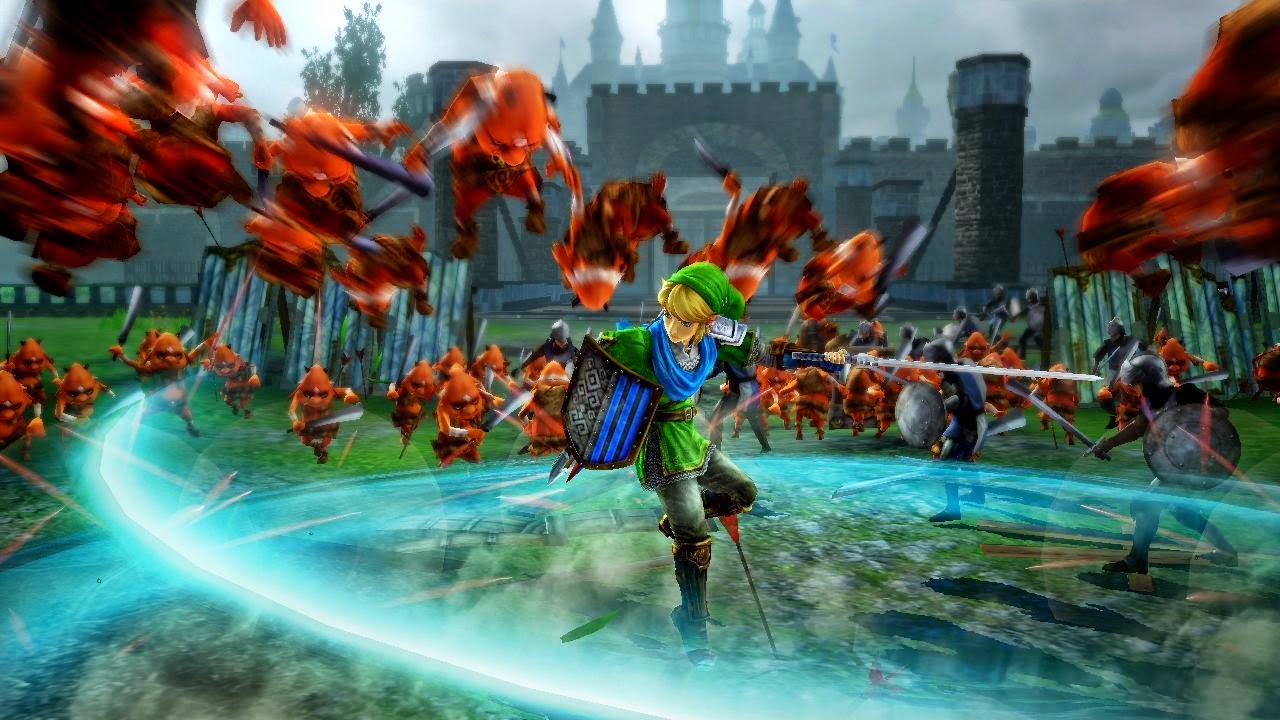
Striking down enough foes will fill up your special attack meter, which can then be unleashed against more of the ever-spawning Bokoblin, Moblin, or Stalchild forces to wipe out a great number of foes in one fell swoop. These special attacks can be great for speeding up the capture process when attempting to take over an enemy base. Each character also has a magic meter that, when full, can be activated in order to slow time for a brief period to inflict major damage to specialty troops and captains, as well as other CPU controlled characters. Since the magic meter is filled up with magic jars as per Legend of Zelda tradition, you will have to collect these from smashing jars within bases or hoping enemies drop them upon defeat. Magic jars are, however, one of the most rare drop items from enemies, so do not expect to reap the rewards of a full magic meter more than once or twice on most missions.
Also drawn from the Zelda franchise are the secondary weapons like the bow, bombs, boomerang, and hookshot, all of which can be used by any of the playable warriors, and all of which have surprisingly practical uses. The bow is reserved exclusively for ranged shots against poisonous Deku Babas and certain boss fights, while bombs can be used to thin out troops as well as discover secrets hidden behind cracked walls. The hookshot can give Link and company a shortcut to higher ground, or can be used to wrestle airborne foes to the ground, and the boomerang can be used to dizzy multiple foes with each toss. Each of these secondary weapons can receive temporary boosts in power and range thanks to another kind of item drop, which will indicate which item is to be granted the power boost before you grab it.

Speaking of boss fights, Hyrule Warriors features showdowns with classic monsters like Ghoma, King Dodongo, and Manhandla, all of which handle very similarly to their 2D and 3D incarnations in past Zelda adventures. While boss encounters are not present in each and every stage, they are certainly the highlights of the missions they are worked into. Specialty enemies like the Gibdo, Aeralfos, and Poes will still take damage from most any weapon, though each is considerably weaker to a different weapon in particular. When weakened, these enemies will momentarily display a defense meter above their heads – hit the meter enough times, and their defense will be broken, giving you a golden opportunity to inflict lot of damage, sometimes finishing them off altogether.
Upgrading character skills like health and attack damage results from the particular items you gain from fallen enemies. Meanwhile, weapons can be combined to carry over bonuses like increased damage from a particular combo or a health buffer to a weapon with a higher power and star rating (effectively the same weapon ranking system as in traditional Dynasty Warriors games). Most characters have a second or even third weapon that can be discovered along their journey through Hyrule, as well as a final, more powerful form of each of these weapons that can hold three different upgrades as opposed to just one. Different potions can be brewed to grant brief power boosts both offensively and defensively, though the most practical to carry in to battle will likely always be that which restores the majority of your character’s health. These can prove especially useful if you find yourself pinned in a corner and subsequently the victim of an onslaught of combo attacks from one of the enemy warriors.

While the plotlines of any given Zelda game have drawn heavy influence from European and western fantasy works, their tales have been largely universal, not identifying strictly with one culture or another. Frankly, it’s an approach that likely largely explains why the series has been so universally well-received for more than twenty-five years. The story mode of Hyrule Warriors does account for the divergent timelines of official Zelda lore, but falls outside of the canon, and is admitedlly simple in its aims. According to this spinoff game, there were forces capable of witnessing all versions of the tale of Link, Zelda, and the Triforce, but they were never meant to interfere in any way. When curiosity leads Cia, a mystic woman of this clan, to contemplate what it is that makes Link such a great and courageous hero, dark forces kept long at bay begin to take hold of her, influencing her ultimate decision to travel to the land of Hyrule and amass an army capable of challenging the kingdom.
Enter Zelda and Impa, who turn to Hyrule’s army and one blond swordsman in particular to defend the castle and surrounding fields. As the fighting escalates and both sides hatch plans to try and trump one another, the trio encounters Lana, a girl from the same clan as Cia, but who would seek to aid the warriors in attempting to halt Cia’s advance across Hyrule and convince her to return to her old ways. As Cia utilizes the Gate of Souls to draw power from many alternate versions of Hyrule, so too do Lana, Impa, and Link seek out the aid of Darunia, Midna, Fi, and other veteran Zelda characters. But while all this attacking, defending, and countering is occurring, other malevolent forces lie in wait.

Challenge mode throws players into singular scenarios with one main goal in mind before the end of the mission, but keeps things interesting by throwing new and unexpected minor challenges as things progress. More time-consuming is the adventure mode, which asks players to complete a series of specific challenges with certain restrictions in place, including time a ten minute time limit to defeat five-hundred enemies, a battle against some of the game’s stronger foes where all attacks (yours included) deal massive damage, and quiz games that will test players’ knowledge of enemy weaknesses. Adventure mode’s overworld map pays homage to the original NES Legend of Zelda, and players will collect candles, bombs, compasses, rafts, and more as they earn higher rankings on these various challenges, all of which can subsequently be used to uncover health upgrades for your unlocked warriors, as well as few of the playable characters.
With regards to these playable characters, the game draws twelve faces from across the Zelda series and introduces one newcomer in the form of Lana. Each of these warriors has a unique play style that utilizes similar button combos with greatly varying results. Midna can summon a fist from her helmet and hurl foes wildly about, Shiek can create a small damaging circle by playing the harp, and Ruto flips back and forth through pools of water that manifest in the most unlikely of locations. Despite the roster not being nearly as large as in most Dynasty Warriors games, Hyrule Warriors does well to cater to a variety of combat strategies while offering well-balanced offensive and defensive capabilities to each character. The creativity drawn from Ocarina of Time, Twilight Princess, Skyward Sword, and more is a wonderful way of catering to die-hard Zelda fans, though Lana’s moveset is a bit lackluster in its flash and flair when compared to nearly any other one of these iconic warriors.

Most of the playable characters look very similar to their original designs. Ghirahim retains a semi-cel-shaded overlay, Zant and Midna are bear more stark color patterns and intricate details, while Darunia and Ruto’s character models are the most simplistic of the bunch, as they hail from an older 3D era. Link, Impa, Zelda, and Ganondorf, meanwhile, all wear outfits that act as crossing points between Zelda and Dynasty Warriors - Link’s green tunic is subtly accented by a blue scarf, Zelda’s armor and dress a hybrid between her 2D and more recent appearances, and Impa’s clothing largely inspired by her counterpart in Skyward Sword, though appearing to hold some influence from Ocarina of Time as well. Ganondorf’s design, however, proves the most polarizing, as his long red hair, angular armor pieces, golden crown-like headpiece, and large jagged swords imply a more distinct eastern influence – somewhere between feudal Japan and Mongolian horde.
Hyrule Warriors also pays homage to its roots by incorporating many classic Zelda tunes infused with rock riffs and dark electronic sounds. While artistically the game may not be representative of the next proper installment in the Zelda franchise, seeing the land of Hyrule and all its denizens in full HD is most pleasing to the eyes. Hyrule Warriors hits a couple of snags in its design, largely resulting from the save system and respawn locations. It is possible to drop a save spot at any given time during a mission, though this is one of the few pointers the tutorial segments do not take time to explain, and given the generally fast-paced nature of any mission, it’s a feature that can effectively go ignored for an entire playthrough. Each time you complete an in-mission objective, however, the game automatically sets a checkpoint for you, which is typically quite convenient, save for instances when the game respawns you in front of an enemy warrior or boss character who spams you with combos that result in a death as sudden as your return to the fight. Hyrule Warriors is by no means a perfect game, not the most extensive one, but it does emphasize heavy arcade-style hack-and-slash design that delivers mindless fun without losing its identity as a proper crossover.
My rating: 8.25 (out of 10)