.

.
Showing posts with label Capcom. Show all posts

Thursday, January 8, 2015

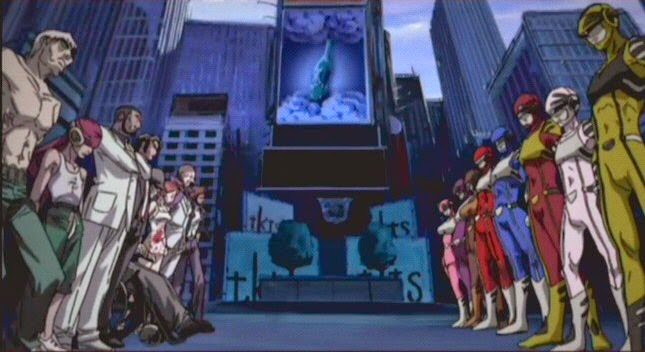
Anime review: Resident Evil: Damnation


Set between the events of the Resident Evil 4 and Resident Evil 6 video games, Resident Evil: Damnation sees Leon S. Kennedy return to the spotlight as he is sent into a small former Soviet nation to investigate the use of B.O.W.s amidst civil unrest. Despite the political reforms that followed the nation’s detachment from the U.S.S.R., rebel groups have risen up arms against the government, and have resorted to the use of Lickers, skinless quadrupeds that are easily identified by their snaking tongues and exposed brain tissue. Given his wealth of knowledge on B.O.W.s, as well as his decorated experience from Raccoon City, Saddler’s cult, and more, Leon is strategic and careful in his actions, but not without the boldness to forge his own path and bend the rules from his superiors a bit (despite Hunnigan’s protests). Even with the tense political struggle going on around him and the serious threats of biological warfare, Leon doesn’t shy away from making the occasional snappy one-liner, most of which are mildly amusing and surprisingly less cheesy than in most RE properties.

There are ties to the more recent Resident Evil games through the use of the parasitic Las Plagas, and while many of the people fighting in the streets turn into the mindless infected, others use the Plagas in tandem with the Lickers, allowing them to directly control the actions of the terrifying beasts like hounds. However, this master-servant relationship comes at a price, in that once the Plagas are willingly injected into the controlling individual’s body, it is only a matter of time before they join the creeping hordes. Limiting the variety of enemies Leon and the freedom fighters encounter is a smart decision, in that it keeps the story and action sequences focused, as well as maintains an appropriate scale for this particular struggle.

Resident Evil: Damnation adopts a more action-heavy aesthetic than some of the other RE tales, though the horror vibe ala RE4 is not lost entirely. The dimly-lit and narrow tunnels beneath the city offer a gloomy atmosphere as the infected pursue Leon and company, while the grime inside parking structures and along old brick alleyways provides a strong contrast to the pristine Imperial halls of the president’s estate. Aside from Leon, the film focuses on two rebel fighters, who initially take him captive as they believe he is a spy employed by the state, but later allow him to aid them in their push towards the capital. Sasha is more of a dark and brooding individual, and while his reasons for fighting are explained in brief, the film does not dwell long on this, an act which is both a blessing and a curse – on the one hand, the narrative does not find itself bogged down with pushing a dramatic angle for some silly romantic subplot, but at the same time it makes it a bit difficult to feel for him or even properly gauge his emotions in the midst of all this fighting. The narrative implies Sasha has experienced some emotional and moral detachment since joining the fight, however, so perhaps this depiction is not wholly inappropriate. The other rebel fighter, JD, is a more gung-ho individual, but dorkishly obsessed with the image of being cool and views Leon’s American identity as a prime example of what he wants to associate with. He may be a goofball, and his dialogue may be among the weakest in the film, but at the end of the day JD has a heart of gold. Ada Wong acts in a supporting role, serving primarily to interact with the nation’s president, but also offering Leon tidbits of advice now and again.

The level of detail seen in the environments and character models is phenomenal, a significant step up from what the previous CG film, Resident Evil: Degeneration, had to offer. Similarly, the story is an improvement, as it chooses to keep itself ground in both its smaller cast and limited scope for the setting of one particular city within a small nation. Though many of the scenes take place underground or in the city streets at night, the eerie lighting does well to evoke the feel of a proper Resident Evil game. While not a narrative that will significantly change up the way viewers understand the pre-existing RE universe, Damnation does offer a satisfying stand-alone narrative that has sufficient levels of intrigue and thrills to keep both old-school and new-school fans engaged for its concise hour-and-forty-minute runtime.

My rating: 7.75 (out of 10)

Saturday, September 27, 2014

DLC review: DmC: Devil May Cry - Vergil's Downfall


Following the endgame events of DmC, Vergil finds himself trapped in a chaotic realm that seems to give physical form to all his inner turmoil. Still failing to understand how Dante and Kat could deny him his vision of a new Nephilim-governed world, Vergil’s calm and composed demeanor begins to deteriorate as he chases down apparitions of Dante, his mother, and plenty of monsters similar to those he and Dante faced in the city of Limbo. This DLC pack – which includes multiple chapters in a similar, albeit considerably shorter format as the main game – recycles some environmental assets, placing them against a red nebulous backdrop where floating platforms and blue vortex doorways are commonplace.

Vergil’s attacks are considerably faster than those of his brother, and can be upgraded in the same way to increase damage and offer a wider variety of ways to take down foes. Aerial juggles and charged power slashes prove practical for dealing with a handful of weaker grunts, while Vergil’s airborne daggers stand in for Dante’s Ebony and Ivory handguns. A couple of key abilities unlocked late in the DLC as part of the story’s progression prove a real treat, though their fanfare is unfortunately short-lived. Whereas Dante had both Angel and Demon weapons he collected during his missions for the Order, Vergil’s sword Yamato can take on either form with the press of the left or right trigger respectively. Angel attacks do less damage, but allow Vergil to dash about the stage at ridiculous speeds, while the slower Demon slashes do considerably heavier damage that is ideal for quickly boosting the combat ranking from D to S.


Vergil’s Downfall lasts a couple of hours, and while most of what lies in wait is rather predictable, the story does hold a couple of unexpected twists that provide greater insight into the antagonistic brother’s outlook on those around him. The dialogue is rather lazily scripted, but the game doesn’t get too bogged down with telling it, opting instead to let you enjoy the combat and seek out hidden health crosses and lost souls as much as possible. Vergil’s Downfall also takes a curious approach to its cutscenes, with most bearing a thickly-stenciled noir motion comic style instead of fully-rendered 3D character models and environments. Though a stark contrast to the core gameplay of this DLC package, it does not feel out of place, just somewhat lazy, given how stiff the motions are of each and every character rendered in these sequences.

Though the finale of DmC gave us something of a teaser of what might lay in store in a possible sequel game, Vergil’s Downfall would appear to be more concrete indication that Capcom and Ninja Theory intend to continue with this boldly reimagined vision of the Devil May Cry series. There is little complicated about the direction of Vergil’s Downfall – it’s not terribly lengthy to burn through once, though it does offer all the same variable difficulty settings as the core game. Vergil’s Downfall is an epilogue that plays out as a short and streamlined version of the core gameplay familiar to anyone who has already completed DmC: Devil May Cry.

My rating: 6.75 (out of 10)*

*(rating applies solely to downloadable content, not its inclusion with the content on the original game disc or other downloadable content)

Saturday, May 3, 2014

Gamecube review: Killer7


You may have gathered from my many reviews of Suda51’s games that I am a huge fan of his work. Much as I love No More Heroes and its sequel, I was acutely aware of the fact that most Suda51 fans held Killer7 to just as high a caliber. I recall seeing promo content for Killer7 before it ever released on the Gamecube via Nintendo Power and various websites, but never had the chance to play it in proper until recently. Whereas No More Heroes is an unapologetic satire on the action game genre as well as the video game industry at large, Killer7 combines horror and action elements in an on-rails shooter that involves clever puzzles, requires quick thinking and fast reflexes, and boasts a curious brand of dark psychedelic flair.

The Smith Syndicate, otherwise known as the Killer7, is made up of – you guessed it – seven core members. Garcian Smith is liason between the six assassins and their master, Harman Smith. In the event that one of the six assassins – Kevin, Dan, Kaede, Mask, Con, or Coyote – is killed during a mission, Garcian can retrieve their remains and bring them back to life. The catch, however is that Garcian must retread their steps into enemy-filled territory. Thus is the big gamble with retrieving a dead Smith – Garcian cannot be upgraded, and in the event that a mission does not require use of the Smith in question’s unique abilities, it may be wise to simply carry on with the remaining members of the syndicate.


Blood is the currency of Killer7, and is used to heal during a mission, required to utilize the unique abilities of each of the Smiths, and can be exchanged for upgrade points to boost the stats of the Smiths. Each Smith has a different skill set, ranging from Con’s speed in both mobility and firing rate, to Kaede’s long-distance scoped pistol, to Kevin’s throwing knives which negate any need to reload. However, each Smith has an offset to prevent any single one from becoming more powerful than the others. Con’s defensive capacities are practically nonexistent, and though Mask deSmith is built like a tank, the spread of his grenade launchers results in his gathering a lower-quality blood far more often than not. Kaede and Mask’s unique abilities often reveal hidden messages and passageways respectively, and are most helpful in solving puzzles. Coyote and Kevin’s abilities are most frequently used to access new areas of the map, while Con’s ability to hear specific sounds and determine the correct path off those sees the least use. Dan’s ability to charge up one Collateral Shot in order to take out enemy spawn points is used sparingly, but is practical nonetheless.

The enemies that the Killer7 face at every turn are monstrous humanoids known as Heaven’s Smiles – effectively walking time bombs with abilities that vary from one mission to the next. If a Heaven’s Smile gets too close to one of the Smiths, it will detonate and chisel away a decent portion of their health bar. Some varieties of Heaven’s Smiles are slow but capable of taking many hits, others are stationary but notably more lethal as ‘turret’ units. Some of the more dangerous Heaven’s Smiles, encountered later in the game, are designed to race toward players before they have much time to devise a countering strategy. While the game never feels cheap or frustratingly difficult, it certainly demands a unique learning curve given its style of gameplay, and a trial-and-error pattern is key to taking down some of the game’s most lethal enemies.


These Heaven’s Smiles are the binds that tie everything together, plot-wise. At the outset, Harman has an encounter with an old acquaintance named Kun Lan. Kun Lan has acquired the means to offer ordinary citizens the chance at becoming Heaven’s Smiles, and furthering his terrorist routine. Swept up in the rivalry of these two old men are political officials representing Japan and the U.S., as well as other radical idealists like one Ulmeyda. It’s a melting pot of cleverly-scripted characters with colorful attitudes that lean more toward the practical and realistic given the scenario at large, as opposed to No More Heroes’ more crazy and eccentric residents. Even with the M-rating slapped on the box, it should be noted that Killer7 is a thinking man’s game – not just because of the logic-based puzzles, but because of the story and setting’s emphasis on more adult themes like modern terror tactics, cultist followings, irregularities in space-time, geopolitics, and moral ambiguity.

Much like the more recent Killer is Dead, Killer7 utilizes a hyper cel-shaded art style, wherein whites are borderline-glaringly bright, and shadows are nearly pitch black. The animations and details of each character model are incredibly well-rendered, however, so it is thankfully not a case of the art style trumping the care put into bringing the Smith Syndicate to life. The soundtrack incorporates a number of industrial and techno tunes to flesh out its near-future setting, while also adding a dash of rock and classical string sounds to the mix. Some of the cutscenes opt for a modern anime approach, while the majority deliver story segments in small doses of grungy 2D digital animation.


Kiler7 will run players about fifteen hours or so on their first playthrough. Some levels are more time-consuming than others, as they may require the Smith Syndicate to retrace their steps in order to complete a puzzle that was impossible to overcome at an earlier point. Others host considerably more enemies, leading players to have their triggers ready to go at a moment’s notice. But even the first introductory level lacks a linear design. There is never a set order in which players must overcome the various challenges of each mission, rather the ultimate goal is to retrieve all the required Soul Shells rewarded from mastering puzzles and exploring the environment. The game does mark each puzzle, Soul Shell, and point of interest on the map screen, making retreading one’s steps a less tedious process, though the game will never state outright what needs to be done at each location.

However, clues can be purchased for an adequate amount of blood from the ghostly figure of Yoon-Hyoon and his luchador mask. Similarly, the bondage jumpsuit-bound individual known as Iwazaru offers tidbits on local enemy tactics in any given locale. Arguably the most interesting of these phantoms is Travis Bell, a young man who knows perhaps more about the picture at large than any of the Smiths. His knowledge of the Japan-U.S. political affairs and the associates Garcian occasionally meets with makes him a key part of unraveling the grander story.


While the seven Smiths are merely faces with separate weapon sets at the start of Killer7, they each have their time in the spotlight, and by the game’s final hours, each will have a distinct and rounded identity. Some of the Smiths are explored in greater detail through letters and key items found within missions, forcing some digging on the part of players. Others, like Dan and Mask, have fully-scripted cutscenes allotted to them. Upon completing the main game, the grueling challenge of Killer8 is unlocked, which grants players access to Harman Smith alongside the other six assassins.

Killer7 is a rare gem, unfortunately overlooked by many due to its limited exclusivity to the Gamecube and release late in the sixth console generation. Despite the fact that the game does see a couple of hiccups few and far between, there isn’t any one element that stands out as being significantly flawed. Killer7 is weird, no doubt, but that is standard of any Suda51 title. Killer7's unorthodox controls and general gameplay may seem a bit daunting at first, but by the time players complete the first mission, it should all feel very fluid and natural. Killer7 deals with some dark plot elements that are very relevant to this day and age, and the culmination of its mature storytelling, wild artistic vision, and crazy creative gameplay make it one of the best games I have experienced on Nintendo’s purple lunchbox console.

My rating: 10 (out of 10)

Sunday, March 16, 2014

Xbox 360 review: DmC: Devil May Cry


Swapping out medieval castles and old European townscapes in favor of a more contemporary urban punk Eastern European setting, DmC: Devil May Cry does as much to build upon the standards set by previous Devil May Cry games as it does to reimagine and reinvent one of the most popular action game series out there. While the initial debut trailer of DmC was met with harsh criticism over the presentation of protagonist Dante, veteran fans of the series ought to give this title a second look, as it is far and away the smoothest-playing title in the series. Ninja Theory has decided to cut much of the fat from the upgrade system, and while there are still plenty of new combos and abilities that can be unlocked, they are simultaneously more practical and less complicated than in previous Devil May Cry games. Earning these upgrades is by no means a cake walk – you’re still going to have to put forth the effort into chaining combos in order to gain more points and a better overall score on each mission. But the game does loosen up a bit on the long-standing tradition of pushing for multiple playthroughs by making it so that you can earn enough points on a single run of the normal ‘Devil Hunter’ difficulty setting to fulfill a well-rounded and decently powerful arsenal. That said, a second or third playthrough on any of the seven difficulty settings is required in order to gather all the hidden collectibles.


The secondary weapons have also be retooled for the sake of practicality, but are still visually pleasing and a blast to use. The scythe Osiris and throwing star Aquila stand in as Angel weapons, dealing lower damage, but doing well to stall enemies or keep them at a distance. The gauntlets Eryx and axe Arbiter are slower Demon weapons that deal significant damage, but also leave Dante more open to enemy attacks, as he cannot recover as quickly after striking in order to perform a dodge. These weapons have variable ranges, and can all be incorporated into sky attacks in order to further chain combos. Dante can maintain his chain via his trademark pistols Ebony and Ivory, but as with previous DMC games, these effectively only serve that lone purpose. Meanwhile, two new guns, Revenant and Kablooey, deal notably greater damage with a more frequent reload rate, as a shotgun and sticky bomb launcher, respectively. Dante can also use chains to latch onto foes, whether they are airborne or groundside, and either pull himself toward them or drag them close to him to strike. To top this all off, Dante still has his signature sword Rebellion, which is the default main weapon, still plenty effective at dealing medium levels of damage to foes at a moderate rate.

DmC does well to incorporate many themes from the older Devil May Cry games into this new vision of the game world. At the outset, Dante believes himself a loner who has he unfortunate habit of drawing the attention of Demons and being sucked into Limbo, a plane of existence unseen by the public, but one that nonetheless influences their day-to-day life. It is not long before Dante meets Kat, a young witch who informs him that she knows of Limbo and that her boss, a man representing an organization known as ‘The Order’ wishes to meet with him. The problem is that it is difficult for Dante to lay low for long, and has his fair share of run-ins with demons before Kat is finally able to introduce Dante to the head of The Order, Vergil. Vergil helps Dante to restore his memories, and Dante comes to the realization that they are brothers, both Nephilim, the sons of an Angel mother and Demon father. Dante also remembers that Mundus, the demon who now reigns over the city where they now live, killed his mother and imprisoned his father, and has been hunting Dante ever since. However, the brothers hold one major advantage over Mundus: the demon does not know of the second Nephilim, Vergil, and thus the two hatch a plan with the help of Kat to strike at Mundus’ resources – his propaganda, his poisonous drinks, all that he holds most precious and important – in order to anger him and draw him away from the demon gate, his source of power, long enough that it might be shut.


While DmC boasts but a handful of boss fights, each is moderately intelligent in its design, providing Dante with a different challenge to tackle. They are nowhere near a rounded-out or in-depth as the likes of boss encounters from more adventure-driven games like The Legend of Zelda or even other contemporary action titles like No More Heroes. Still, the majority of DmC’s boss encounters handle about as smoothly as the rest of the experience, and are more a test of Dante’s endurance and adaptability to new threats than anything else. Occasionally, Dante will encounter weapon-specific enemies, which can only be fought with Angel or Demon weapons respectively. This adds an extra degree of tension to combat, if only for brief periods.

Challenge stages make their return, and are divided into different levels of difficulty that correspond to the color locks that bar access until matching keys are discovered. These stages include combat scenarios that limit the damage Dante can deal with certain weapons, and races against the clock to reach the end of a series of platforms. These race-style levels are decidedly more adventure-oriented in their design, and appear a number of times during the main game (sans the time limit) when Dante travels to a dream-like setting to unlock more of his memories. The variation in level design in DmC is one of the game’s greatest strengths, and while you spend the majority of your time in the warped version of reality known as Limbo, the game does pull a few clever punches generally reserved for game series boasting more complicated plots such as Metal Gear Solid or Bioshock.


DmC is surprisingly smart with regards to its scripting. Considering how abrasive and cocky Dante initially comes across as, it’s impressive to see his character progress into an anti-hero players can actually get behind, and to have some genuinely funny bits of humor sprinkled throughout. Much of this is due to the way that the voice actors portray their respective characters, a delivery which comes across as being very natural across the board for Dante, Vergil, Kat, etc. The soundtrack, comprised primarily by tracks written by Combichrist and Noisia, retains some of the metal thrash sounds of older Devil May Cry titles, while adding some electronica into the mix. Yes, there is some dubstep worked in, and while it comes across as a bit silly in the moment, it never steers the atmosphere of the game too far from its roots.

My rating: 9.25 (out of 10)

Friday, November 8, 2013

3DS review: Resident Evil: The Mercenaries 3D


One of the earliest big-name releases for the 3DS, Resident Evil: The Mercenaries 3D was effectively a means for Capcom to tide Resident Evil fans over until the release of the more bold and highly-anticipated Resident Evil: Revelations. The Mercenaries 3D has a very similar control scheme to its 3DS sister title, but plays quite differently. The major stages from the mercenaries bonus game modes of both Resident Evil 4 and 5 have been compiled in The Mercenaries 3D. The first handful of missions act as tutorials, asking for players to perform simple tasks like running past a dozen or so markers before the time runs out, or killing ten to fifteen enemies. As each mission is cleared, the parameters become a little more complex. While it is good of Capcom to throw these tutorial bits into the mix for those who may have missed out on the modern RE titles, it is also mildly annoying that there is no option to skip them, and seasoned veterans of the arcade-y mercenaries gameplay style may find the first twenty-five minutes boring and tedious.

That said, once the full mercenaries mode is made available, it proves quite enjoyable. The Mercenaries 3D lacks any sort of story mode, so anyone interested in this title should keep in mind that this a purchase that should be made entirely on how much he/she enjoyed the mercenaries mode from Resident Evil 4 and 5. Stages like the African caves and medieval castle remain largely unchanged, though a few of the larger ones have seen small portions cut from them. The limited spawn counter issue from Resident Evil 4 seems to have been rectified, as enemies will continue to descend onto the battlefield as long as you keep shooting them up. Overall, the game looks quite good – the textures are certainly not as impressive as on the home console releases, or even as impressive as in Revelations, but for as early a 3DS release as The Mercenaries 3D was, it’s none too shabby.

There are eight characters to select from, and while only a couple are available from the outset, the rest will be unlocked through a natural process of completing each ‘chapter’ worth of stages (each chapter usually consisting of approximately a dozen missions or so). There is also an in-game achievement list, and meeting certain criteria like beating a mission while using only one weapon or chaining a set number of combo kills will net rewards like abilities and alternative costumes for the eight characters. The costumes provide little more than an aesthetic alteration, which is a bit disappointing, since Resident Evil 5 saw different loadouts ascribed to each new costume. The aforementioned abilities can be added to a character’s loadout to grant them slight boosts to their healing, critical hit ratio, mobility, and so on, and can come in handy when tackling some of the more grueling late game missions.

The Mercenaries 3D supports both single player action and cooperative via online or local means. The standard loadouts of Chris, Jill, Claire, Hunk, Barry, Rebecca, Wesker, and Krauser are nicely varied, and though some characters share the same weapons like the grenade launcher, the play style from one character to another is prevented from becoming too similar by providing them different types of ammunition and distinctly different physical stats. Rebecca is more about speed and offense, Krauser is something of a one-trick pony focused on accuracy and critical hits, Chris and Jill act as the two comfortable balanced defaults, etc. There may not be a lot of content to Resident Evil: The Mercenaries 3D, but then again, it isn’t trying to deliver a full-fledged RE experience like Revelations or any of the numbered entries in the series. The Mercenaries 3D is meant to satiate a hunger for pure, unbridled arcade-y gameplay, and it handles surprisingly well on a handheld, touch screen implementation for herb healing and all.

My rating: 7 (out of 10)

Wednesday, September 11, 2013

Xbox 360 review: Dead Rising 2


Set five years after the original game, Dead Rising 2 takes place in Fortune City, an American west casino town that effectively behaves as a baby brother to Las Vegas. Chuck Greene, former motocross champ, has found himself participating in Terror is Reality, a stadium game show based around the premise of having four competitors slaughter hordes of zombies for cash prizes. Not long after Chuck’s run, the otherwise safely-contained zombies break loose and quickly spread out from the arena into the rest of Fortune City. Fearing for the safety of his daughter Katey, Chuck heads off to find her and, once reunited with her, makes his way to a safehouse with a handful of other survivors. While the group should be able to rest easy knowing that rescue will arrive in three days and that the shelter is secure, Chuck has to provide Katey with a constant supply of Zombrex, as she was bitten once before but never turned into one of the undead. To compound the situation, Chuck learns that someone has framed him for setting the zombies loose, and so in order to earn the trust of the other safehouse survivors and clear his name, he must venture out into Fortune City to figure out just who is trying to blame him for the outbreak and why.

Dead Rising 2 utilizes the same basic engine as the first game, offering up a third-person perspective for the bulk of Chuck’s running, fighting, crafting weapons, and changing outfits. With firearms, flamethrowers and the like, the camera can zoom in temporarily to allow Chuck more precise aim, which comes in most handy when engaging survivors who have mentally gone off the deep end in some of the game’s boss fights. These ‘boss’ characters are little more than a typical survivor model with a potentially larger health bar and, occasionally, some special tactic or another. In the case of a schedule-obsessed postman, his attack patterns involve both a shotgun and some time bombs that he hurls at Chuck. With a guy dressed as children’s store mascot Slappy, it’s a combination of speedy roller skates and flamethrowers, making an up-close-and-personal approach less than ideal. While these psychopaths are all aesthetically unique, their personalities are effectively the same – the zombies hit, they were shell-shocked, and thus took their roles way too seriously; so seriously that they would rather kill Chuck than give up their routine, no matter how trivial or misguided it might be post-outbreak.

It is immediately apparent how much better Dead Rising 2 plays than its predecessor. Zombies are not as prone to grabbing onto Chuck or his allies and devouring their health, while practical weapons like a spiked baseball bat or sledgehammer will keep the infected at bay long enough for Chuck to complete his first few introductory tasks. The save system sees the biggest improvement by far, allowing players to save their game at any bathroom stall at any point, regardless of what weapons they have on hand, how many survivors are travelling with them, etc. Collecting Zombrex for Katey can be handled through a few different means – Chuck can save up money to buy it from pawn shops located around Fortune City, or he can take on certain missions that will detail Zombrex as a reward before he commits himself to aiding a survivor who is willing to help Chuck out in turn. Making sure Chuck has Zombrex on hand once per day is not so much a challenge due to any explicit difficulty factor, but instead requires planning and strategy on part of the player, as they must find time to divert their attention to finding the Zombrex as well as administering it to Katey at a specific time each day.

As far as the weapons at Chuck’s disposal are concerned, there are typical blunt objects like the aforementioned bat and hammer, elusive firearms including pistols and shotguns, and well as heavy hitters with a more limited range of use like flowerpots, signs, and giant teddy bears. Mowing down crowds of infected with putt-putt speed golf carts or more literally with a lawnmower provides a good chuckle from time to time, but the real winners are also the most rewarding with regards to boosting Chuck’s experience points – those weapons being all the special combo ones. The most fun and admittedly funny moments come from Chuck’s use of the Paddlesaw (two chainsaws attached to opposite ends of a kayak paddle), Electric Rake (a leaf rake with a car battery strapped to it, emitting a jolt from the metal teeth), Rocket Launcher (a series of metal pipes that fire bottle rockets out in gatling gun fashion), and the Knife Gloves (boxing gloves with knives protruding from the knuckles). A few other combo weapons are one-time uses and are intended to quickly clear a large area, and can thus prove useful when escorting large groups. Meanwhile, the construction helmet with beer bottles strapped to either side – aptly title the ‘Beer Hat’ – allows Chuck to refill his health bar on the go, and can be extremely helpful during the game’s handful of boss fights, some of which are sprung on players without much warning. However, it’s best not to rely too heavily on alcohol in order to refill Chuck’s health bar, as too much booze and no food will make him throw up.

Gaining experience points will merit Chuck new levels, which in turn grant him bonuses like more slots in his inventory and a larger health bar. Experience points are earned at a very gradual pace when killing zombies, while escorting survivors will net Chuck large bonuses. While the main story is consistent regardless of how many times you replay Dead Rising 2, you are granted complete freedom with regards to which psychopaths you decide to fight and which survivors you opt to bring back to the safehouse. Saving certain characters will open the door to further missions, as well as trivial distractions like a game of poker.

Online multiplayer sees four players compete to earn the highest score in the Terror is Reality game show that Chuck competes in during the single-player game’s intro sequence. The main event of this multiplayer mode is Slicecycles, wherein players hack up hordes of infected via chainsaws attached to motocross bikes, while the rest of the games include the likes of a target shooting range, strapping dynamite helmets to zombies and hitting a button to make them explode, a tag-like match with players running inside of giant hamster balls, and so on. In essence, these feel like some bloody, M-rated equivalents of Mario Party games, though they certainly lack the spirit and fun-factor of Nintendo’s board game video game. The Terror is Reality minigames are no doubt inspired, and arguably one of the most creative multiplayer modes to grace any zombie game, but the entire mode feels like a brief afterthought tacked onto the end of the main star, the single-player story mode.

Sure, most of the characters Chuck encounters during his days in Fortune City are more caricatures than fully realized characters, but that’s part of Dead Rising’s charm. What Resident Evil is intended to be to serious and dark zombie games, Dead Rising is to a 70s and 80s B-movie presentation. It’s not a game that is meant to be taken too seriously – in fact, Dead Rising and its sequel do more than their fair share of poking fun at tropes within the zombie subgenre of films and video games. While it is unfortunate that Katey and Chuck’s relationship falls to the wayside and isn’t explored in any real meaningful way like it was in Case Zero, Dead Rising 2 is more about gameplay than storytelling. Know that while Chuck will spend most of his time hacking, slashing, blowing up, and setting fire to a sea of undead, you - the player - will have a riot in controlling him to do so.

My rating: 8.25 (out of 10)

Thursday, August 22, 2013

XBLA review: Dead Rising 2: Case Zero


Chuck Greene and his daughter Katey are on their way to Fortune City when they make a stop in the small town of Still Creek. Host to a typical set of small storefronts, ma and pa restaurants, and a few means of local entertainment, Still Creek spans just over a block’s distance, with a small quarantine zone blocking off the highway. As Chuck steps inside the gas station store to look for supplies, someone hijacks his pickup, taking his much-needed supply of Zombex for Katey along with them. The fact of the matter is that Katey was bitten and infected, but Chuck has thus far prevented her from turning into a zombie by giving her regimens of Zombex medicine – without it, she runs the risk of turning into one of those bloodthirsty creatures, and Chuck runs the risk of losing the one person he still has to hold onto and care for.

Luckily, tracking down a new box of Zombex is the easy task. Chuck’s initial trek outside of the gas station/scrap yard safehouse has him push through a thick horde of infected into the quarantine zone just outside the other end of town. Once he’s nabbed the Zombex, his focus shifts to restoring a motorbike, the pieces for which are scattered about Still Creek’s handful of businesses. Some are already in the possession of other local survivors and can be acquired for money or taken by force, while others require Chuck to scour the interior of some of the larger buildings and access otherwise locked rooms.


There are a little more than a half-dozen survivors that Chuck can choose to aid at his leisure. Some will give him money for his troubles, while others simply reward him with a boost in experience points. As Case Zero lasts approximately an hour and a half for a single playthrough, this may seem a daunting task, but most of these rescue scenarios allow Chuck to easily string multiple survivors along at once, drastically reducing travel time back and forth.

Much like with the full Dead Rising 2 experience, Chuck can craft new, more powerful weapons out of the various tools and firearms he finds lying around Still Creek. This portion of the experience is nowhere near as in-depth as in the main game, but Chuck can still access some of the more entertaining weapons like the Electric Rake, Paddlesaw, and the tried-but-true Spiked Bat. Still, easier-to-locate weapons like the Broadsword and Moose Head can prove just as much fun to use when slicing and dicing the infected or simply mowing them over with brute force.


The only segment where the gameplay becomes notably weaker is during the final minutes when Chuck and Katey make their escape run on the recently-repaired motorbike. It doesn’t control terribly well, and requires you to slow down significantly if you want to make even wide turns through the streets, effectively killing the high that one would expect of an ‘escape run’ scene. However, the rest of this prologue to Dead Rising 2 operates well enough. The other characters are a mildly interesting bunch, and do not share more dialogue than necessary due to the in-game time limit tied to Chuck’s to-do list. There’s a nice sampling of the larger gameplay offered by Dead Rising 2 throughout, and a lot of what constitutes Chuck and Katey’s dynamic shines through in fairly convincing, if not brief, interactions between the two. As for the replay value, it is centered primarily on unlocking 100% of the achievements tied to Case Zero, and a second or third playthrough won't offer anything beyond stacking Chuck's experience points until they cap out at level five.

My rating: 7 (out of 10)*

*(rating applies solely to downloadable content, not its inclusion with the content on the original game disc or other downloadable content)

Sunday, October 28, 2012

Top 5 moments that best put the 'evil' in Resident Evil 6

A lot of sinister things have been done over the years in the Resident Evil games. It's really no surprsise - I mean, the series has 'evil' in its name. Sure, exposing people to a virus that turns them into a mindless horde of flesh-eaters is pretty bad behavior. But abominations like the Hunters and Novistadors and truly vile; don't even get me started on Wesker and his little Uroboros pet project. This list is a compilation of the five moments I found best put the 'evil' in Resident Evil 6. Be warned: this list is filled with spoilers, so if you don't want your RE6 experience ruined, play through the game first and then come back to compare notes with me.


#5 - Zombies with guns: Don't get me wrong, I loved the way in which the J'avo were implemented into Resident Evil 6. Having squads of tactical and organized zombies is great, and the fact that they are stronger than run-of-the-mill infected makes for much more interesting (as well as tense) combat. But seriously, who was the idiot at Neo Umbrella that thought it would be a good idea to give zombies guns? They weren't dangerous enough with the whole flesh-eating routine? Not to mention that their body parts mutate into some heavy and quite practical weaponry.

#4 - Pong torture game: Just before Chris and Leon have their standoff over (impostor Ada Wong) Carla Radame's fate, the two find themselves in a security room, their identities protected thanks to a wall that runs down the center of it. But there are small gaps at the foot of the wall that allow small electronic discs to slide back and forth. When Carla activates these, the two heroes and their respective companions must shoot the discs back to the other room, not knowing who they are harming in the process. It's like Saw with Japanese vacuum robots that explode.

#3 - Chris's team dies: After aiding Carla, Chris and Piers discover she has an agenda all her own. This revelation comes too late, unfortunately, as she injects all of the team members into Chrysalis enemies. Racked with guilt over what happened that day - or more specifically, the fact that he could not keep his promise to rookie Finn that everyone would make it home in one piece - Chris becomes an alcoholic who wanders from one bar to the next. He completely forgets his role as commander of a BSAA squad until Piers manages to find him and drag him back to the battlefield.


#2 - Chris' team dies... again: As if the first time wasn't bad enough, Chris Redfield's team that is sent into China is picked off one by one - this time at the hands of a giant invisible snake. Basically, Capcom took the idea of Yawn from the original Resident Evil, made him much meaner and scarier, and gave him the ability to turn invisible. All of this makes for one of the most intense segments in the entire game, as you never know where the snake is going to pop out from next.

#1 - Everything that Simmons does: Though I don't much care for Simmons as a character, I have to admit, his actions are downright nefarious. He tests the C-virus on Helena's sister, coerces her into helping unleash it on the population of Tall Oaks, forces Leon to kill the President of the United States, ends up making Helena fight her sister, sets both Leon and Helena up as prime suspects in unleashing the virus, watches as the Chinese populous descends into chaos, mutates into a number of animal forms before turning into a giant fly and feeding off lesser zombies, before finally kicking the bucket. He's no Albert Wesker, but damn if Simmons didn't try to follow in his footsteps.

Tuesday, October 23, 2012

Xbox 360 review: Resident Evil 6


Spread out over the course of about six months, the events of Resident Evil 6 call veterans Leon S. Kennedy and Chris Redfield back into action to stop a zombie outbreak that threatens multiple fronts. Also caught up in the mess made by Neo-Umbrella is Jake Muller, a mercenary with incredible physical prowess who has only recently discovered his role as son of the late Albert Wesker. The game is divided into three major campaigns, as well as one shorter story revolving around Ada Wong that is unlocked after the others have been completed, much like the side stories of Assignment Ada and Separate Ways in Resident Evil 4. With a return to the familiar viral outbreak scenario instead of Las Plagas or Uruboros, there is a certain familiarity about Resident Evil 6.

While the core gameplay builds upon the more recent action-oriented entries into the series, each campaign plays with a distinctly different style in mind. Chris controls fast and furious as he did in Resident Evil 5, and totes quite a full arsenal. While he faces hordes of the tactical J'avo (who are infinitely more intelligent than the standard zombie), Chris' campaign is - interestingly enough - arguably the scariest of the batch. The enemies he goes up against are considerably stronger than those the other protagonists face, and some prove highly adaptable - like the Rasklapanje, who can continue fighting even when their torso has been separated from the legs, or tear off their own arms to throw them at Chris' face to block his field of vision. The environment can play just as important a role, when enemies are difficult to see or when trapped in tight quarters with many powerful foes. All of it makes for a very tense experience that does well to balance the action and horror elements.


Piers, Chris' second-in-command, is easily the weakest of the three partner characters. He constantly forgets his place and questions Chris' orders time and time again. Conversely, the chunk of Resident Evil 6 centered around Chris presents him in a more genuinely human light than RE5 did during its entire run. When his team was mutated by the C-Virus in eastern Europe, Chris blamed himself for their deaths and his inability to keep a promise to rookie Finn. He represses all memory of the incident and wanders the country in a drunken stupor until Piers recovers him. As Chris regains his memories, he begins to travel down a dark path of vengeance, and a whole new side of him is presented. It's an interesting look at the concept of man being the darkest beast of them all that the series hasn't really touched on outside the boundaries of evil mastermind villains of yesteryear.

While the President of the United States is visiting Ivy University, he is infected by a C-Virus outbreak. Faced with no other option, Leon shoots him and is informed by one Helena Harper that she may have some valuable information for him regarding the cause of the local outbreak. Leon has a handful of nicely varied weapons that he collects over the course of his campaign, and the college town surrounding Ivy University is an obvious throwback to the events of Raccoon City. For the first time in the series history, the chaos erupts before your very eyes as cars spin out of control, motorcycles crash, and people abandon their loved ones as zombies spread out in every direction. Presenting all of this as scripted in-game events as opposed to cutscenes makes the experience all the more immersive.

The enemies Leon and Helena face are primarily standard zombies, though there are a number of specialized (and subsequently more-challenging-to-kill) zombies, such as the screamer, the highly-agile and feral bloodshot, the whopper, and the spore-carrying Lepotitsa. Leon's campaign also features a wide variety of boss fights, many of which last for a good portion of a chapter. As a whole, Resident Evil 6 features what is probably the most varied array of enemies the series has ever seen, which will keep you on your toes as you explore the crypt beneath Tall Oaks, an abandoned market in Lanshiang, China, the plane that Leon and Helena board to travel from the former to the latter, and so on. The occasional puzzle element will work its way in, though these are far more prominent in Ada's bonus campaign. In terms of its gameplay, Leon's campaign controls the most like RE4, though the story elements and classic gothic horror motif evoke memories of RE2 and Resident Evil Zero.


As the new kid on the block, Jake is paired with Sherry Birkin, and the two share a unique relationship as children of two of the series' most prominent villains. Jake initially comes across as brash and selfish, informing Sherry that he will go along with her plan to bring him back to the U.S. government to research the C-Virus antibodies in his blood so long as he gets paid a hefty sum of money. While this is an easy arrangement for Sherry to make with her superiors, she tries to convince him that there is more potential than just using his skills as a soldier of fortune. There is a solid progression and development of them individually as well as partners of circumstance.

Jake's hand-to-hand combat works well enough, and his advantage in strength allows him to pull of faster (and often more brutal) finishing combos on enemy J'avo. The rest of his arsenal is relatively light, but he controls about equal with Chris and Leon. The environments Jake and Sherry must traverse are a bit less impressive than those that make up the other campaigns. One has the duo searching for key items in the middle of a snowstorm, and the visibility becomes so poor so frequently that reliance on the mini-radar is essential. Another requires them to sneak past the pursuing Ustanak (a nod to RE3's Nemesis) without setting off detectors that take on the form of giant insects, which is not crafted in a particularly intelligent manner. Quick-time events have been molded into more of interactive cutscenes that seamlessly transition from actual gameplay to the cinematics. With regards to their implementation in Jake's campaign, however, they often begin when he and Sherry are confined to a very small area with awkward camera angles and limited mobility, which makes them frustrating interruptions to an otherwise natural flow.

Jake does spout off a few cheesy one-liners fitting to his bad boy image. But the writing in Resident Evil 6 is a significant step up from most other entries in the series with regards to dialogue. Though Piers isn't exactly the most likeable, Helena and Sherry play off their respective leads well. The characters that really leave the most to be desired are the major villains. Without spoiling who they are or what their goals are, it is safe to say that the means do not even come close to justifying the end, and that they cannot compare to the evil geniuses of Albert Wesker, William Birkin, James Marcus, etc. At the same time, the web of conspiracy that strings the main characters brings an element of mystery and intrigue to the table. The plot explores the results of the C-Virus as it affects individuals on a more personal level, as well as widespread global panic, with bioterrorism now so frequent an occurrence.


Each of the campaigns will intersect with the others at key points, and if you are playing online, there is the potential for four human players to be cooperating in a boss battle or other major plot point. Though there is no real pause option, the game allows you to huddle in a safe location and bring up the options menu on your character's cell phone. The item menu is still accessed in real-time, but has many more slots than in RE5 and is much easier to manage thanks to quick-button commands. Herbs multiply when combined, and heal one block of the health bar a piece. Each character also has a stamina bar, which will be depleted and need to recharge if they perform too many kicks and punches. It isn't a perfect system, but it is an improvement over what Sheva and Chris had to rely on in RE5.

Mercenaries mode makes a return, albeit in a limited fashion. Unless you preordered from one of the major retailers offering extra stages as bonus content, your time spent in Mercenaries mode will be limited to three stages. These stages are all inspired by different areas in the three major campaigns, and present solid variation in size and layout. There are also eight playable characters that have their own set of weapons and items, with costume variants that offer even greater freedom in taking on a great number of the infected as the time limit draws closer to zero. Time bonuses and multipliers are spread evenly across any given stage, with the largest of the three - Steel Beast - requiring players to balance moving toward the next bonus with chaining kills. With the ultimate goal of 150 kills in a single round, running into a standstill on an empty stage like in RE5 is highly unlikely. That said, the RE6 version of Mercenaries behaves largely the same as in the past two numbered entries, though enemies are smarter and characters motions are more fluid.

Also available post-game is Agent Hunt mode, where players can take on the role of an enemy in another player's game in hopes of hindering their progress. Serpent emblems lay hidden in each campaign, and shooting/collecting these will unlock files relevant to the overarching story or figures of some of the game's major enemies. Also, there are individual skill stores for the different gameplay modes, where players can exchange in-game points for special upgrades. These range from better melee damage to less damage taken from enemies, higher drop rate of ammunition to more time from chaining bonuses in Mercenaries mode, and so on. Ada's bonus campaign is brief, with each individual chapter lasting around a half-hour to forty-five minutes, compared the hour average of the other campaign chapters. Hers is a story meant to tie up some of the loose ends, and the execution is handled well enough. There is a significant emphasis on stealth and puzzle elements early on, with the former being much more direct and less frustrating than Jake and Sherry's run-and-hide from Ustanak routine.


The soundtrack is an interesting blend of haunting choir tunes and tense techno battle themes. The lighting effects go a long way in creating the game's many diverse environments, though there are many textures that appear highly dated when viewed up close. Character models look good, and weather elements lend themselves to creating a much richer and fully-realized set of environments like snowfall over the streets of a partially-destroyed European city and a rainstorm picking up as Leon and Helena seek refuge in a cemetery church not far outside of Tall Oaks.

There is a lot to do in Resident Evil 6. The three campaigns make for one of the longest Resident Evil stories woven yet, and the bonus game modes provide plenty of replayability. There are moments where the game stumbles over its experimental nature, but it is largely a successful blend of action and horror, making for a more fast-paced and fluid experience than in RE4 and a more consistent classic horror style than the few jump scares presented in RE5. It may not be exactly what fans were expecting, but there are elements meant to appeal to Resident Evil fans of all kinds, and appears to be Capcom's way of returning to the basic and most successful elements that propelled the series over the years, while simultaneously taking it in a new direction now that the major plotline surrounding Albert Wesker has concluded.

My rating: 8.5 (out of 10)

Sunday, October 14, 2012

Resident Evil 6 journal - entry three


From the day that Capcom announced Resident Evil 6 would have three separate campaigns, Chris' was the one I found myself least excited to experience. Anyone who read my review of Resident Evil 5 knows that I did not hate the game. Unlike many reviewers, I rather enjoyed RE5, though I recognized it as an action game with horror elements sprinkled here and there, whereas Resident Evil 4 had walked the line between action-horror and survival-horror. While I really enjoyed the way that Resident Evil 5 controlled, the run-and-gun nature of the gameplay had me worried that Chris' campaign would be way too easy.

I would not go so far as to say that any one of the campaigns is more difficult than another, but Chris' chapters present a challenge consistent with Leon's and Jake's. While Chris and Piers have more heavy weaponry at their disposal, the game throws far more enemies their way at any given time. Also, despite the fact that these two characters are soldiers, they still feel like two guys dealt the worst hands possible, as their teammates suffer unfortunate deaths as the storyline progresses. The fact that these two take on such a huge responsibility makes for what is surprisingly the scariest of the three campaigns, with bosses that can turn invisible, smarter J'avo than in Jake's campaign, and plenty of Chrysalis enemies.

Perhaps the darkest beast of all is man itself, as the story breaks down who Chris Redfield is in a matter of hours better than Resident Evil 5 did in its entire run. The fact that Chris' campaign starts off with a tragic loss leads him down a dark path where he discards his traditional gathered demeanor in favor of a vengeful one. This puts him at odds with second-in-command Piers, a talented sniper who forgets his rank time and time again (and proves to be the only real obnoxious major character in the game, though certainly not as nauseating as past characters like Ramon Salazar from RE4 or Jessica Sherawat from RE Revelations).

Though the core gameplay was largely a run-and-gun style carried over from RE5, Chris and Piers did not feel overpowered, as the game does well to provide you with just enough ammo, grenades, and herbs to complete your objectives as long as you play it smart and tactical. Being constantly aware of your environmental surroundings as well as the capabilities of your enemies is key when deciding how to proceed with dispatching them, especially if you want to conserve ammo for an end-level boss encounter. There are a few moments where the camera angle shifts and you are forced to participate in one of the cinematic running sequences that I mentioned in the previous two journal entries. But these are few and far between when compared to Jake's and Leon's campaigns, and really only prove frustrating near the very end.

Saturday, October 6, 2012

Resident Evil 6 journal - entry two


One of the main themes that Capcom stated they wanted to come across in Jake’s campaign prior to the release of Resident Evil 6 was the sense of being stalked by the Ustanak as mirroring Nemesis from Resident Evil 3. While Ustanak is prominent in the first couple of chapters of RE6, those same chapters control like a curious combination of Resident Evil 4 and the older entries in the series. The European town that Jake and Sherry run through as they try to escape the Ustanak and J’avo is reminiscent of RE4 both in terms of aesthetics and layout. While the two aid Chris Redfield and company in fighting a giant B.O.W. that bears some resemblance to the El Gigante, they also spend plenty of time solving environmental puzzles, riding vehicles, and sneaking around sensor bugs that Ustanak sets up within an ice cavern.

Being children of two of the most important Resident Evil villains, Jake and Sherry have a unique and genuinely interesting relationship. Despite Capcom’s tendency in recent years to create or recreate female leads that are weak and whiny, Sherry holds her own alongside bad boy Jake as one of the strongest lead characters in RE6. To that end, I think Jake and Sherry’s storyline could prove the best of three, though Leon and Helena’s is certainly more dark and creepy.

Going back to the gameplay, the brief stealth sections are not particularly well-handled, and the Ustanak is more of a constant annoyance than a full-fledged villain. The latter element would be fine, if the campaign did much of anything to explore the individuals who command Ustanak, but in the end Jake and Sherry’s story feels the most far-removed from the main storyline. Jake controls more or less like the other characters, though his kung-fu fighting and wrestling suplexes give him a distinct leg up in hand-to-hand combat. The enemies do not feel quite as varied as in Leon’s campaign, though there is still a solid variety presented, most of them being B.O.W.s and J’avo as opposed to traditional zombies.

There is one level where Jake and Sherry must collect a series of key items scattered about a mountainside in the middle of a snowstorm. There are quite a few enemies littered about, and the entire scenario is pretty tense and creepy. However, it is also easy to find yourself lost, and the mini-map in the top corner of the screen practically becomes a necessity. Perhaps the most poorly designed gameplay element of Jake’s campaign are the running sequences that border between traditional gameplay and quick-time events. I wasn’t much a fan of the way these were implemented in Leon’s campaign, but they are usually a mess in Jake’s campaign. Though there are only a handful of these running sequences, the level designs always grant you minimal space and Sherry tends to get in the way, slowing you down and sending you to a premature death within seconds.

Don’t get me wrong – Jake’s campaign was fun, and the story was really cool, even though Leon’s proved superior as a whole. Even though Jake shoots off his fair share of cliché bad boy phrases, they are nowhere near as silly as some of the dialogue in the older entries. As a whole, Jake’s campaign plays pretty solid, despite a few hiccups along the way. The hand-to-hand combat works better than I expected, and there is a nice variety presented in the level designs. There is a large gap of time that the story skips over, and even though it makes sense with the overarching plot, it feels like another chapter could have been added to Jake’s campaign.

Wednesday, October 3, 2012

Resident Evil 6 journal - entry one


In a similar vein to my Pokémon Black/White and Heart Gold/Soul Silver journals, I will be posting a few short entries on the Resident Evil 6 campaign before I post my review (which will cover both the campaign, Agent Hunt and Mercenaries Mode, etc.) This is both to help better gather my thoughts on the game as well as provide my (spoiler-free) experience with the three main campaigns. As of today, I have completed Leon's storyline and plan to tackle the other two later this weekend and into the following week, as I can't imagine that the game will take me much longer than that to fully take in (also, Pokémon Black 2/White 2 hit store shelves this Sunday, so I will be spending the better portion of this Fall with my DS).

Leon's campaign is in many ways a throwback to previous entries in the series. It does well to blend the action elements of Resident Evil 4 and Resident Evil 5, while retaining the classic horror thematic of the earliest series on the Resident Evil timeline (i.e. - Resident Evil Zero, Resident Evil 2). There are some direct nods, such as a church that bears a striking resemblance to the Los Illuminados' place of worship in RE4, as well as familiar settings like Tall Oaks, a small American college town that becomes engulfed in chaos following a viral outbreak.

The environments are nicely varied, and include such memorable settings as ancient underground ruins, the classrooms of Ivy University, and Chinese market streets. The lighting effects are fantastic and each distinct area is wonderfully realized. Unfortunately, some of the textures look highly dated up close, and blood animations are subpar. Conversely, there are a lot of different zombie types that Leon and Helena take on, including the classic infected, reanimated skeletal remains, screamers, spore carriers, and acid spitters. Probably the best of the bunch are zombies and B.O.W.s seemingly inspired by RE4's Regenerators. The first are zombies that shed their rotting flesh and replace it with a hard glassy shell, leaving their exposed chest as their sole weak point. They are very fast and can lunge at Leon from a fair distance. The second appears to be a B.O.W. with black leathery skin (not unlike Ridley Scott's Alien) that can sever at the torso to strike at Leon's legs, as well as bite off its arms and throw them, allowing them to run about on their fingers and blind the protagonist's field of vision. These enemies have the ability to regenerate, and are both fast and smart, despite having a glaring weak point once the chest and legs have been separated.

While Leon's story begins with him investigating Tall Oaks for signs of where the outbreak began, he crosses paths with the other two protagonists and their partners after traveling to China. Leon also encounters Ada Wong a few times along the way, and their past becomes a prominent plot point during later chapters. While both RE4 and RE5 had human NPCs present, this is the first game to feature citizens in panic in-game, bringing about a better realization of the terror and gravity of the situation at hand. While RE5 posed the question of what might happen if bioterrorism spread across an entire country, RE6 looks at the potential for a worldwide outbreak.

The menu system is not perfect, but it is a decent improvement over the one used in RE5. There is still a cap on the number of items Leon can carry, but it is not a meager nine slots. Health is now divided into sections of a single bar, and being hit by an enemy will deplete one section of that bar. Leon can mix herbs to quickly multiply the number of herbs on hand, and can use these to either heal a single bar at a time or the whole bar (by tapping the bumper repeatedly to use up the appropriate amount). Quick action sequences are not so intrusive as in RE4 or RE5, and are instead blended in as a sort of interactive movie segment that maintains the game's fluidity.

Leon's campaign features some stellar boss fights, as well as a one or two that seem a tad cheesy in the midst of an otherwise solid action-horror story. The main villain of Leon's campaign, however, is rather one-dimensional and his goals seem frankly illogical when compared to the brilliant madmen of yesteryear (Wesker, Marcus, etc.) I have only scratched the surface of Mercenaries mode, and I have yet to touch either Jake's or Chris' campaign. You can expect to see journal entries regarding those within the coming week or two.

Wednesday, August 1, 2012

Ada gets her own campaign in Resident Evil 6

Capcom recently announced that a fourth campaign will be included as an unlockable bonus in Resident Evil 6. In the style of Resident Evil 4's Assignment Ada or Separate Ways, the story will follow Ada as she crosses paths with the main cast. The graveyard gameplay footage below would indicate that Ada's levels may place emphasis on classic horror.


Also announced was a new gameplay mode known as Agent Hunt. It appears to be a zombies vs. humans mode, with emphasis on group tactics to take down the game's heroes. Over time, players can mutate and upgrade their zombie character, providing a variety of tactical approaches in order to gain the upper hand.

Sunday, July 1, 2012

3DS review: Super Street Fighter IV: 3D Edition


After the positive reception Super Street Fighter IV received after its console releases, Capcom re-released it for Nintendo’s 3DS, with a few tweaks here and there. Surprisingly, the 3DS is quickly becoming a welcome home to many a handheld fighting game, and having thoroughly enjoyed Super Street Fighter III: Third Strike Online Edition, I figured this was the next logical entry to take a crack at.

From the moment you fire up Super Street Fighter IV: 3D Edition, all thirty-five playable characters are available for use. A wide variety of play styles is accounted for, and every player should be able to find at someone that fits their specific approach to combat. The downside to this is that it significantly reduces the replay value. Were there a handful of characters that needed to be unlocked before use, it would have expanded the gaming experience substantially, but there is only so much that can be drawn from character stories that are comprised of two cutscenes a piece and a trophy collection.

The main arcade mode follows each character’s individual involvement with S.I.N. and Shadaloo, though the majority of the experience is spent in combat. This allows for the arcade experience to move along at a nice pace. The final boss fight against Seth feels both challenging a balanced – a step in the right direction after Third Strike’s lopsided final fight against Gil. Five levels of difficulty are available, and the graduation from one to the next feels consistent and fair. Players can also pick up single matches, either against a CPU or online against another player. The car crushing and barrel smashing minigames are available for play at any time, while a series of challenges can be accessed to hone each character’s individual moves.

The 3D effect is used in two different ways. While viewing in the standard side-scrolling fighter mode, the depth perception increases, better defining the distance between the fighters, the backdrop, and any environmental objects. Super Street Fighter IV: 3D Edition also allows players to play a match in an over-the-shoulder mode meant to create a more cinematic approach to the fight. While it is an interesting idea, the standard tried-and-true camera angle proves more practical and convenient.

Overall, the game looks quite nice. The level of detail is obviously downgraded from the console versions of Super Street Fighter IV, but the colorful comic book-style character models and their fluid motions make the visuals very smooth. None of the environmental objects move, but backgrounds are decorated with a range of spectators, brightly colored cars, and solid lighting effects. The soundtrack is catchy and presents a variety of musical styles, though it is not as bold and experimental as Third Strike’s.

Super Street Fighter IV: 3D Edition presents a fun handheld fighting experience. It is easy to jump into, though increasing the difficulty setting will be sure to please veterans of the series. Though the replay factor is somewhat lacking and the number of gameplay modes pretty standard, it is impressive that Super Street Fighter IV: 3D Edition runs so smoothly on a handheld.

My rating: 8 (out of 10)

Monday, June 4, 2012

DmC: Devil May Cry E3 trailer

The new Devil May Cry is looking so much cooler with each new trailer. I get the sense that a lot of people have warmed up to this new game over time. Granted, it's still not the same Dante from the older games, but I never felt that was necessarily a bad thing. I think this new direction for the series will prove quite entertaining. And thank goodness, we finally have a release date confirmed - January 15, 2013. Smokin'.

Resident Evil 6 E3 gameplay trailer

The female antagonist has now been confirmed to be Ada Wong, which makes sense in the grand scheme of the Resident Evil story. The environments highlighted here look even cooler than the ones we've seen in previous trailers, due in part to the fact that they provide dynamic gameplay. The plane tilts back and forth as Leon shoots down infected passengers, while the bodies littering the underwater area look delightfully creepy. Prior to this trailer, we had a general idea of where the story was headed and who the heroes were, but this one focuses more on the villains and different enemy types.

Monday, May 7, 2012

HD Collection wishlist

It seems that HD collections of games from last generation's consoles are all the rage right now - at least, from the developers' standpoint. And frankly, any given one of them - from the largely criticized Silent Hill HD collection to the more graciously accepted Devil May Cry and Metal Gear Solid HD collections - are solid packages for the price. Paying $30 to $40 for two to three games, each of which lasts significantly longer than many current gen titles is none too shabby. Personally, I would like to see some more of these HD collections hit store shelves. I realize that the some of the games listed below have a much better chance of seeing inclusion on an HD collection than others. But this is my own personal wishlist, and if I want to bend the rules a little bit, I shall do just that.

With the WiiU on the horizon, Nintendo could break into the market of these HD collections by turning to releases from the purple lunchbox. While I personally stuck with the Gamecube through thick and thin, there are quite a few gamers who opted for the Playstation 2 or Xbox and in turn missed out on some great gems. Nintendo does like to group games based on the audience they are catering to, and as such I have organized two hypothetical Nintendo HD collections by the ESRB ratings of the included games.


The first is the 'E for Everyone' collection, whose main attraction is Super Mario Sunshine. Mario Sunshine is an underappreciated entry into the plumber's adventures, and has a lot to offer in terms of playability. Included with it would be Pikmin, a brilliant little strategy/adventure game, and Kirby Air Ride, a very different experience with the pink puffball than his traditional side-scrolling platformers.


The second collection would include games labeled with the 'T for Teen' rating. At the forefront would be Metroid Prime, which is hands-down one of the best games from last generation's consoles. The second entry would be Star Fox Assault, one of the most graphically gorgeous games on the Gamecube. The story mode is linear in comparison to Star Fox 64's multiple routes. But switching between vehicles provides dynamic gameplay and the multiplayer is surprisingly addictive. To top things off, F-Zero GX would be included for the gamers who want an extra level of challenge (which isn't to say that the other two are a cake walk).

I love what Konami has done with the Metal Gear Solid HD collection, and I really commend them for porting Peace Walker over to consoles. I would like to consider the possibility of them creating another Metal Gear Solid HD collection, and including The Twin Snakes and Portable Ops. This might not seem as substantial a package as what the first MGS HD collection offered, but if they were to include the original Metal Gear Solid (accessible from the menu of The Twin Snakes in the same manner that Metal Gear and Metal Gear 2: Solid Snake were accessible from the menu of Metal Gear Solid 3) and the VR missions, as well as everything included with Portable Ops and Portable Ops Plus, the sum of those parts would serve as a nice rounded out package. I'm not knocking the original MGS. But the character models and environments are really nothing spectacular considering the graphical limitations of the original Playstation. That's why I would feature The Twin Snakes as a prominent part of the package. But if both tellings of the Shadow Moses incident can be incorporated into a second Metal Gear Solid HD collection, then obviously players should have their choice.


Capcom loves to repackage and re-release their games as many times as possible. While the HD versions of Resident Evil 4 and Code Veronica did not make as big of a splash as Capcom had probably hoped, they could easily make up for this by releasing a proper physical HD collection to follow up those two games. Should Capcom choose to revisit the formula that the older games in the series followed, my suggestion would be that they stick with the earliest events in the Resident Evil chronology. As such, the games I would include in a second Resident Evil HD collection would be Resident Evil Zero, the Gamecube remake of the original Resident Evil, and Resident Evil 2. The two Gamecube entries present the classic horror style that the series is known for, and look downright gorgeous for the hardware they originally ran on. Resident Evil 2 certainly looks more dated, but is one of the most popular entries in the series, and would be more warmly received than either of the Outbreak titles or Dead Aim.

Finally, an entry that I really cannot see happening anytime soon (if at all) would be a Sonic Adventure HD collection. This collection would include both Sonic Adventure DX and Sonic Adventure 2: Battle, as those versions of each game would make for a more completed package. It's possible that SEGA could tack Sonic Heroes on as well, but beyond that there are really no other 3D Sonic games old enough to be considered for such a collection. The reason I consider a Sonic Adventure HD collection so unlikely is that Sonic Adventure was ported to the Xbox Live Arcade not too long ago, and SEGA even went ahead and released a Dreamcast collection disc that included the likes of Space Channel Five and Sonic Adventure. Also, Sonic Generations is still relatively recent in gamer's minds, so I can't see SEGA jumping on an HD collection anytime real soon.

Saturday, April 21, 2012

Project X Zone gameplay trailer

The Japanese gameplay trailer for Project X Zone (pronounced "Project Cross Zone") has been released and shows how the RPG combat will work in-game. The game is a collaborative effort between Capcom, Namco, and SEGA, and will feature characters from the major franchises of each company. These characters will progress through the game in teams of two, and include the likes of X and Zero, Jill Valentine and Chris Redfield, Ryu and Ken, Kurt Irving and Riera Maruserisu, Jin and Ling Xiaoyu, and Kos-Mos and T-elos. The full list of characters has not yet been revealed, so more character announcements between now and the game's release.


Admittedly, I'm not as familiar with the cast of games like Tales of Vesperia, Xenosaga, or Virtua Fighter. If I get this game once it comes stateside, it will be primarily for the Capcom roster. Still, I think it is great that they are granting players the freedom to play so many different teams. Hopefully this game turns out to be good - I always like to see companies work together to create something new for the fans.

Friday, April 20, 2012

Anime review: Resident Evil Degeneration


A CG film starring series veterans Claire Redfield and Leon S. Kennedy, Resident Evil Degeneration returns to a formula that is in keeping with the roots of the video games. The opening montage revisits the history of Raccoon City in brief, as well as the Umbrella Corporation's involvement in the outbreak of the T-virus. Flash-forward seven years to present day in the Harvardville airport, and demonstrators have lined up to protest one Senator Ron Davis, as allegations have surfaced that the pharmaceutical company WilPharma has been testing similar viruses on human subjects, and that Senator Davis is supporting them.

Claire enters the scene almost immediately as she is meeting up with some friends of hers who are familiar with a recent viral outbreak in India. It doesn't take long for the virus to find its way into the airport, however, and a plane crashes right into the building, quickly escalating the danger. Claire, the smug and selfish caricature known as Senator Davis, and a few other survivors manage to hole themselves up inside a safe area of the airport while the entire area is placed under military lockdown. When a rescue mission is planned, the White House sends Leon S. Kennedy to personally oversee it due to his familiarity in dealing with hordes of the infected. Leon asks that only two soldiers accompany him, as he wishes to keep casualties to a minimum, and they enter the airport via a rooftop entrance that has been deemed safe.


For the next half hour, the film plays out exactly as one would expect, with Leon and company leading the charge into dangerous territory, running and gunning as they go. It is rather predictable and leans more toward the action-style that Resident Evil 4 and 5 have come to be known for as opposed to the horror-style of the older games. But after their escape, the cast splits into two parties. The first is led by Leon who hopes to track down Curtis Miller, brother of soldier Angela Miller, as Claire claims she saw him in the airport moments before the outbreak. Claire, meanwhile, visits WilPharma in person to see if there was in fact any connection between the company and the turn of events at the airport. It is at this point that the story really gets going, with everything in the airport providing more in the way of setup and an obligatory zombie routine.

The CG looks pretty good, though perhaps not quite as impressive as the likes of similar projects like Final Fantasy VII: Advent Children. Resident Evil Degeneration's character models are well-rendered and maintain the look of the more recent video games. Occasionally, mouth movements will not sync well with the dialogue, though the actual voice acting is pretty good overall. Similarly, character models can appear stiff and robotic when engaging in conversation, though they are very fluid when in combat. Lighting effects go a long way in adding atmosphere to the different environments, each of which stands out as being particularly well-rendered. The water and fire effects, though brief, are standout mentions as well. There is some great attention to detail in scuff marks on battle gear and the loading mechanisms of firearms during close-up shots. Dynamic camera angles keep the viewing experience entertaining, while the soundtrack is a combination of moody melodies that add more of an emotional atmosphere and generic, redundant action themes.


There are a few notable logical gaps in the way some of the characters behave that range from slightly odd to eye-roll ridiculous. The fact that Leon and company do not exit the airport with the survivors the same way that they entered seems peculiar, while one character in particular has access to seemingly every restricted area in every building without so much as a convenient plot device to explain this. Also, the number of failsafe mechanisms WilPharma has in place is downright ridiculous. Regardless of any precautions they might be taking with the knowledge of what happened in Raccoon City, the funds it would take to install and maintain all of the failsafes displayed outweighs the amount of money the company would spend on the pharmaceuticals by seemingly exponential amounts.

There is a break in the action between the airport and visit to WilPharma that explores the family history of Curtis and Angela. It serves as a nice change of pace and prevents the film from seeming like it is trying to dish out too much action at once. However, the dialogue that Angela and Leon share here drags on a bit longer than necessary and staggers into the realm of sappy and cliché.

As the intro makes clear, the film does attempt to work its way into the larger Resident Evil Universe. There are even some ties to Resident Evil 5 toward the end of the film. But for the most part, Degeneration stands on its own as a new chapter in Capcom's franchise. That is not to say that the content in this chapter is particularly eye-opening; it revisits a lot of familiar territory. As a tie-in property, it serves as a decent action flick. Just don't expect anything near the caliber of 28 Days Later out of this zombie movie, nor even the quality and quantity of what the video games can convey.

My rating: 7 (out of 10)
Related Posts Plugin for WordPress, Blogger...