.

.
Showing posts with label puzzle. Show all posts

Sunday, March 6, 2016

PC review: SUPERHOT


SUPERHOT is the most innovative shooters I’ve played in years. It relies on a couple of key gimmicks that bolster its success and fun factor, the most obvious being that time slows to a near-standstill each time that you, the player character, stop moving. Enemies freeze mid-jog, thrown objects hang in midair, and bullets push forward at a snail’s pace as you observe your surroundings and prepare your next move. You can attack foes with your fists, throw objects to disarm them and steal their katanas, pistols, shotguns, and rifles, and even make use of a new ability introduced late in the game to really mix up the formula in interesting and creative ways.

The story mode is not particularly long – it will last most players around two hours. There is a narrative thread woven in that, while not too greatly in-depth, reaches a satisfying conclusion within that limited time frame, and does very well to match SUPERHOT’s aesthetic nods to works like The Matrix, Killer7, and a dozen other action films/games. The white backdrops of office cubicles, a narrow alley, bar, mansion staircase, and parking garage all require different approaches, and forcing players to plan out their plans of attack as well as adjust on the fly is refreshing in an era when most shooters would opt for the simple ‘run-and-gun’ formula.


That isn’t to say that SUPERHOT is devoid of any flaws – there are a couple of stages where enemies are so tightly packed that the slightest movement of your character can cause you to end up in their line of fire, resulting in a retry of that stage. And the aforementioned gameplay mechanic that is introduced late in the experience (the nature of which I will not spoil, given how much it turns familiar strategies on their heads), does not see as widespread of use as it probably deserves. Still, predicting enemy movements is fun, gauging the distance between yourself and a red polygonal foe intuitive, and for a first outing, SUPERHOT is fun, responsive, and visually engaging game with its minimalist digital style.

For anyone turned off at the notion of a two hour story mode, fret not – there is plenty more to be explored in SUPERHOT’s additional game modes. Endless mode sends waves of increasingly well-armed foes your way, and asks you to take down as many of them as possible before they overwhelm you. There are variants of this mode that act as a time attack, or simply ask you to execute twenty kills in a row. Challenge mode, meanwhile, requires you to revisit the stages of the story with a specific weapon, like a katana, in hand, and asks that you kill all the foes with only that type of weapon.

Some of SUPERHOT’s stages will be easy to breeze through, others may require you a half-dozen attempts or more, as an unfortunate sidestep from behind a pillar could place you on the receiving end of a buckshot spray. But calculating enemy moves and besting them is a really satisfying feeling, especially when you get to view the real-time playback of your Hollywood bad-assery. There is a strange charm to overcoming a stage, leaving polygon thugs in a heap of shattered red gems, and hearing the repeating words: “SUPER. HOT. SUPER. HOT.”

My rating: 9.25 (out of 10)

Sunday, August 23, 2015

Xbox 360 review: Shadows of the Damned


Shadows of the Damned is, in many ways, simpler in design than some of the more well-known Grasshopper Manufacture games. The story tells of Garcia Hotspur, a leather-jacket wearing and tattoo-decorated demon hunter who is brimming with hardened attitude, on a journey into the depths of hell to rescue the soul of his beloved Paula. Garcia is accompanied by Johnson, a demon who has renounced his hellish nature at the cost of losing his body and being reduced to a flaming skull. Johnson is both tour guide and weapon to Garcia, transforming from a simple torch to three different firearms – pistol, machine gun, and shotgun – each of which receives appropriate, fun and inventive upgrades as the plot progresses.

From the earliest moments of the game, the dynamic between Garcia and Johnson proves among Shadows of the Damned’s highest points. Johnson always has a timely quip to lend to the narrative, and even pokes fun at Garcia’s reading skills during one of the optional storybook segments which offers further exposition to the game’s handful of boss characters. Shadows of the Damned is less reliant on pop culture references than other Suda51 creations like No More Heroes or Lollipop Chainsaw, and the majority of humor therein is quite crude. As such, the delivery sometimes falls flat, but the game never shies away from a fast-paced and intense balls-to-the-wall presentation.


Shadows of the Damned presents a wonderfully cohesive vision of hell that strings together environments that are twisted mockeries of earthly planes within impossible spaces, while sprinkling in fairy tales of the boss characters’ falls to damnation. There are occasional, if not relatively small areas to explore or travel back to in search of an upgrade gem, but by and large, Shadows of the Damned follows a very linear progression through each of its stages. It does offer a solid variety of fun and wildly different gameplay elements that pop up from time to time, including a turret segment and a bowling minigame. The weak link among these is a side-scrolling shoot-‘em-‘up segment reminiscent of a particular stage in Grasshopper Manufacture’s 2D action platformer Black Knight Sword, but here, it feels not only awkwardly pasted in, but more of an annoying hurdle than a clever spin on the established familiar third-person shooter gameplay.

On the subject of the three firearms at Garcia’s disposal, they each bear grounded designs that become increasingly alien and appropriate given the game’s netherworld setting. Red gems upgrade the rate of fire, ammo capacity, reload speed, and so forth for each, as well as the quick-time melee responses for Johnson’s torch form. Each of the firearms performs well in taking down enemies that require particular strategies to be defeated, and overall, these three weapons handle in a manner that is equally balanced between familiar standards of the shooter genre and fresh gameplay variety, and are thus highly intuitive. Much as these guns do well at felling foes, they also serve to solve a number of short-lived but mildly thought-provoking puzzles.


Tunnels filled with shadowy mists that connect portions of some of the game’s levels, as well as moving floors and staircases, incorporate a dash of adventure gameplay. At times, ammo for particular weapons can be sparse, though Garcia can always count on a demon-human hybrid mutant with a hillbilly accent to offer up his wares at a small price at least once per level. The soundtrack is rockin’ from start to finish, with mellow industrial tunes reminiscent of Silent Hill dipping in frequently – fitting, not only due to the game’s narrative direction and themes, but also because the soundtrack was scored by Akira Yamoka.

Shadows of the Damned is not a particularly difficult game, nor is it a particularly lengthy one. There will be learning curves associated with chase sequences at a mere two or three junctures, but beyond those momentary hurdles, players should have no trouble blasting their way through the hordes of hell to reach Garcia’s beloved Paula. The boss fights each present a new strategy, and are enjoyable across the board, though they certainly do not leave as lasting an impression as the boss encounters in Grasshopper Manufacture’s action entries of No More Heroes or Killer is Dead. Perhaps Shadows of the Damned clocking in shy of the ten hour mark is just as well, given the rather straightforward tale that is spun along the way, and the moderate amount of replay value it offers.

My rating: 7.25 (out of 10)

Tuesday, August 4, 2015

Wii U review: Splatoon


Each time you boot up Splatoon, the celebrity Squid Sisters of the game’s fictional realm will list off the maps currently in rotation for both ranked and unranked playlists, capping their announcement with warm wishes that every inkling girl and boy “stay fresh!” And that is exactly what Splatoon brings to the table – a fresh hybrid of third-person shooter combat, sandwiching platform and action elements between its other major design point of painting the stage in neon ink colors. At its core, Splatoon is a team-oriented shooter where the objective is not so much offing enemy team members, rather attempting to cover as much of the map as possible in your team’s respective color. With perhaps a slight hint of Super Mario Sunshine playing into Splatoon’s inspiration, and certainly more than a small dose of Jet Set Radio, this spunky, upbeat I.P. is a welcome addition to the Wii U, as well as to the online gaming community for the way it manages to shake up so many staples of the shooter genre with simple tweaks.

The novelty of all this, of course, would wear thin rather quickly if the game suffered from lag or connection issues. While this was certainly a fully merited concern prior to the game’s release given Nintendo’s often less-than-stellar performance of online components of Wii titles like Super Smash Bros. Brawl, Splatoon has – against all expectations – the best connection record of any multiplayer online game I’ve ever managed to get my hands on. The two or three times I encountered any form of lag were during the first weeks following Splatoon’s launch, and they were marginal, at worst, lasting only a brief few seconds. Occasionally, the game will be unable to connect to matches during server maintenance periods, but these roadblocks are short-lived and only to be expected. And the frequency with which new, free content such as additional maps, weapons, and game modes are trickled into the mix is more than sufficient compensation for these segments of downtime.


Painting the town orange or purple or lime green or whatever your team’s assigned color is remains a constant across the entire experience, though ranked matches do introduce both ‘king of the hill’ and ‘capture the flag’ variants in the forms of Splatzones and Tower Control, with more game modes on the way. Single player has players navigate short but increasingly creative and visually appealing stages as they battle enemy Octolings in order to rescue captured cute and yellow Zapfish. This story mode does not boast the most complex narrative, nor does it last more than a few hours, but the sheer variety of environment designs, thoughtful strategies regarding boss battles, and overall fun factor make it worth diving into. A one-on-one local multiplayer mode is also included, wherein players compete to pop balloons for the most points, but is significantly less meaty and also less enjoyable than the other main modes.

Splatoon does have a couple of significant drawbacks, however. The single player mode, while short and sweet, offers up blueprints for new weapons for those who do a little bit of exploration. The Amiibo functionality for this game works the same way, offering remixed versions of select single player stages with different weapons loadouts, and rewarding players with some of the game’s coolest costumes as well as a couple of extra armament options. However, if you did not purchase these Splatoon Amiibo, you are fresh out of luck, unless Nintendo decides to release these as paid DLC items in the future.

The other big hit against this original I.P. is the fact that, within any given multiplayer playlist, there are only two maps in rotation at any given time. Matches are fast, lasting only three minutes each, and you’ll see a lot of the same environments in rapid succession. Throwing a couple more maps in rotation at a time would have circumvented this issue entirely, though the game does switch up the maps that are in rotation quite frequently, which slightly eases the blandness of being dropped into Blackbelly Skatepark six times in a row.


While Splatoon may not boast an abundance of multiplayer maps, the selection it does offer includes design variations that are greatly appreciated, and work well with the different game modes. The rises and dips of Blackbelly Skatepark provide a reasonably sized outer ring for players to quickly propel through in squid form before taking to two legs and entering the firefight-focused center. The Kelp Dome is one of the game’s larger maps, and allows for players to shoot down from a catwalk on opponents below, albeit at the risk of being more greatly exposed to return fire. Port Mackerel and Arowana Mall provide more traditional symmetrical settings, while the winding ramps and square arena of Saltspray Rig host matches that can drastically shift at a moment’s notice.

Unranked matches will net you experience points regardless of whether you win or lose, while ranked matches only reward experience points to winners and subsequently move your letter ranking up or down based on performance. Leveling up grants you access to new weapons or variants of previous ones with alternate stats and loadouts. Much like the game’s clothing items, these weapons cost experience points to claim as your own.


However wildly different two weapons might be, they will always offer pros and cons, so as to keep the entire experience balanced. As a result, the weapons players choose are bound to be the ones they enjoy and are most confident with. While the roller covers a large area, it has minimal range, and is generally ill-suited for fighting other players. The brush splatters paint rapidly from side to side, but handles in an unusual manner, and drains ink rather quickly. Likewise, building up your charge meter to unleash brief but very powerful and broad range of the Killer Wail plays to a much different audience than the timed free-roam invincibility of the Kraken.

Clothing items grant you bonuses such as the ability to conserve ink, a slightly improved buffer when under enemy fire, faster respawn times, and so forth. These are attributed at random upon earning a set amount of experience points while donning a particular shirt, hat, or pair of shoes in battle. These skills do not carry over from one article of clothing to another, however, the sea snails that are earned as rewards for participating in Splatfests – Splatoon’s poll-based tournaments in which Team Cat is pitted against Team Dog, Team Marshmallow against Team Hot Dog, and so forth – can be exchanged for extra skill slots, or to re-roll slots on pieces of clothing which already have these slots filled up.


Gibberish inkling vocals add a further level of depth to the wonderfully-crafted soundtrack. The game’s musical offerings draw inspiration from electropop, J-pop, punk, and even rock sounds that border on the thrash range. Combine this with the spunky and colorful character models, and a nautical reimagining of Tokyo’s Shibuya Crossing as the hubworld menu, and you have a recipe for a truly unique and endearing property. Splatoon is a sensory bombardment at every turn, but never to an overwhelming degree. Above all else, Splatoon is exceptionally weird, fun for players of all skill levels, and a welcome break from the familiar.

My rating: 8.75 (out of 10)

Monday, February 23, 2015

3DS eShop review: Pokémon Shuffle


Pokémon Shuffle follows in the line of Pokémon Trozei and a number of other Nintendo properties that have spawned puzzle game spinoffs over the years. The gameplay is simple enough – line up three of the same Pokémon in order to clear space and allow more blocks to trickle down. Each time a set of three or more Poké-blocks are cleared, it will inflict damage upon the opposing Pokémon accordingly. And yes, Pokémon Shuffle does take typing advantages into account. Optimizing a team’s format to deal greater damage to a Pokémon can lead to faster victories, and any remaining turns that went unused during a match can be factored into a bonus at the end, improving your chances of catching a Pokémon.

What makes Pokémon Shuffle such a distinct release for Nintendo is its role as the company’s first major ‘free-to-play’ release. Players are allowed to tackle five matches at the outset, with each attempt using a single heart, one of Pokémon Shuffle’s in-game currencies. The early stretch of Pokémon Shuffle is quite generous, as NPCs reward you with jewels, another of Pokémon Shuffle’s in-game currencies, which can be exchanged for either more hearts and thus subsequent attempts at puzzles, or for coins, the third and final of Pokémon Shuffle’s in-game currencies.


As the game progresses, overcoming certain hurdles will reward you with more jewels, which is a welcome substitute for the otherwise thirty-minute wait time it takes for a single heart to replenish. It also lessens the pressure from Pokémon Shuffle’s intended ‘pay-to-win’ formula. Coins, meanwhile, are rewarded in small amounts at each successful conclusion of a match, and can be exchanged to earn a few more rounds in a single given match, a slight boost in the experience points earned by your party members, the chance to start out with a mega-evolution bonus, and more. These coin-based rewards are among the game’s most expensive rewards, and gauging just how much your in-game currency is worth can play a major role in strategizing for matches.

Similar to the jewels, coins are sometimes earned at mile markers, or simply by ‘checking in’ with the network servers on a daily basis. Another of Pokémon Shuffle’s online components comes in the form of special matches, which are only available for short periods of time, but pit you against rarer Pokémon that can make strong additions to your team. Finally, the 'EX' missions pit you against higher-level and even legendary Pokémon, but remove the limited number of turns in favor of a timer countdown that can last anywhere from thirty seconds to a few minutes. Often, these higher-level Pokémon will dish out attacks of their own in an attempt to hinder your progress or throw off your combo chains.

Of course, given the ‘pay-to-play’ formula Pokémon Shuffle is designed to experiment with, there is the option to exchange real world money for in-game currency, and while I am no less opposed to this formula on the 3DS than I am on tablets and phones, it may be worth noting that the exchange prices in Pokémon Shuffle are somewhat less costly than their iOS and Android contemporaries. That said, Pokémon Shuffle is a refreshing addition to the microtransaction school of design, in that the application is not so much that you are paying to win, rather that should you choose to pay, you will be extending your playtime with the game immediately as opposed to waiting a half-hour or more before your next possible match. If you are taking to this game as a casual title to play a few bouts at a time in between sessions of other, more meaty 3DS titles, it’s a solid product that provides intuitive entertainment for free. For those willing to pay for more jewels and coins, your mileage with Pokémon Shuffle may vary.

My rating: 7 (out of 10)

Saturday, May 3, 2014

Gamecube review: Killer7


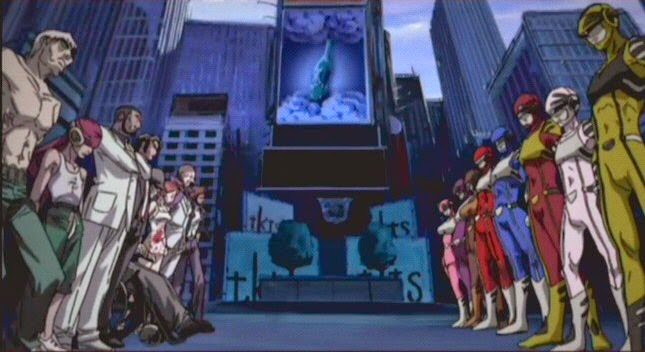
You may have gathered from my many reviews of Suda51’s games that I am a huge fan of his work. Much as I love No More Heroes and its sequel, I was acutely aware of the fact that most Suda51 fans held Killer7 to just as high a caliber. I recall seeing promo content for Killer7 before it ever released on the Gamecube via Nintendo Power and various websites, but never had the chance to play it in proper until recently. Whereas No More Heroes is an unapologetic satire on the action game genre as well as the video game industry at large, Killer7 combines horror and action elements in an on-rails shooter that involves clever puzzles, requires quick thinking and fast reflexes, and boasts a curious brand of dark psychedelic flair.

The Smith Syndicate, otherwise known as the Killer7, is made up of – you guessed it – seven core members. Garcian Smith is liason between the six assassins and their master, Harman Smith. In the event that one of the six assassins – Kevin, Dan, Kaede, Mask, Con, or Coyote – is killed during a mission, Garcian can retrieve their remains and bring them back to life. The catch, however is that Garcian must retread their steps into enemy-filled territory. Thus is the big gamble with retrieving a dead Smith – Garcian cannot be upgraded, and in the event that a mission does not require use of the Smith in question’s unique abilities, it may be wise to simply carry on with the remaining members of the syndicate.


Blood is the currency of Killer7, and is used to heal during a mission, required to utilize the unique abilities of each of the Smiths, and can be exchanged for upgrade points to boost the stats of the Smiths. Each Smith has a different skill set, ranging from Con’s speed in both mobility and firing rate, to Kaede’s long-distance scoped pistol, to Kevin’s throwing knives which negate any need to reload. However, each Smith has an offset to prevent any single one from becoming more powerful than the others. Con’s defensive capacities are practically nonexistent, and though Mask deSmith is built like a tank, the spread of his grenade launchers results in his gathering a lower-quality blood far more often than not. Kaede and Mask’s unique abilities often reveal hidden messages and passageways respectively, and are most helpful in solving puzzles. Coyote and Kevin’s abilities are most frequently used to access new areas of the map, while Con’s ability to hear specific sounds and determine the correct path off those sees the least use. Dan’s ability to charge up one Collateral Shot in order to take out enemy spawn points is used sparingly, but is practical nonetheless.

The enemies that the Killer7 face at every turn are monstrous humanoids known as Heaven’s Smiles – effectively walking time bombs with abilities that vary from one mission to the next. If a Heaven’s Smile gets too close to one of the Smiths, it will detonate and chisel away a decent portion of their health bar. Some varieties of Heaven’s Smiles are slow but capable of taking many hits, others are stationary but notably more lethal as ‘turret’ units. Some of the more dangerous Heaven’s Smiles, encountered later in the game, are designed to race toward players before they have much time to devise a countering strategy. While the game never feels cheap or frustratingly difficult, it certainly demands a unique learning curve given its style of gameplay, and a trial-and-error pattern is key to taking down some of the game’s most lethal enemies.
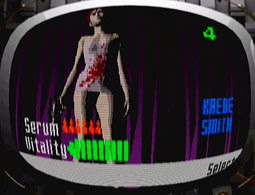

These Heaven’s Smiles are the binds that tie everything together, plot-wise. At the outset, Harman has an encounter with an old acquaintance named Kun Lan. Kun Lan has acquired the means to offer ordinary citizens the chance at becoming Heaven’s Smiles, and furthering his terrorist routine. Swept up in the rivalry of these two old men are political officials representing Japan and the U.S., as well as other radical idealists like one Ulmeyda. It’s a melting pot of cleverly-scripted characters with colorful attitudes that lean more toward the practical and realistic given the scenario at large, as opposed to No More Heroes’ more crazy and eccentric residents. Even with the M-rating slapped on the box, it should be noted that Killer7 is a thinking man’s game – not just because of the logic-based puzzles, but because of the story and setting’s emphasis on more adult themes like modern terror tactics, cultist followings, irregularities in space-time, geopolitics, and moral ambiguity.

Much like the more recent Killer is Dead, Killer7 utilizes a hyper cel-shaded art style, wherein whites are borderline-glaringly bright, and shadows are nearly pitch black. The animations and details of each character model are incredibly well-rendered, however, so it is thankfully not a case of the art style trumping the care put into bringing the Smith Syndicate to life. The soundtrack incorporates a number of industrial and techno tunes to flesh out its near-future setting, while also adding a dash of rock and classical string sounds to the mix. Some of the cutscenes opt for a modern anime approach, while the majority deliver story segments in small doses of grungy 2D digital animation.


Kiler7 will run players about fifteen hours or so on their first playthrough. Some levels are more time-consuming than others, as they may require the Smith Syndicate to retrace their steps in order to complete a puzzle that was impossible to overcome at an earlier point. Others host considerably more enemies, leading players to have their triggers ready to go at a moment’s notice. But even the first introductory level lacks a linear design. There is never a set order in which players must overcome the various challenges of each mission, rather the ultimate goal is to retrieve all the required Soul Shells rewarded from mastering puzzles and exploring the environment. The game does mark each puzzle, Soul Shell, and point of interest on the map screen, making retreading one’s steps a less tedious process, though the game will never state outright what needs to be done at each location.

However, clues can be purchased for an adequate amount of blood from the ghostly figure of Yoon-Hyoon and his luchador mask. Similarly, the bondage jumpsuit-bound individual known as Iwazaru offers tidbits on local enemy tactics in any given locale. Arguably the most interesting of these phantoms is Travis Bell, a young man who knows perhaps more about the picture at large than any of the Smiths. His knowledge of the Japan-U.S. political affairs and the associates Garcian occasionally meets with makes him a key part of unraveling the grander story.


While the seven Smiths are merely faces with separate weapon sets at the start of Killer7, they each have their time in the spotlight, and by the game’s final hours, each will have a distinct and rounded identity. Some of the Smiths are explored in greater detail through letters and key items found within missions, forcing some digging on the part of players. Others, like Dan and Mask, have fully-scripted cutscenes allotted to them. Upon completing the main game, the grueling challenge of Killer8 is unlocked, which grants players access to Harman Smith alongside the other six assassins.

Killer7 is a rare gem, unfortunately overlooked by many due to its limited exclusivity to the Gamecube and release late in the sixth console generation. Despite the fact that the game does see a couple of hiccups few and far between, there isn’t any one element that stands out as being significantly flawed. Killer7 is weird, no doubt, but that is standard of any Suda51 title. Killer7's unorthodox controls and general gameplay may seem a bit daunting at first, but by the time players complete the first mission, it should all feel very fluid and natural. Killer7 deals with some dark plot elements that are very relevant to this day and age, and the culmination of its mature storytelling, wild artistic vision, and crazy creative gameplay make it one of the best games I have experienced on Nintendo’s purple lunchbox console.

My rating: 10 (out of 10)

Saturday, December 10, 2011

25 Days of Villains - #16: GLaDOS

"In the event of a catastrophic failure, the last two minutes of my life are preserved for analysis. I was able - well, forced, really - to relive you killing me. Again and again. Forever. You know, if you had done that to someone else, they might dedicate their life to exacting... revenge."


GLaDOS is one of the most animated and emotive robotic characters in recent video games. She’s ruthless in her attempts to try and kill Chell with test chambers that include spike plates, turrets, and deadly neurotoxins. But her darkly comedic dialogue is largely what makes Portal such a unique and memorable experience. Without GLaDOS, Portal would be a really good puzzle game. Because of her, it’s a story that players can really engross themselves in.

As the events of Portal 2 reveal, GLaDOS was created as a way for Aperture Science to allow one of their most important minds, Caroline, to live on forever. Cave Johnson’s team led the project forward, despite Caroline’s concerns. While everything was going well at first, GLaDOS’ desire to recreate the Schrodinger’s Cat experiment with lethal neurotoxins resulted in the death of a number of Aperture staff members. While the team thought the installation of a morality core would be sufficient for preventing further catastrophes, scientist Doug Rattman saw another outcome – one that was much darker for everyone at Aperture. And though Rattman managed to alter the list of candidates, placing his faith in Chell, he and everyone else at Aperture died for the sake of GLaDOS’ “testing”.

Even after Chell manages to set everything straight at the end of Portal 2 and GLaDOS sets her free, she hasn’t really changed. She even tells Chell that the reason she is letting her leave Aperture is because Chell is simply too difficult to kill. Understanding herself to be Caroline reborn, GLaDOS wipes that part of her from her memory banks, then uses two robots, ATLAS and P-body, to find something hidden deep within the facility. She has her fun blowing up ATLAS and P-body along the way, but they are not human, and the effect just isn’t the same. Which is why GLaDOS is overjoyed when ATLAS and P-body finish their duties and discover a whole new area of Aperture filled to the brim with humans in stasis.

Boss theme:

Technically there is a battle theme when facing GLaDOS, but it’s nowhere near as great as “Still Alive”.

Sunday, October 23, 2011

Valve announces in-game editor for Portal 2

According to Valve, early 2012 will see an update for Portal 2 that will allow players to create their own test chambers and challenges. This applies to both single-player and co-op chambers. Players can then vote on and share their creations online. This news comes from GameTrailers, who has stated that little else is currently known about the update. There has yet to be confirmation if this new feature will apply solely to the PC version, or if it will include the console versions as well.

Friday, May 20, 2011

Xbox 360 review: Portal 2


Portal 2 picks up some years after the conclusion of the first game. No concrete time frame is given, but it's obvious that a few years have passed, as the entire facility is in disrepair. Following her initial defeat of GLaDOS and subsequent escape, Chell has been dragged back into Aperture and placed within a long-term relaxation chamber. A brief tutorial on the games controls plays out before Chell meets Wheatley, a personality core tasked with keeping track of all the human test subjects. Wheatley promises to help Chell escape Aperture, and, after acquiring the portal gun, Chell finds herself in GLaDOS' chamber once more. Wheatley - while trying to find an escape for Chell - accidentally reactivates GLaDOS, and he and Chell are separated, with the latter being sent to retrace her steps through Aperture's test chambers.

The game's introductory sequence is hauntingly surreal. While the chambers Chell traverses are familiar territory to anyone who has experienced the first Portal, the plantlife and new gameplay elements add enough flavor early on to set Portal 2 apart from its predecessor without dishing too much to players right away. New gameplay elements including lasers, repulsion and propulsion gels, aerial faith plates, and light bridges are introduced gradually as the single player mode progresses, eventually seeing a myriad of combinations late in the game. The puzzles are both more plentiful and more challenging than in the first game, but a large portion of what makes them so enjoyable is the process of solving them. Players may find it takes a few tries to successfully complete the early test chambers, while later portions of the game take more time and patience in order to complete far more complex tasks in gigantic areas. But the process of trial-and-error is far more rewarding than relying on game guides.

A few tweaks have been made with regards to how the portals apply to test chamber walls. No longer do players have to try three or four times simply to line a portal up a just the right angle of rotation. It's a small change in the grand scheme of things, but it goes a long way.

The cooperative multiplayer mode allows players to take on four different sets of chambers, each of which contains seven tests that become both progressively longer and more challenging. While there a variety of puzzles are presented, each area puts major emphasis on one of the new elements introduced in the single player game. For example, one of the areas focuses largely on the aerial faith plates, another on light bridges, and so on. The last few test chambers in each area then go on to combine all of the previous elements. While the multiplayer mode can be replayed time and time again (either online or splitscreen), veteran players will find a lack of challenge, simply because they've already completed each chamber. In the single player game, there are a number of hidden rooms riddled with artwork and messages from the Rat Man (aka as Doug Rattman for those familiar with the comic that bridges the gap between the two games). The game has quite a few easter eggs and clever achievements to unlock, but due to its linear gameplay, there isn't a ton of replay value presented in Portal 2.

The single player game is certainly more story-driven than that of its predecessor, and utilizes more adventure elements. In contrast, the cooperative mode is a more pure puzzle and platforming experience, with a story that is plenty funny but nowhere near as memorable or fleshed out as the single player story. In this regard, Portal 2 offers two games in one, both deeply rooted in the core mechanics of the first Portal. Regardless of personal preference of either mode, players will find that Portal 2 is a more complete and rounded out gaming experience - something that Valve stressed from the moment they announced the sequel. The single player experience lasts roughly seven to eight hours, while the cooperative mode adds an extra five to six hours, depending on how long it takes teammates to solve puzzles.

I absolutely loved the dark comedy that fueled the first game, with GLaDOS constantly balancing her love of testing and desire to murder Chell, quirky phrases from the turrets, messages left scribbled all over the Rat Man's hidden rooms, and of course the promise of cake. With Portal 2, there is a larger cast of characters, and though they come and go as the story progresses, the game is considerably funnier than its predecessor. This is due in no small part to the game's voice actors. Ellen McLain reprises her role as the devilish and calculating GLaDOS, while Stephen Merchant plays her polar opposite - Chell's robotic ally Wheatley, who causes a number of screw-ups, but is ultimately a breath of fresh air as the most human character in the game, as well as its most lovable character. J.K. Simmons provides insight into the early years of Aperture Science as Cave Johnson, the company's founder, a man who is expresses himself in both a blunt and colorful manner with some off-the-wall metaphors and vehement distaste towards limitations on science (physical, legal, or otherwise).

For a 2007 release, Portal looked and sounded quite nice. But this is 2011, and Valve has gone out of their way to revamp Aperture Science with overgrown plantlife and incomplete chambers among the enrichment center's familiar white and gray sterile design. Graphically, the game isn't quite as impressive as other recent releases, but the great attention to detail and more drastic lighting and shadow effects raise the bar significantly from the original Portal. Aperture feels more alive than ever, with panels adjusting as tests are completed and chambers gradually becoming more and more complete as GLaDOS restores the facility around Chell. The feel of Portal's soundtrack is retained, but expanded upon. Instead of having a few ominous tracks throughout, Portal 2 chooses the more techno-heavy route, borrowing some inspiration from the musical stylings present in Half-Life 2.

I must admit, when I first heard that Eurogamer gave Portal 2 a perfect ten score, I was a little skeptical. Sure, the first game was a huge game-changer, not only for Valve but for the puzzle and adventure genres as well. But it would certainly be a difficult act to top. After playing through both modes, I can happily say that Portal 2 is one-of-a-kind game. It still retains everything that made the first Portal great, but goes the extra mile to deliver a much more rounded out experience. Although it's still early in 2011, there's no doubt in my mind that Portal 2 stands a very good chance of earning game of the year.

My rating: 10 (out of 10)

Tuesday, May 17, 2011

Portal 2 DLC announced

Valve recently announced DLC for Portal 2. No concrete release date or details have been given as of yet. If I had to take a guess, though, based on the way the game wraps up, it would seem more likely that the DLC would be additional test chambers for the cooperative multiplayer mode, or at the very least a continuation of Atlas and P-Body's story. It could also be that Valve plans to release reworked test chambers much like those that were included in the first Portal. Whatever the case, this announcement isn't terribly surprising, considering the overwhemingly positive response Portal 2 has been getting. What is a pleasant surprise, however, is the fact that the DLC will be free of charge for download on PC, Xbox 360, and PS3.

Sunday, September 12, 2010

Portal 2 Co-op update

Another brief update, with the new trailer for Portal 2 co-op attached. It seems that Valve is going to make the cooperatvie gameplay narrative-driven, though where all this plays into the overarching story of Portal remains to be seen. I'll keep things updated with new posts and information as I receive it, but for now just enjoy the trailer.

Related Posts Plugin for WordPress, Blogger...