.
Friday, April 19, 2013
DLC review: Mass Effect 2 - Zaeed: The Price of Revenge
Zaeed Massani is a gun-for-hire who has seen his fair share of combat on many outlying alien worlds. His combat experience and driven nature has made him an ideal candidate for Cerberus’ fight against the Collectors, and so the Illusive Man has sent Commander Shepard his dossier, detailing his current location on Omega. Recruiting Zaeed is a simple matter of revisiting Omega and engaging in a brief conversation – it is his loyalty mission that proves more challenging, making up the bulk of this DLC pack.
To be frank, Zaeed is rather lackluster when compared to practically any other member of Shepard’s ragtag team. He has quite a few stories to share about his weapons and kills on hostile worlds during humanity’s early treks beyond their home system, but the writing concerning his character feels significantly less inspired than Tali’s role as daughter of a Quarian admiral, Samra’s justicar code, Legion’s emergence as a ghost in the machine, and so on. While he stays generally calm and focused on board the Normandy and during any regular mission, he suddenly adopts a ruthless lone wolf strategy when he and Shepard embark on his loyalty mission.
The mission sees Shepard, Zaeed, and whichever third character you decide to bring along for the ride dropped onto a humid jungle planet. As it turns out, Zaeed was one of the founders of the Blue Suns mercenary group, and has been chasing his former partner – who ousted him long ago – for years. Having finally tracked him to this remote world apparently sets Zaeed into a bloodlust, as he completely ignores Shepard’s insistence that they develop a strategy, opting instead to blow up the whole facility while the three party members and a number of innocent scientists are still inside. The entire mission is perhaps a bit more visually exciting than many of the sidequests in Mass Effect 2, due primarily to the fact that there are all sorts of explosions being set off around Shepard and Zaeed as they fight their way out of the facility. Aside from the option to shoot a few cases from the ceiling and have them fall on foes for quick kills, combat is pretty straightforward – fight your way from one end of the room to the other, then repeat.
Shepard has to act as a babysitter to Zaeed’s immaturity, insisting that they clean up the mess Zaeed made and help get the scientists to safety (if you are playing the Paragon route), while Zaeed is so concerned with exacting his long-delayed revenge that he threatens to harm the Commander if the Blue Suns get away. In terms of gameplay, there isn’t anything new, though it isn’t apparent that this DLC desperately needs something wildly innovative in that department. What it really could have benefitted from, however, is better writing and a more consistent presentation of Zaeed.
My rating: 5.5 (out of 10)*
*(rating applies solely to downloadable content, not its inclusion with the content on the original game disc or other downloadable content)
Thursday, April 18, 2013
Xbox 360 review: Mass Effect 2
Following the events of the first Mass Effect, Commander Shepard and the crew of the Normandy are sent to investigate a string of recent disappearances on human colony worlds. Their intel states that whole settlements have simply been left abandoned with no sign of what happened, while many ships in nearby space have similarly gone silent. While their search initially turns up nothing, Shepard and company soon find themselves under fire from a giant unidentified vessel. With the Normandy quickly being torn to shreds, Shepard instructs the surviving crew members – including his/her love interest and pilot Joker – to abandon ship. Unfortunately, Shepard is trapped in the debris and finds himself/herself pulled into the gravitational pull of a nearby planet, as the N7 suit begins leaking oxygen.
Two years later, Shepard awakes in a medical facility controlled by Cerberus, an organization concerned first and foremost with humanity’s role in the galaxy. While Shepard is not the biggest fan of Cerberus, being familiar with some of the questionable actions they have carried out in the past, he/she realizes their research and work is the reason he/she is still alive and is thus willing to cooperate with them to a certain degree. After an assault on the medical facility forces Shepard and his/her two new Cerberus comrades Jacob and Miranda to fight their way off-station, he/she is finally able to meet the man responsible for investing so much time and money into reviving Shepard – the appropriately named Illusive Man. Shepard comes to realize that the Illusive Man is just as concerned with the strange disappearances on human colonies, even if the two do not share similar ideologies. Shepard also learns that the Illusive Man is willing to provide him/her with a crew and a brand new Normandy built to the most advanced specifications. Reunited with Joker, Shepard sets off on a bold mission to assemble a team of humans and aliens, each with unique abilities and backstories, in order to find out just what has been going on during the past two years.
Those new to the series can start from square one, creating a custom Commander Shepard or using one of the default characters. However, those continuing the adventure from the original Mass Effect can import their save data, which will influence the way certain subplots play out as well as the manner in which some NPCs react to Commander Shepard. As Commander Shepard has been rebuilt by Cerberus, Mass Effect 2 grants you the freedom to alter his/her appearance and character class. In effect, if you played the first game as an Infiltrator but want to try your hand at being a biotic in the sequel, there is no restriction against this. Also, importing a save game will reward you with a few resources and an early boost in experience points.
Oddly enough, Mass Effect 2 removes many of the elements that the original Mass Effect carried over from its spiritual predecessor, Star Wars: Knights of the Old Republic. While Mass Effect played as a combination of real-time RPG and third-person shooter, Mass Effect 2 leans significantly more toward the latter. That said, combat is more fast-paced and streamlined, and though players are expected to select a character class at the outset of their journey, they are also granted some greater freedoms with abilities like incinerate, disruptor and cryo ammo, and a few new biotic abilities. As a result, taking a more run-and-gun approach in Mass Effect 2 does not immediately bar you from the use of a biotic ability. Conversely, some of the new abilities are better attuned to a couple of specific character classes, and the likes of the tactical cloak may prove significantly more useful for an infiltrator than any biotic class.
Party members are gathered at a more gradual rate than in the first Mass Effect. However, the order in which you acquire them is not exactly set in stone. Granted, there are a few characters that you will not be able to bring aboard the Normandy until the majority of the rest have been rounded up, but if you wish to add Jack to your party immediately so that you have access to a biotic powerhouse or reunite with Garrus to get an advantage in ranged combat, you can seek out these characters almost immediately after speaking with the Illusive Man. Though the Illusive Man provides his reasons as to why each party member is valuable to Shepard’s mission in a series of dossiers, you may find that there are certain characters you hardly ever bring along on missions, simply due to the large pool of options available.
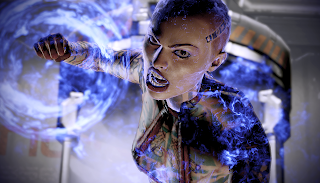
Assuming you’ve gathered every possible party member by the end of the game, you should have access to approximately two of each class – Jack and Samara are both biotics, Tali and Legion are both tech experts, Thane and Garrus are both ranged soldiers, and so on. However, there are certain weapon loadouts and abilities that one may have that the other does not. If you find yourself concerned with these specifics in combat or you like to double-dip by using characters that fall in between two character classes, these discrepancies can prove a rather valuable asset. Still, the way a character is going to handle in battle in determined first and foremost by his/her primary class and the health, shielding, and available weapon loadouts that are associated with that.
A few familiar faces show up over the course of Mass Effect 2. Depending on which squadmate was spared on Virmire in Mass Effect, Ashley or Kaidan will have a very brief exchange with Shepard during one of the game’s key missions. Meanwhile, Liara has found a new calling as an information broker and can grant Shepard access to a sidequest or two on Illium, while Wrex (assuming he too survived the events on Virmire) will be the new clan leader on the Krogan homeworld of Tuchanka. Joker and Doctor Chakwas return to duty aboard the Normandy, but Tali and Garrus are the only characters who return as permanent party members in Mass Effect 2.
Whereas the first Mass Effect provided rather limited romantic pursuits for Shepard (two options per gender), the sequel offers greater flexibility and more specific tastes, from tattooed and foul-mouthed prisoner Jack to Normandy Yeoman Kelly Chambers (for male Shepard) and calm and collected assassin Thane to old pal Garrus (for female Shepard). The process of interacting with these romantic interests is much more lengthy than the last time around, but is subsequently more rewarding, as they see greater character development and offer up otherwise unshared information through dialogue. While the first title merely forced an option upon players who chose to pursue multiple interests and then effectively left things on more or less good terms between Shepard and the individual he/she did not choose, juggling relationships in Mass Effect 2 can render more noticeable consequences. Should a character be turned down in favor of another, he/she may feel spurned and thus limit their interactions with Shepard for the remainder of the game.
Aside from acquiring party members, the most exciting and well-planned missions in the game are the loyalty missions, which roughly double the amount of playtime for the main storyline. These are in no way necessary to complete the game, but are highly recommended for those who wish to keep the morale of their allies up and the casualty rate down. These missions allow Shepard to get to know his team better, and the decisions presented therein can leave significant impacts on Shepard’s Paragon and Renegade ratings. Completing loyalty missions allows Shepard’s team to better prepare themselves for the ultimate end-game test, known as the Suicide Mission.
From the outset, it is clear that Mass Effect 2 has a significantly higher production value than the first title. Characters are even more lifelike than before, environments are host to greater detail and variation, and there are a notably larger number of in-game choices that will factor into the game’s final outcome. The soundtrack is far more memorable than that of the first game, with many variations on a few major themes that will stick with you long after the game ends. Though the soundtrack may not rank as the greatest of its day, it carries a certain charm akin to the tunes of Star Wars. Meanwhile, the more upbeat tunes associated with the clubs and bars of Omega and The Citadel are repetitive in an infectiously catchy way.
The Citadel has been reworked in an attempt to cut out some of the fat from the first Mass Effect. All the stores and sidequest locations are confined to a few levels stacked vertically, and Shepard can fast-travel from one to the next, though taking the stairs doesn’t require a significant amount of time or effort. On the one hand, there is little-to-no chance that you will find yourself lost – at least not after your first couple of visits. However, it also removes much of the exploration element, as Shepard can no longer stumble upon conversations or items/people of interest. Most of Shepard’s necessary purchases on the Citadel can be made during his/her first visit, which further nullifies the point to repeat visits outside of those that are a key part of a loyalty mission. The Citadel is still bustling and lively, as vehicles fly by in the distance and both advertisements and news broadcasts adjust to your in-game actions. In fact, this approach of streamlining the Citadel is carried over to both Omega and Illium, the two other hub worlds of Mass Effect 2, in an attempt to mask the condensing of these otherwise lively and interesting planets.
Instead of scanning worlds with the push of a button to recover artifacts and historical info, Mass Effect 2 allows the Normandy to scan for four specific elements. Gathering these is key for upgrading weapons and armor, as well as making improvements to the ship’s hull and internal systems. Occasionally, scanning a planet will result in EDI, the Normandy’s new AI, informing Shepard of an anomaly on the planet’s surface, which will open up a sidequest and allow Shepard to land on the planet. These sidequests include straightforward combat against some of the galaxy’s more notorious armed organizations such as the Eclipse troops or the Blue Suns, and exploration missions where Shepard will pick up a transmission from a downed ship and then seek out any survivors or data from the crash site. BioWare has taken notable strides in making these outlying worlds unique and interesting to look at, as they have done away with the process of recycling bases and locales that frequented the uncharted worlds of the original Mass Effect. Any and all frustrations with handling the Mako are in the past, as every world is explored on-foot. However, few of the sidequests are particularly lengthy and as a result are only marginally more memorable than their counterparts in the first game.
While the first game dropped hints of how alien cultures operated at large through bits of dialogue and entries in Shepard’s codex, Mass Effect 2 provides a more up-close look at the lifestyles and practices of the familiar Asari, Turians, Salarians, Krogans, and Quarians, while also throwing a few new species like the Drell and Vorcha into the mix. Speaking with an Asari security officer vs. speaking with an Asari bartender allows Shepard and players to see just how diverse the members of a single race can be, and prevents them from fitting to cookie-cutter standards, since the first game held greater limitations on players’ impressions of the species of the Citadel. While the new aliens are interesting to learn about, the major species from the first game still hold the greatest political sway in the Milky Way, and are thus the most frequent faces Shepard will encounter during his many missions.
While not every change Mass Effect 2 implements is for the better, the vast majority of them are. The dialogue is better written, the galaxy is more expansive and exciting to explore, the missions have seen a greater deal of care and effort put into their design – there is a significant amount of simply better content in Mass Effect 2, which is impressive, as the original Mass Effect was not a weak first outing by any stretch of the imagination. There are a few drawbacks like the inability to retain the vast majority of party members from the first game and some borderline-agonizing load times, but as a whole, Mass Effect 2 is an exciting and thoroughly engaging sequel that earns its place among the modern space epics of our time.
My rating: 9 (out of 10)
Sunday, March 31, 2013
DLC review: Mass Effect - Bring Down the Sky
A ruthless group of Batarians have strapped rocket engines to an asteroid and have redirected its course, intent on wiping out a human colony and making a statement to the Citadel Council about the Batarian's role in the galaxy. But the Batarians didn't count on Commander Shepard and company intervening. Perhaps the most well-rounded sidequest mission in Mass Effect, the Bring Down the Sky DLC is short, sweet, and to-the-point.
Shepard's team will traverse the surface of the asteroid in the Mako, stopping at each engine control station to take out the rogue Batarian troops and stop the propulsion. There are a few dialogue option sequences, wherein Shepard can convince one of the Batarian squad leaders to leave without a fight and initiate a secondary quest search for the remaining scientists stationed on the asteroid prior to the Batarian takeover. Most of this DLC requires a traditional combat approach, though one portion requires Shepard to carefully navigate through a mine field on foot.
The experience isn't substantial enough to make it as memorable as any of the main story missions, but it's still enjoyable for what it's worth. The dialogue between Shepard, the science team, and the Batarian leader is well-scripted, considering the mission takes less than an hour to complete, and it's nice to see BioWare expanding their universe just a bit more through the inclusion of this new alien race. If you find yourself bored with the limited exploration on the default uncharted worlds of the main game, this more linear DLC may prove a satisfying (if not brief) distraction.
My rating: 7 (out of 10)*
*(rating applies solely to downloadable content, not its inclusion with the content on the original game disc or other downloadable content)
Shepard's team will traverse the surface of the asteroid in the Mako, stopping at each engine control station to take out the rogue Batarian troops and stop the propulsion. There are a few dialogue option sequences, wherein Shepard can convince one of the Batarian squad leaders to leave without a fight and initiate a secondary quest search for the remaining scientists stationed on the asteroid prior to the Batarian takeover. Most of this DLC requires a traditional combat approach, though one portion requires Shepard to carefully navigate through a mine field on foot.
The experience isn't substantial enough to make it as memorable as any of the main story missions, but it's still enjoyable for what it's worth. The dialogue between Shepard, the science team, and the Batarian leader is well-scripted, considering the mission takes less than an hour to complete, and it's nice to see BioWare expanding their universe just a bit more through the inclusion of this new alien race. If you find yourself bored with the limited exploration on the default uncharted worlds of the main game, this more linear DLC may prove a satisfying (if not brief) distraction.
My rating: 7 (out of 10)*
*(rating applies solely to downloadable content, not its inclusion with the content on the original game disc or other downloadable content)
Saturday, March 23, 2013
Xbox 360 review: Mass Effect
Mass Effect is effectively the natural evolution of Bioware's former bestselling and critically-acclaimed Star Wars title, Knights of the Old Republic. The core of Mass Effect's gameplay should feel familiar to KotOR veterans, but this is more than a simple rehash. Indeed, the Mass Effect galaxy is filled with many species of aliens, and the purpose of the Citadel echoes the likes of KotOR's hubworld Taris, but what may initially seem a love letter to KotOR fans becomes a brand new science fiction epic set in its own wonderfully-realized universe.
Humanity is one of many species that now operates as part of the Citadel, a giant artificial station believed to have been constructed by the long-extinct but hyper-advanced race known as the Protheans. With a recent push for further human representation in the Citadel Council, Commander Shepard has been tasked with seeking out an artifact on the planet Eden Prime, with a Council representative looking to observe and evaluate Shepard as a potential candidate for the Spectres - a group of independent and powerful agents that can operate above and beyond normal police or military restrictions. As Shepard and company quickly discover, Eden Prime has come under attack by the synthetic armies of the Geth, who have not traveled beyond their own system in two centuries. Leading the Geth's charge is Saren, a rogue Turian Spectre who believes humans are too great of a threat to the galaxy. After locating the artifact, Shepard has a vision of impending destruction, and the race is on to discover what Saren's ultimate plan is.
Building your character from a few different classes and backstories determines how the game will play out for you. Whether Commander Shepard was born into a military family or grew up on a colonial world doesn't limit the ultimate outcome of his/her story, but it does hold slight influence over the manner in which NPCs approach and converse with the protagonist early on. Of greater influence is personal play style. Aside from the traditional gun-toting soldier, there are Biotics and a tech-oriented class geared more toward a support role. Biotic characters act similar to force-adepts from Star Wars, as they can erect barriers, temporarily freeze enemies, and even fling objects/people short distances through the air. Three combination classes exist, each that balances two of the aforementioned classes, providing greater adaptability on the go while also limiting the weapons and special training available to Commander Shepard.
Shepard's decisions in handling major plot points, sidequests, and even minor dialogue sections will influence how NPCs perceive the lead character. Decisions perceived as 'good' will build Shepard's Paragon meter and will make him/her more well-liked by the various species of the Citadel. Conversely, decisions perceived as 'bad' will give Shepard Renegade points and a reputation as ruthless and violent. As such, inhabitants of the Citadel will be more inclined to view him/her as a dangerous and aggressive human who is more interested in advancing humanity's influence over the galaxy than working cooperatively with races like the Turians, Salarians, Asari, and so on. While the Paragon/Renegade meters are similar to the Force Alignment meter from KotOR, it is possible to build both meters simultaneously, and the two need not compete to balance with one another.
Shepard's alien comrades are arguably more interesting and better developed than the default human comrades. While humans Kaidan and Ashley have a history of Biotic training and an upbringing in a military family respectively, their stories don't ever seem to flesh out in as colorful or interesting a manner as the rest. Asari scientist Liara seeks to understand Prothean culture, but comes to better understand human behavior during her time aboard the Normandy. She is a powerful Biotic, and though her ability in wielding weapons is severely limited, she can wreak havoc on enemies with abilities like Throw and Warp. Wrex is a 'shoot first, ask questions later' kind of guy, and his hulking Krogan figure allows him to act as a tank character. Garrus is more of a typical soldier, able to wield assault rifles and snipers, and his past history with the Citadel police force known as C-Sec provides Shepard with plenty of useful info regarding the behavior of different species and organizations. Tali is a tech expert, but can still be trained to handle pistols and shotguns well, making her something of a middle ground between a support character and a close-quarters combatant. On her pilgrimage from the Quarian artificial homeworld known as the Flotilla, Tali is as eager to learn about the greater galaxy as she is to provide Shepard with info on the Geth and show the rest of the crew what she knows about ship tech. Each character's dialogue is intelligently written, and adds an extra degree of complexity and believability to their presentation, from Wrex's grudge against the Citadel's decision to unleash a genophage that limited the Krogan population, to Garrus' dissatisfaction with the limitations he faced as C-Sec, to Normandy pilot Joker's pride in his ability to handle the fastest ship in the galaxy despite his brittle bone disease.
The story is focused primarily on stopping Saren and the Geth, but conversations and lore make the world seem much larger. Even though Shepard is unable to visit the homeworlds of the Asari or the Quarians, their cultures still pop up as points of discussion frequently enough to offer a concrete idea of how non-human races operate both on their own and as part of the Citadel collective. Most sectors of the galaxy are host to multiple systems, and each system is host to one planet that Shepard and company can land on and explore. Others can be scanned for resources or lore. Sometimes Shepard will merely discover further resources or Prothean artifacts, other times he/she will have an encounter with another group, whether they are mercenaries, biotic cultists, or the insectoid Rachni. While scans will provide Shepard with a glimpse at events in the Milky Way, asking the game's many characters about their own history or knowledge of how different groups operate will paint the larger picture bit by bit, and all this can be referenced later on through Shepard's codex via the pause menu.
A handful of major missions makes up the core of the game, each of which is more fully realized though far more linear than Shepard's excursions to uncharted worlds, and some include major decisions which will alter the way that the remainder of your playthrough of Mass Effect (as well as events in the sequel games) pans out. The majority of sidequests are accessible through the Citadel, though the layouts of some bases are recycled in more combat-heavy sidequests. The game utilizes a simple but solid cover system, requiring players to simple press into a pillar or crouch behind a short wall to be able to fire over it, then retract to better cover themselves once more. However, improving shield power and physical endurance as your party levels up can make open firefights a more viable option.
The enemy AI is quite intelligent, whether they divide their forces between holding covered positions and pushing forth toward Shepard's crew in confined areas, or spread out to try and flank the Mako at one of their outposts. Party members can be directed to charge foes, take cover, or fall back to Shepard's side, though they will occasionally block the immediate field of vision by standing in front of said hero/heroine. While the majority of combat will be spent taking down Geth, their designs are nicely varied. The standard body sizes include soldiers, snipers, and shock troopers, while small agile Geth attempt to overwhelm Shepard's team with speed, agility, and little in the way of defensive measures. Larger Geth range from tall and bulky bipedal designs to giant quadrupedal units that behave more or less as mobile turrets, the latter of which usually seek to stop any advances Shepard's team attempts to make in the Mako through Geth-controlled territory.
If there is one element that falls significantly short of the quality players should come to expect from the rest of the game, it is how the Mako controls. The Mako is dropped from the Normandy nearly each and every time Shepard's team visits a new planet, and is used to traverse tough terrain. However, it bounces all over the place and turns in a manner that feels very unnatural. After a few excursions, it may seem slightly less annoying, but it never handles as smoothly as the likes of the Warthog from the Halo series.
Weapon upgrades are rather basic, and provide firearms with better stability, slower rate of overheating, etc. The same goes for the defensive upgrades that can be attributed to armor and the tech upgrades exclusive to Biotic characters. Reverting unwanted items to Omni-gel is somewhat useful early on, but becomes borderline-pointless once Shepard is leveled up a decent amount. To that end, it feels like Bioware could have made the process of breaking down weapons and items more complex - i.e. salvaging them for specific part upgrades. Override sequences are essentially Simon-style fast-paced button prompts, and quickly become second nature.
The game's soundtrack is not particularly outstanding, but as a whole, it is quite evenly divided between tracks that match the element of exploration and tracks that perpetuate a sense of adventure and action. As Mass Effect is an older Xbox 360 title, graphics have a tendency to 'bump-in' at times, usually when a cutscene is prompted. That said, the game looks gorgeous for the day of its release - the Citadel is pristine and brightly-lit while character models are full of emotion.
My rating: 8.25 (out of 10)
Sunday, February 17, 2013
Xbox 360 review: Lollipop Chainsaw
Following the formula of No More Heroes, Grasshopper Manufacture's Lollipop Chainsaw is equal parts violent hack-and-slash and comedic romp through the zombie-infested city of San Romero. Juliet Starling arrives at school on her eighteenth birthday to discover that an emo student named Swan has unleashed the armies of the undead. Juliet - born into a family of zombie hunters - fights her way through the sea of zombies until she finds her boyfriend Nick, who - attempting to protect Juliet - becomes infected himself. Very much in love with Nick, Juliet performs a magical spell that allows her to remove Nick's head and keep him alive, while his body cannot be saved. Chainsaw in-hand and Nick's decapitated head hanging from her belt, Juliet vows to undo Swan's work.
Juliet avoids typical blonde ditz clichés due to the fact that she is a Zombie Hunter and has a game plan in mind with each new peril she faces. Some of her behavior does come across as silly, but that is primarily a result of her innocent nature combined with her bloody line of work. These two opposing forces allow her to become a truly memorable protagonist, and quite a likeable one at that. Nick is a source of great humor as well, considering he is more or less along for the ride, and is well aware that he is by far the most normal and sane member fighting the undead - the rest of whom are all members of Juliet's family. He constantly quips about his lack of a body, but also acts as eyes in Juliet's blind spots, rooting her on as she dishes pain to the zombie masses.
The games' jokes and one-liners bounce back and forth between stupid and uninspired to rather clever set-ups. Some NPCs swear simply for the sake of reminding players that Lollipop Chainsaw is an M-rated game, while the majority of Juliet and Nick's conversations are as cutesy as they are awkward and entertaining. Each of the boss characters represents a different genre of music, with most bearing a resemblance to a specific famous musician. These character designs, as well as much of the dialogue, are far less subtle parodies than what Grasshopper Manufacture presented in No More Heroes. While Lollipop Chainsaw may not win any awards as a comedic work, the B-movie atmosphere is consistent and the game does not take itself too seriously, despite the writers seeming to think it is more cleverly-scripted at times than it actually is.
While the earliest levels take place in bubbly cheerleader/zombie hunter protagonist's high school, later stages explore the greater area surrounding the school. Most stages incorporate some sort of minigame element, though the core of the gameplay lies in pom-pom hits, chainsaw swings, and the resulting combos you can chain together. Certain attacks will be unlocked as part of the game's natural progression, but most will be unlocked through the in-game store by spending medals earned from zombie hunting. This allows for a significant degree of freedom, as players can effectively unlock new combos at their leisure, making each person's individual playthrough unique. The gameplay may not be as fluid or exciting as the likes of No More Heroes, but it certainly holds its own in following a similar formula to the combat system in games like Devil May Cry.
Nick's head can occasionally be attached to an empty zombie body to open new pathways for Juliet. Using these will prompt a sort of quick-time event that requires players to press specific buttons one after another. It's rather dull, and each of these Nick-on-a-headless-zombie sections must be completed to progress through the entirely-linear game. On the other hand, Juliet can collect Nick Tickets throughout the game which can be spent on a few different attacks that utilize Nick's head, from firing him out of a popper cannon, to spinning him around on a ribbon. These will cause a fair amount of damage to foes and some even grant Juliet temporary damage resistance, acting as an alternative to her other powerful attack that results from chaining enough kills and filling the chainsaw gauge. Once the chainsaw gauge is filled, Juliet can temporarily power up her swings and slashes, making them rainbow colored and briefly granting her invincibility. Decapitating three or more zombies at once rewards Juliet with a large sum of medals, and this is made much easier in her powered-up state.
While the fighting is largely repetitive, the game mixes the experience up by placing environmental barriers that Juliet must cut down, encouraging players to race across rooftops with the chainsaw dash ability, and placing Juliet within classic arcade games like Pong and Pac-Man. Each boss fight has multiple phases and distinguishes itself from the others very well. One element the whole experience seems to lack is something to properly connect the different stages. The story does well enough to explain why Juliet and Nick land on a farm and need to scale a skyscraper-sized arcade, but each level feels like it could have been expanded upon. The game only lasts around six hours, and while it does encourage multiple playthroughs for completionists, there seem to be a lot of missed opportunities on the part of the development team. The game also lacks much of a challenge factor. For fans of typical action hack-and-slash games, the normal difficulty setting will be a walk in the park, and even rookies of the genre will likely find the challenge at least a little underwhelming. Meanwhile, the harder difficulty settings do little more than restrict your stock of health-rejuvenating lollipops.
Graphically, the game looks okay - nothing more, nothing less. There is a subtle cel-shaded look that layers everything, adding to the comic book style the game tends to lean toward in its overall artistic presentation. While character models are well-animated, textures and character models themselves do not look particularly good when compared to many other games of this generation - due in large part to the aging of the Unreal Engine - and the game's brightly-colored environments do little to mask this visual shortcoming. On the other hand, the soundtrack is a standout part of the game's presentation. The original score is upbeat and action-oriented, while licensed tracks like Toni Basil's "Mickey", Dead or Alive's "You Spin Me Round (Like a Record)", and Skrillex's "Rock n' Roll (Will Take You to the Mountain)" are plain fun to listen to and add an extra level of pep and silliness to the cheerleader-driven narrative. Though few and far between, there are a handful of moments where the audio mixing becomes very unbalanced, and it is difficult to hear scripted dialogue over environmental noises.
There are ranking modes and plenty of unlockable costumes, but the core of the experience lies in playing through the story. A single playthrough of Lollipop Chainsaw will only last a few hours, which may be a deal breaker for some, especially when stacked up against its contemporaries. Fans of Grasshopper Manufacture and Suda51's previous work will no doubt feel at home, though they may not be laughing quite as hard nor as often as usual. Lollipop Chainsaw is fun, fast-paced, and the individual levels are well-developed. Unfortunately, the game lacks significant extra substance to land it a spot comparable to other games of its kind.
My rating: 7 (out of 10)
Monday, February 11, 2013
Wii Virtual Console review: Super Metroid
While I am a big fan of Nintendo’s Metroid franchise, I have more experience with the 3D Prime titles than most of the traditional side-scrolling adventure releases. I played through both the original Metroid and its remake, Metroid: Zero Mission – two games which I quite enjoyed. However, I know many gamers who swear by Super Metroid as not only one of the best games in the series, but one of the best games of the SNES-era. Eager to check it out, I downloaded Super Metroid from my Wii’s Virtual Console library.
Fans of the original Metroid or Zero Mission should feel right at home – Super Metroid sees Samus return to planet Zebes in search of the baby Metroid that followed her home at the end of Metroid II. Ridley and the Space Pirates have captured the baby Metroid, and all-too-familiar with their track record for nefarious behavior, Samus pursues, intent on retrieving the specimen. Samus will retrace her steps through Crateria, Brinstar, Norfair, and so on, while also visiting new and expanded areas. The game does a great job of balancing a fresh and familiar feel, as each major area looks incredibly colorful and detailed. Lighting effects and objects such as pillars and stalactites go a long way in creating an illusion of depth and openness to the regions Samus visits. Meanwhile, the soundtrack walks a fine line between adventurous and eerie, perfectly fitting to one of Samus’ most dangerous missions.
The controls are far more fluid and responsive than in the two titles that preceded Super Metroid. Items and upgrades are placed at more intelligent junctures, and it certainly feels like the game does its best to direct you toward each objective, so there will be little time spent wandering aimlessly. Multiple elevators per region makes finding an entrance or exit to another region much easier, though the fact that you are only able to view the map one region at a time (depending on your current location) is mildly annoying. That said, Super Metroid holds a decent challenge factor, and seeking out at least a few non-essential energy tanks and weapon upgrades is recommended due to the gradually-increasing difficulty factor.
If there is one thing that drags Super Metroid down, it is the inability to exit certain areas. This really only becomes a problem late in the game, but always occurs immediately prior to a boss fight, and should you have fewer energy tanks or missiles at your disposal than you would like, the degree of frustration it causes can range anywhere from a mild annoyance to thoroughly aggravating. While this sort of thing only occurs a few times during the course of the game, the points where Samus is temporarily stuck are unfortunate, and the problem seems as though it lies largely with a simple oversight on the part of the development team.
There are quite a few boss fights in Super Metroid, each with its own unique strategy. Some encourage use of specific weapons, while most follow the traditional pattern of dodging swipes and firing missiles. Regardless of the required approach, the majority of the boss encounters are quite memorable – some not only because of the intensity of the fight but also because of scripted events prior to or during the encounter. As for the lesser enemies, they fit the typical Metroid designs – you can expect to run into Geemers and Shriekbats not long after Samus exits her ship, though later enemies are faster and practically require use of new/upgraded weapons if you hope to gain more health/ammo than you plan to lose.
While I thoroughly enjoyed Samus’ first outing, its remake, and even her trip to SR388 in Metroid II (the latter of which I am currently playing through), it is easy to see why Super Metroid is so beloved by fans of the series. It takes everything established by its two predecessors and cleans them up. The experience is far more smooth and streamlined, without sacrificing the challenge factor. Regardless if you are a longtime fan of the series or Super Metroid is your first outing with Samus Aran, it will certainly prove a memorable experience.
My rating: 9.25 (out of 10)
Monday, February 4, 2013
Anime review: Evangelion 3.0: You Can (Not) Redo
Warning: This review includes some spoiler content for anyone who has not viewed Evangelion 2.22: You Can (Not) Advance, and includes some minor spoilers regarding the plot of the beginning of Evangelion 3.0: You Can (Not) Redo. While I generally try my best to avoid including any spoiler content in my reviews, the nature of the Evangelion films makes this difficult. Evangelion 3.0 is especially tricky to review in a manner that does the film justice, due to how different a direction it travels in comparison to the previous films or the original Neon Genesis Evangelion series.
Fourteen years have passed since Shinji Ikari initiated Third Impact and Kaworu Nagisa subsequently intervened with his own Evangelion Mk 06, halting the process. Evangelion 3.0 opens with Asuka and Mari piloting their own Evas in pursuit of Shinji and Unit 01, who are in orbit above Earth and headed planetside in a cross-shaped container. After one very exciting open scene, the group descends through the atmosphere as Kaworu watches on. Shortly thereafter, Shinji awakens onboard the Wunder, the flagship of an anti-NERV organization known as Wille. After Wille engages and defeats some enemy forces, Shinji comes face-to-face with Asuka. Glad that she is alive, Shinji asks her what has happened to Rei. Asuka, who is less-than-ecstatic to see Shinji, informs him that she does not know where Ayanami is, which Misato follows up by implying that Rei is dead. Convinced that he was successful in rescuing her during the Third Impact, Shinji begs for someone to explain what exactly is going on, but his time with these familiar faces is cut short, as Evangelion Unit 00 attacks the Wunder with the goal of retrieving Shinji. Though Misato orders Shinji to remain on board the Wunder, going so far as to threaten his life, Shinji leaves with Ayanami and the forces of Wille are ordered not to pursue.
Shinji's story in Evangelion 3.0: You Can (Not) Redo is very much one of a stranger in a strange land. At times, it carries a similar tone as Evangelion 1.0: You Are (Not) Alone or even the early episodes of the original anime series, wherein Shinji was scared and confused about what all these foreign pressures being thrust upon him meant and why he was chosen to be a protector of all mankind. But in Evangelion 3.0, Shinji's confusion arises from his fourteen-year absence. The moment he returns to the world, he is caught up in a power struggle, and there is little time for anyone to explain to him just what is going on. Asuka and Misato blame him for the current state of the world, while Rei seems to have completely forgotten the dynamic of her relationship with Shinji. Gendo appears before Shinji only briefly to inform him of NERV's plan to build a new Evangelion, and thus Shinji finds Kaworu the only person he can confide in.
Evangelion 3.0 spends less time showing off spectacular battle sequences than the previous installment, in favor of character and plot development. Asuka, Shinji, and Kaworu are easily the three most prominent cast members this time around, though Rei's unfamiliarity with people and habits is of relative significance to Shinji's wrestling with his inner self. The film does well to answer some major questions left lingering from You Can (Not) Advance. A couple of subplots from the original series are revisited and reworked to fit the Rebuild of Evangelion storyline. Religious tones are more specific, with themes of penance for sins and coping with loss taking center stage. Evangelion 3.0 is a much darker film than the two that preceded it, and its second half treads a path that echoes End of Evangelion in certain respects.
When the Evas do enter combat, they look even better than during their last outing, and it is really impressive how the animation team manages to work in so much detail to every scene while keeping everything so clean and visually captivating. The design of Mari's Evangelion Unit 08, the Wunder, and even some of the updated character designs are quite adventurous. Meanwhile, the soundtrack is intense and carries a different feel from those used in the previous films. It is largely comprised of brand new songs, all of which fit the mood of the film very well, from scenes where Shinji and Kaworu are playing the piano to segments where events prior to the film are explained. And of course, the classic Eva battle themes see a few new renditions, with the occasional inclusion of a heavy electric guitar part.
Evangelion 3.0: You Can (Not) Redo zooms in on a very specific place and time in the storyline of this new film series. Whereas Evangelion 1.0 and 2.0 consolidated events most Evangelion fans were familiar with, 3.0 has to slow down and bridge gaps. While it may not answer every burning question fans have about this new film series' story, it does well to set in motion an endgame. By the film's conclusion, viewers should get a sense that there a clear goal in mind for the fourth film's plot, even if we don't know exactly how Hideaki Anno and his team intend to let it play out.
My rating: 9 (out of 10)
Subscribe to:
Posts (Atom)


