.
Showing posts with label Bioware. Show all posts
Thursday, April 16, 2015
Top 5 Party Members in the Mass Effect Trilogy
#5 - Legion: Though the Geth served as the primary enemy foot soldiers in the first Mass Effect, they were not of a terribly complicated nature. The Quarians crafted them many years ago, only to have things go horribly awry when the Geth declared themselves independent and war broke out between these mechanical creations and their organic creators. In Mass Effect 2, the hive-mind mentality of the Geth is expanded upon, and a ‘ghost in the machine’ emerges in the form of Legion, a Geth who has modeled his own form after Commander Shepard and would dare to question the behavior of his kin. Legion’s intellect borders that of his organic comrades, and Mass Effect 3 presents a particularly dangerous scenario where Shepard must side with either the Quarians or the Geth in the fight against the Reapers – though, provided his skills are sufficient, he can choose a third option that sees both sides unite in the effort to repel the Reapers’ onslaught of the galaxy.
#4 - Liara T’Soni: I did not get around to actually playing the Mass Effect trilogy until quite a few months after the third entry had been released, despite the series having been frequently recommended to me by friends. One significant benefit to this, I felt, was the ability to immediately jump into the next game, not having to wait years between releases like everyone else had. However, I was strikingly aware of the greater limitations the first title offered in gameplay, dialogue, and moral choices. I played as male Shepard my first time through the Mass Effect trilogy, and seeing as the first game only offered me two options for romantic partners, one of whom I left to die on Virmire on account of her being one of the least likeable characters in the franchise, I defaulted to Liara. Her nerdy, somewhat naïve nature was certainly preferable to the company of Ashley (or Kaidan, in the case of female Shepard), but I never felt like she came into her own until the second game, when she was pushed to a supporting cast member.
Where Liara did truly shine was during the events of the Lair of the Shadow Broker DLC for Mass Effect 2, where she shows Shepard just how much of a no-holds-barred badass she’s become in the Commander's absence. She’s broken out of her shell and then some, following a trail of digital breadcrumbs, tracing as many of the Shadow Broker’s contacts as she knows exist, helping save Shepard’s life (yet again), before making a seemingly-impossible assault upon the Shadow Broker’s carefully-hidden headquarters. By the time Mass Effect 3 rolls around, Liara has taken over the role of the Shadow Broker, keeping close watch on the web of information and trafficking of resources to aid Shepard and the crew of the Normandy. She also returns as a party member, still one of the most adept Biotics in the series.
#3 - Jack: The other great Biotic in the Mass Effect series is Jack, with her tattoo-decorated body, shaved head, and take-no-prisoners mentality. After being enlisted to help Cerberus per their bringing the Normandy’s famous commander back to life, Shepard is tasked with a number of missions to recruit highly-valuable and equally skillful individuals from across the galaxy. Recruiting Jack is a job that reeks of danger quite some time before it actually goes sour, with the crew of the redesigned Normandy SR-2 visiting a prison facility where the guards seem to be as ruthless as the prisoners they keep locked up. Before Shepard and company can reach their intended target, the warden informs them that he will be adding Shepard to the list of inmates, believing the commander’s notoriety will land him a hefty payout.
A skirmish with the guards later, and Shepard’s team makes it to the holding cell where Jack is being kept on ice. Upon awakening, she immediately enters a destructive rage, blowing holes through walls, and using her Biotic powers to blow away anyone who tries to get in her way. The trail of wreckage she leaves is plenty easy to follow, though it only adds fuel to the already chaotic fire that has erupted within the prison complex. While she is thoroughly reluctant to join a team funded by Cerberus, she proves an invaluable ally in the fight against the Collectors, using her Biotic powers for both offensive and defensive strategies during the Suicide Mission at the end of Mass Effect 2, and then going on to train a new generation of Biotics during the events of Mass Effect 3. She’s foul-mouthed, doesn’t much care what anyone thinks of her, and would much prefer to play by her own rules, but when Shepard is in a tight spot, he/she can always count on Jack to take whatever the enemy is throwing their way and toss it back in their face three-fold.
#2 - Garrus Vakarian: Garrus is one of those rare characters that proves so likeable in nearly every situation he and Shepard find themselves in. Whether scouting the seedy underbelly of Omega for shady characters, treading deep into abandoned mining facilities, or helping repel an invasion of Reaper forces, Garrus proves a trustworthy friend through thick and thin. His intimate knowledge of C-Sec formalities and Turian battle strategies makes him an invaluable asset with a rifle in his hands, but his cool personality and genuine advice led him to be equally valuable for personal support. Garrus is not without his own shortcomings, treading into some dark territory during the second game, and lacking finesse when it comes to charming the ladies. But all of these elements propelled him to become one of the most enjoyable personalities in the Mass Effect trilogy, as well as one of the most memorable characters in recent video game history, and I kept him in my company about as often as the games would allow.
#1 - Tali’Zorah vas Normandy: When Tali first joins Shepard’s crew aboard the Normandy, she is excitable, practically shoving her way past crew members to analyze the ship’s internal engineering. And while her understanding of the galaxy may be somewhat naive at the outset of her pilgrimage, she is not exactly an impressionable youth. She always has a couple of tricks up her sleeve, thanks to her long history of technical expertise. She was an enjoyable sidekick for much of my playthrough of the original Mass Effect, but when I started up the second game, I realized how much she had matured during her time away from Shepard and company. Working with the crew of the Normandy, she had found her own voice, become more cunning, and offered her fellow Quarians a unique view of the galaxy beyond their Flotilla home fleet.
Tali’s role as tech expert led her to prove an invaluable support party member throughout all three games, and alongside Garrus, served as my go-to ally for the vast majority of the story. She embraced her particular skill set while others preferred the spectacle of explosive weaponry or Biotic powers, and always looked up Commander Shepard as ally, mentor, and friend, holding a great deal of respect for him/her. She also was not afraid to voice her opinion in the event that she did not agree with Shepard or any one of the other crew members, with each concern she raised being very much valid. That is not to say that Tali shied away from some free-spirited fun, as she was always down to boogie in one of the Citadel’s many clubs, cracks some crude humor on occasion, and delivers hilarious drunken ramblings during Shepard’s house party in The Citadel DLC. While easily one of the most enjoyable characters in the first title, Tali’Zorah truly bloomed into one of my favorite RPG companion characters of all time in the sequel games, and was, for me, a no-brainer pick as Commander Shepard’s love interest.
Tuesday, April 7, 2015
Character Select: HK-47 (Star Wars: Knights of the Old Republic)
The earliest comrades to join the amnesiac protagonist’s party in Star Wars: Knights of the Old Republic fit the typical Star Wars formula – Bastila is a skilled young Jedi, Carth is slick with pistols and skeptical of certain galactic factions (though whiny and far less enjoyable company than the likes of one Han Solo), T3-M4 is a whistling astromech droid, and Zaalbar is… a Wookie. The party members that joined the adventures across the stars past the game’s halfway point struck me as having more creative personalities, overall, and offering further insight into the ever-expanding Star Wars universe. Of particular note was HK-47, an assassin droid who was positively gleeful to aim his rifle at any organic being he was instructed to.
“Translation: He requires proof of good faith. We must make a contribution to his people that shows we are not a threat. Shall I blast him now, master?”
HK-47’s behavior of constantly prefacing each statement with situation-appropriate terms including ‘query’, ‘statement’, ‘observation’, and ‘advisement’ formed an endearing trait, as well as a curious complement to his twisted comedic personality. HK-47 was devoutly loyal to his comrades, even if he did insist on referring to all of his human and alien travelling companions as ‘meatbags’. He performed well as a ranged heavy hitter, blaster rifles being his specialty. Once HK-47 was counted among the misfit crew of the Ebon Hawk, I never swapped him out of my party.
“Explanation: It’s just that… you have all these squishy parts, master. And all that water! How the constant sloshing doesn’t drive you mad, I have no idea…”
“Translation: He requires proof of good faith. We must make a contribution to his people that shows we are not a threat. Shall I blast him now, master?”
HK-47’s behavior of constantly prefacing each statement with situation-appropriate terms including ‘query’, ‘statement’, ‘observation’, and ‘advisement’ formed an endearing trait, as well as a curious complement to his twisted comedic personality. HK-47 was devoutly loyal to his comrades, even if he did insist on referring to all of his human and alien travelling companions as ‘meatbags’. He performed well as a ranged heavy hitter, blaster rifles being his specialty. Once HK-47 was counted among the misfit crew of the Ebon Hawk, I never swapped him out of my party.
“Explanation: It’s just that… you have all these squishy parts, master. And all that water! How the constant sloshing doesn’t drive you mad, I have no idea…”
Saturday, December 28, 2013
DLC review: Mass Effect 3 - Citadel
Effectively a love letter to all Mass Effect fans, Citadel is filled to the brim with wit, self-parodies, and intense action. It runs a story that is exciting, yet does not take itself too seriously, as out of the blue Shepard finds himself/herself target number one of a mercenary organization. It’s not the best way for the Commander to start his/her shore leave, and longtime friends Garrus, Tali, and Liara make a point of stating how Shepard can’t go for more than a day without getting into some crazy scenario. The main story runs about an hour and a half or more, depending on the difficulty setting, and compared to many of the other Mass Effect DLC packs, it certainly dishes out a decent challenge factor.
Beyond that, there are plenty of distractions to indulge in. From the moment Shepard is ordered to take shore leave, he/she is granted access to Admiral Anderson’s large upscale apartment. Shepard is free to purchase new furniture and décor as he/she sees fit, and can eventually throw a party for however many or few old comrades he/she chooses. Unfortunately, the game automatically assigns James, Cortez, and Traynor to the party, the latter two of whom are infinitely easier to stomach than the resident meat-head of the crew. Still, it is thoroughly entertaining to listen to Tali’s slurred and drunken ramblings, Grunt’s bizarre reaction to alcohol leading him to believe he can stop bullets with his mind, and EDI’s confronting Traynor about a past comment she made about the robot’s voice being sexy.
There is also a whole new section of the Citadel open to explore, complete with minigames and short, character-specific situations like playing wingman to Garrus as he fumbles his way through a date, or starring alongside Javik in a half-baked Blasto the Hannar sequel. The Citadel DLC has plenty of funny moments, and a few key heartfelt ones, too. It’s the best Mass Effect 3 DLC by a longshot, and arguably ranks among the best DLC packs the entire series has had to offer. Perhaps best of all is the fact that it does not feel like a portion of the game that was cut out for the sake of making another quick buck off downloadable sales, yet the sum of its parts prove surprisingly cohesive with the rest of the Mass Effect 3 experience.
My rating: 9 (out of 10)*
*(rating applies solely to downloadable content, not its inclusion with the content on the original game disc or other downloadable content)
DLC review: Mass Effect 3 - Leviathan
After witnessing the murder of a scientist on the Citadel, Shepard and company begin to follow a trail of clues that imply an indoctrination process similar to what the Reapers have proven capable of. Except, the entity the crew of the Normandy and their allies in the science field are trying to seek out is not a Reaper. Rather, it is a being known as Leviathan, one rumored to have killed a Reaper at some point in the past. Knowing the power this Leviathan might possess, Shepard enlists EDI to help locate it, a process which takes them back to scene of the initial crime, to a derelict research station, and eventually to a watery world riddled with shipwrecks.
Leviathan is straight-forward in its design. It cuts right to the chase, with Shepard’s search for Leviathan playing out in a similar manner as his/her visit to Eden Prime in the first game. There are artifacts that hold sway over those who have come into contact with them, and Leviathan is shown to be capable of channeling messages through these individuals. There is plenty of variety in the game design, from gathering clues around a small research lab, to unlocking a series of doors aboard the space station, and the typical combat against Reaper minions. All of it will be strikingly familiar to anyone who has played more than a few hours of Mass Effect 3, and it does feel like the Leviathan DLC’s pacing is a bit fast for the grand scale it intends to deliver its story on.
The writing is handled well enough, and the eventual one-on-one encounter Shepard has with Leviathan is intense and very cool in its design. The ultimate payoff, however, does not echo as strongly as other events in the Mass Effect universe. Recruiting Javik in the From Ashes DLC obviously had a lasting impact on which teammates you had at your disposal and subsequently provided a unique perspective on the Reaper conflict. But the finale of the Leviathan DLC is a quick one-off scene that simply wraps itself up without the effects leaving meaningful ripples across the galaxy.
My rating: 7 (out of 10)*
*(rating applies solely to downloadable content, not its inclusion with the content on the original game disc or other downloadable content)
Saturday, June 29, 2013
Top 10 Games of the Seventh Generation Consoles - #4: Mass Effect 2 and Mass Effect 3
While I thoroughly enjoyed the original Mass Effect, the sequels improved upon the gameplay and storytelling significantly. The first game provided a glimpse of the greater universe that you actually get to explore in the sequels, and while there are certainly elements of BioWare’s Knights of the Old Republic that inspired the Mass Effect games, the homeworlds and cultures of the Asari, Turians, Krogans, Hanar, and so on feel strikingly original.
These two games run incredibly close for me. While neither is perfect, they both have their strengths and weaknesses that ranks them at approximately equal quality in my eyes. Mass Effect 2 was more reliant on shooter mechanics, but offered a greater host of side missions and squad members. Mass Effect 3, though more focused on reaching the end of Commander Shepard’s story, brings back many traditional RPG elements absent in ME2 and offers fewer squad members that, while specialized to one role or another, are more adaptable than in the previous installment.
Above all else, what impressed me most about the two games was the weight of your decisions and how it impacted the manner in which the greater story unfolded. The original Mass Effect forced you to choose one human squadmate to live and the other was left to die, but these were characters that I frankly could not have cared less about. Sure, there was the romance subplot, but it only offered two options per gender. Mass Effect 2 rectified all of this by including loyalty missions – sidequests that would earn Shepard the trust of his squadmates. Opt not to complete a loyalty mission and there’s a good chance your pals might not survive to the end of the game. As for the romance subplot, there were significantly more choices available to both male and female Shepard, each of them arguably more interesting and involved than those offered in ME1. Mass Effect 2 required much more time and attention than the first game, but it also gave a lot more back. It was a game that allowed you to play however you wanted, and your decisions would carry over to Mass Effect 3. The characters you allowed to live would appear in Mass Effect 3, potentially offering you assistance in your fight against the Reapers, while those who died might be mentioned in dialogue, but were otherwise nowhere to be seen.
The Mass Effect sequels are phenomenal spiritual successors to the Knights of the Old Republic titles as well as the original Mass Effect. Gone are the clunky periods of exploring uncharted worlds in the Mako, gone are the repetitive landscapes and underground bases - all replaced with planets that exude a sense of adventure. While BioWare’s love for space operas like Star Wars are clearly visible in the art and story direction of Mass Effect, these games host their own lively universe - one that was equally creative and engaging. Whether Shepard is investigating a string of disappearances on human colonies, securing the last hope of curing the Krogan genophage, or helping to beat back Reaper forces from one of the moons orbiting the Turian homeworld, each quest is uniquely exciting.
Monday, April 22, 2013
DLC review: Mass Effect 3 - From Ashes
From Ashes sees Commander Shepard and company return to Eden Prime, the colony that the Geth hit first during their campaign in the original Mass Effect. Cerberus forces have apparently uncovered more Prothean artifacts, and knowing the gravity that Shepard’s contact with the first Prothean beacon had, Liara believes this new discovery could be just as important. As Liara has devoted much of her life studying the Protheans, she volunteers to go planetside with Shepard, along with whichever third party member you select. There is a bit of dialogue shared by the third party member, but the majority of the exchanges are made between Shepard and Liara due to their history with Prothean culture and technology.
Once the trio has landed, they discover that Cerberus’ discovery was not one of a Prothean artifact, but instead one of an actual living Prothean. As the Prothean is still sealed inside his stasis pod, Liara instructs Shepard that they must locate certain frequencies from nearby terminals to ensure that the pod opens properly and does not jeopardize the Prothean’s health and safety in the process. There are only a handful of Cerberus troops stationed at the excavation site, and as a result the fight to locate said terminals is not particularly difficult, nor is it the most interesting aspect of the experience. In fact, the real meat of this DLC lies in scripted cutscenes that detail the memories of the stasis-bound Prothean. Only Shepard is able to see them via the terminals, while everyone else sees static, an apparent side effect of his/her contact with the Prothean beacon in the first game.
Once the Prothean – named Javik – is revived, Shepard informs him that he is the only living Prothean in the universe, a matter which Javik already expected would be truth. Instead of spending time in shock or grieving his fallen comrades, Javik almost immediately swears his allegiance to Commander Shepard’s cause of seeking out a means to destroying the Reapers. Javik is highly skeptical of the Commander’s odds of success, and frequently informs him of how horribly the Protheans lost to the Reapers – how the Reapers divided their people, turned some of them on one another and slowly slaughtered the rest. But he also realizes that Shepard’s actions in rallying the fleets of the Citadel species places his strategy ahead of the Protheans’ own. In battle, he controls as a typical soldier class, as his default weapons are an assault rifle and a pistol. He is capable of utilizing the unique power Dark Channel, a damaging biotic attack, as well as Slam, Pull, and Lift Grenade. He also adds unique dialogue in both main missions and side missions, further relaying information on the Reapers, Protheans, and long-extinct cultures of a previous galactic cycle.
My rating: 7 (out of 10)*
*(rating applies solely to downloadable content, not its inclusion with the content on the original game disc or other downloadable content)
Sunday, April 21, 2013
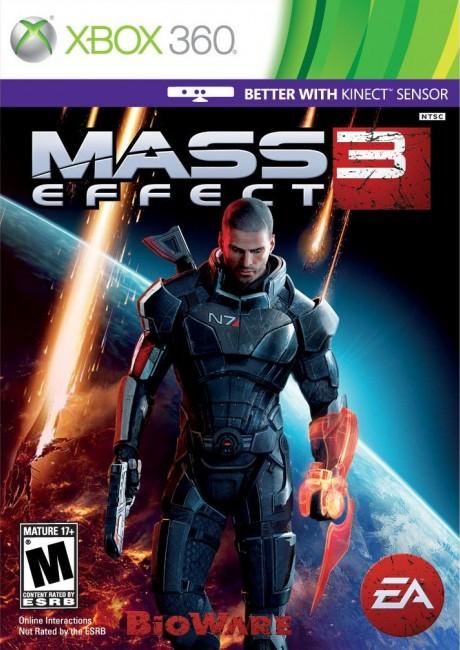
Xbox 360 review: Mass Effect 3
As the finale of Mass Effect 2 made abundantly clear, the Reapers are headed toward the Milky Way, and so the third game begins with Commander Shepard and Admiral Anderson trying desperately to appeal to Alliance Command. Despite all of Shepard’s warnings over the past three years, few among the Alliance or the Citadel Council heeded them. As a result, Earth is quickly overrun by Reaper forces intent on destroying everything in their path. Shepard and Anderson manage to fight their way to the Normandy, though Anderson opts to stay behind and help carry out the fight on Earth, instructing Shepard to rally as many allies as he/she can.
While the Reapers hit Earth hard, they also sent some of their forces to systems controlled by the Asari, Turians, Krogans, and Quarians. While most of the representatives of these alien races would be otherwise inclined to send Shepard aid, they simply cannot spare extra troops or supplies until the threats to their own planets have been removed. While this might initially sound like a repetitive and menial process of gathering allied forces, each mission will earn Shepard extra war assets to improve his/her readiness rating for the endgame strike back at the Reapers, as well as further progress on the Crucible, an ancient device that the Protheans attempted to complete during their own conflict with the Reapers, but were unable to finish before their empire crumbled. While the previous games did a very good job of making main story-related missions memorable, Mass Effect 3 does perhaps the best job of making them plain fun, with many being epic in scope.
Once again, you are able to import your Shepard profile from Mass Effect 2 into Mass Effect 3, though you cannot transfer directly from the original Mass Effect to the third game. Choices you made in the first two games as well as characters who survived and died will be reflected through dialogue and which characters appear during certain missions. And while Mass Effect 2 seemed to push for Commander Shepard to seek out a new romantic relationship by limiting his/her interactions with Ashley/Kaidan/Liara to very brief exchanges, the third game is more open in allowing you to either pursue a brand new relationship or carry on with one from the previous titles. If Mass Effect 3 is your first foray into the series, the option to start fresh is also presented, and you will be prompted to select from one of three scenarios (which are largely concerned with who in Shepard’s company died prior to the events of Mass Effect 3).
Mass Effect 3 sees the return of a number of traditional RPG elements that were absent from the second game. The game still plays like its two predecessors - a hybrid of third-person shooter and real-time RPG. But leveling up abilities offers different choices as you allot more points to Overload, Warp, Tactical Cloak, and so on. These branches will often allow a perk or longer duration specific to the ability you are levling up or a more overarching improvement to health, shields, or recharge time that may be more practical in the long run but will also provide a slightly smaller percentage of that which it rewards you with. The Paragon and Renegade meter returns and – much like before – players are not necessarily required to select one path over the other and can build both simultaneously if they so choose. That said, there are a few major decisions in Mass Effect 3 that require very high ratings of either Paragon points or Renegade points, and certain dialogue and mission outcomes will be locked unless Shepard’s meter meets this criteria. The ultimate outcome of these decisions can drastically alter the manner in which a mission and subsequently the remainder of the game plays out, and could potentially cost Shepard the loyalties of some of his/her comrades.
Your party in Mass Effect 3 is notably smaller than it was in Mass Effect 2, but it also sees the return of many familiar faces – Liara, Garrus, Tali, and either Kaidan or Ashley return (assuming they all survived the events of the previous games), while EDI steps into a combat role after transferring part of her consciousness to a robot body. The only other new party member (aside from the game’s extra DLC offerings) is James Vega, an alliance soldier who proves to be something of a meathead and behaves primarily as a run-and-gun tank character. While the pickings are somewhat slim, the payoff is that each character plays in a unique manner – Liara is the strongest biotic choice, but Kaidan balances both biotic and soldier. EDI and Tali are both tech-oriented characters, with the former playing to ranged combat and utilizing holograms and the incinerate ability, while the latter is all about close-quarters combat, relying on her shotgun and drones to take out foes. Shepard’s long-standing allies may not play in a drastically new way, but it seems that BioWare has found the perfect balance of abilities and classes to offer players without going overboard with the number of characters at your disposal.
The planets Shepard visits as part of the main storyline each offer up a handful of side missions that can alter the way the primary mission plays out, and subsequently affect the ultimate endgame. Many of these see Shepard reuniting with old friends for a short while. While traditional combat frequently makes up the core of these optional missions, they feel fresh and unique due to the inclusion of new elements like Shepard mounting a turret on the side of a transport as he/she provides cover fire for allied forces, the ability for Shepard to be uploaded into the mainframe of the Geth network, and some up-close and personal encounters with the Reapers themselves.
The majority of combat missions are spent facing down the forces of Cerberus and the mutated species collected by the Reapers. Both of these factions have a wide variety of troops at their disposal, with Cerberus forces being primarily human, save for the ocassional deployment of a stationary turret or large Atlas mech. The humans-turned-husks are the weakest of the Reaper forces, with the teleporting Asari-based Banshee, lumbering Brutes (comprised of both Krogan and Turian remains), and mobile turret Rachni known as the Ravagers giving Shepard and company a much greater challenge. Both armies will keep Shepard on his/her feet and require you to adopt new strategies on the fly. The first few missions limit the variety of forces you are pitted against, however, offering both a tutorial mission during the Reaper attack on Earth and ample time to adjust to Mass Effect 3’s combat style.
While the classic dialogue wheel makes its return, it is used primarily within missions and is largely unused when Shepard interacts with the inhabitants of the Citadel. While this may seem like laziness of BioWare’s part, it makes some sense given that this is the final game in the trilogy. Most of the exchanges Shepard has with these individuals act as wrap-up to the handful of interactions and moments of decision making he/she had with them in the past two games. Meanwhile, Shepard still has more involved subplots and conversation options relating to familiar faces from Mass Effect 2 and its respective DLC packs that don’t appear as party members – i.e. Miranda, Thane, Kasumi, etc. A few key points in the game that are meant to come across as really epic scenes end up seeing a slightly less impressive delivery due to some vague cheesy lines delivered by Shepard. True, the Reapers may have every major planet in the Milky Way on their hit list, but there is a better way to express this than having Shepard yell: "The Reapers are here!" Thankfully, the majority of the game sees writing that is consistent with the quality the previous games put forth. The earliest events of Mass Effect 3 make it clear that the game will tread into dark territory more than once, and as a result, having completed loyalty missions in Mass Effect 2 can mean the difference between life and death for some of these characters.
The Citadel itself holds greater importance in Mass Effect 3 than it did in Mass Effect 2 as the origin of a number of subplots as well as some genuinely engaging missions and cutscenes. Though the Citadel is not as large as it was in the original Mass Effect, it certainly feels open and worth exploring. In Mass Effect 3, the Citadel is divided into six major areas – the Normandy’s docking bay, the lower docks (where war refugees gather), Huerta Memorial Hospital, the Purgatory dance club, the Presidium Commons, and the Human Embassy. Each of these areas appears distinct to its own purposes, but is also in keeping with the general style and feel of the Citadel. Mass Effect 3 sees the Citadel return to its more glamorous role as a primary hubworld instead of a momentary distraction.
While there are a number of planets that are revisited, Shepard and company get to see new areas of each. Though Tuchanka and Noveria may be familiar territory, they have never looked better, and the same can be said to new planets like Sur’Kesh, homeworld of the Salarians, and Thessia, homeworld of the Asari, thanks to improved textures and lighting effects. Graphically, Mass Effect 3 does not see as significant an improvement over its prequel as Mass Effect 2 did over the first game, but it’s still a noticeable step up in quality. Seeing the homeworlds of the Citadel species firsthand is a sort of icing on the cake for anyone who read through all the Codex entries on the Asari, Turian, Krogan, and Salarian people. Meanwhile, scanning planets for resources has been done away with. Instead, the Normandy can scan whole sections of a system, and any nearby discoveries will be noted by a red ring encircling a planet or destroyed ship of interest. The fuel left over from the ship debris will immediately be siphoned for the Normandy to use, while a discovery on a planet’s surface will prompt the same scanner from Mass Effect 2, albeit with the artifact in question (or whatever other war asset lies waiting on the planet) being the singular target.
Equally as noteworthy as the game’s visual presentation is the soundtrack that accompanies the different stages of the fight against the Reapers. While Mass Effect 2’s soundtrack was host to a few key themes and held a certain intense space opera charm, Mass Effect 3’s soundtrack is easily the most complex and emotionally charged of the three games. The variety of tunes and instruments does an exceptional job at conveying the desperation of a galaxy slipping toward extinction as well as Shepard’s own internal struggle, a plot point that echoes more heavily in this game than it did in Mass Effect 2. Though Mass Effect 2 does not rely too heavily on them, the pre-rendered cutscenes are gorgeous, and are just long enough to give you a real appreciation for BioWare’s universe without dragging on for too long.
Mass Effect 3 sees the inclusion of a multiplayer mode that pits teams of four players against waves of enemies, which include the likes of Cerberus troops, the Collectors, Geth forces, and mutated Reaper creations. These waves become increasingly larger and dish out stronger foes as time progresses. Occasionally, a wave will require players to multitask and coordinate roles as they escort a drone from one side of the map to the other or hack a few data terminals. The four challenge levels range from Bronze to Platnum, with Platinum offering up the greatest difficulty setting but subsequently rewarding players with the most substantial gains. Completing missions rewards players with both experience points and in-game credits. Players can thus increase their characters’ abilities in a similar manner as in the single player campaign, and can spend the in-game credits to purchase packages that contain a random assortment of ammunition, weapons and upgrades, and even new characters. All six character classes are unlocked from the outset, though access is initially restricted to default male and female human characters. However, the experience gained as one character in a specific class (like an Adept or Vanguard) carries over to all others in that class, so unlocking an Asari, Quarian, Vorcha, or Volus character does not require you to start from level one and work your way back up. Completing missions in multiplayer also improves the Galactic Readiness Rating on the galaxy map within the single-player game, as each multiplayer mission played improves the degree of preparedness for the respective sector of the galaxy where the missions are located. This holds a slight degree of influence over the way that the last leg of Mass Effect 3’s campaign plays out, though it is not as great a factor as the other decisions Shepard has prior to that point.
Much like in Mass Effect 2, Mass Effect 3’s final hours play as a lengthy continuous mission separate from the remainder of the game. Admiral Hackett will inform Shepard of the fact that this mission is effectively the beginning of the end, and that there is no turning back once it is initiated. However, it cannot be accessed until the majority of the rest of the game has been completed, so there are (thankfully) no real nasty surprises in store for players who may have jumped the gun and proceeded to an early fight against the Collectors in Mass Effect 2.
The finale itself may not be exactly what every Mass Effect fan was expecting, but it is largely fitting. The final set of cutscenes does well to bring closure to the story that has come together over the course of five years, but may still leave a few points open-ended, depending on which of the endgame routes you select. BioWare has done a phenomenal job of picking out the best elements of the previous games and carrying them over to Mass Effect 3. Certain elements like the lack of interactive dialogue may incline some to believe that BioWare went too far in their attempts to better streamline the game, but as a whole, Mass Effect 3 is a fantastic final chapter to one of the most prominent and arguably most influential games of this console generation.
My rating: 9 (out of 10)
Saturday, April 20, 2013
DLC review: Mass Effect 2 - Lair of the Shadow Broker
After receiving some valuable intel from one of her contacts, Liara believes she may have the necessary information and resources to track down the infamous Shadow Broker. While the Shadow Broker was only briefly mentioned in the first Mass Effect, his presence is felt more directly in the sequel, as many a human and alien speaks of him and the many agents he has scattered across the galaxy. With this sudden and potentially life-changing opportunity presented before her, Liara sets out to meet with her contact.
Not long after, her apartment is attacked, and Shepard searches it for any clues that Liara might have left behind. Shepard deduces that she must have gone to meet with her contact, but the moment Shepard arrives at the building where Liara was headed, and explosion is detonated from inside. Shepard fights agents of the Shadow Broker as he/she climbs toward the top, and eventually discovers that the Shadow Broker had agents tracking Liara for some time now, having recognized her as a legitimate threat to the stability of his network. A high-speed chase through the streets of Illium and another intense shootout later, and Shepard and Liara have the necessary coordinates to finally track down the Shadow Broker, and potentially reunite Liara with a lost friend and comrade.
Lair of the Shadow Broker is without a doubt the most well-crafted DLC pack for Mass Effect 2, and serves as something of a bridge to the events of Mass Effect 3. The combat, though familiar, pits Shepard and Liara against unfavorable odds in a variety of environments from the aforementioned blown-out building to the top of a windswept floating platform to narrow industrial corridors. The need to alter your strategy as the environment demands it makes combat far more enjoyable than in most of the rest of Mass Effect 2’s sidequests and even more enjoyable than some of the main storyline missions. The effort put into this DLC pack mirrors that of the main game, and to that end it feels like a missing chapter that should have been on-disc on the game’s release date.
In the event that Shepard romanced Liara in the original Mass Effect, he/she will have the opportunity to carry it on here or call it off if they wish to seek out another romantic pursuit. Shepard can also invite Liara aboard the Normandy to reminisce about their past adventures for a brief while. This final portion of the DLC doesn’t play a huge role in the grand scheme of things, but is a nice little addition that helps Mass Effect 2 feel more like a true sequel to the first game.
My rating: 9.25 (out of 10)*
*(rating applies solely to downloadable content, not its inclusion with the content on the original game disc or other downloadable content)
Friday, April 19, 2013
DLC review: Mass Effect 2 - Kasumi: Stolen Memory
Offering up a new permanent party member for recruitment, Kasumi: Stolen Memory is one of the more noteworthy entries among the Mass Effect 2 DLC packs. While Kasumi can be immediately added to your party by paying a visit to the Citadel, her loyalty mission makes up the bulk of the DLC. It plays out in a nontraditional manner, at least when compared to the majority of the other sidequests in Mass Effect 2. One Donovan Hock is holding a fancy get-together for the rich and corrupt of the galaxy – those individuals who gain from the death and suffering of a galaxy at war – and has come into the possession of a graybox filled with information left behind by Kasumi’s now-deceased lover. However, Mr. Hock has yet to crack the code and access the information therein, and as such Kasumi wishes to retrieve it by cloaking herself and having Shepard – disguised as one of the rich and famous – infiltrate the party and unlock the security measures that stand between her and the greybox’s hiding spot.
Shepard spends most of this mission unarmed as Kasumi requires him to track down voice samples, traces of DNA, and an access code. It’s up to Shepard to pay close attention to the finer details of the party, offering a unique and substantially different gameplay experience than what the core of Mass Effect 2 provides. The DLC doesn't exactly hold your hand through the loyalty mission, and though the party setting isn't too large to find yourself lost in, you may have to do a couple laps around a room before you find the exact materials you need. Traditional combat does make its way into the mix during the latter half of the loyalty mission, and this variety combined with the excellent writing of the approximately hour-long experience makes it fresh and enjoyable.
Kasumi is distinct among the Mass Effect 2 party members due to her focus on quick close-quarters strikes. She relies heavily on her ability to cloak herself, allowing her to literally walk right up to a foe and take them out before ducking back to Shepard’s side, waiting for her ability to recharge, and then repeating the process. She takes up residence in the lounge area of the Normandy, opposite Samara’s quarters. As with Zaeed, she does not offer the traditional interactive dialogue wheel, though she still has a number of stories to share relating to the stolen paintings and sculptures decorating the room. She will also drop a few humorous quips and will express her support of Shepard’s choice to pursue one of the other squad members as his/her romantic interest. While it isn’t a particularly lengthy addition to the story of Mass Effect 2, Stolen Memory presents a thoroughly enjoyable loyalty mission and unique character that make it well worth the relatively short time and decently-challenging effort it takes to complete.
My rating: 7.75 (out of 10)*
*(rating applies solely to downloadable content, not its inclusion with the content on the original game disc or other downloadable content)
DLC review: Mass Effect 2 - Zaeed: The Price of Revenge
Zaeed Massani is a gun-for-hire who has seen his fair share of combat on many outlying alien worlds. His combat experience and driven nature has made him an ideal candidate for Cerberus’ fight against the Collectors, and so the Illusive Man has sent Commander Shepard his dossier, detailing his current location on Omega. Recruiting Zaeed is a simple matter of revisiting Omega and engaging in a brief conversation – it is his loyalty mission that proves more challenging, making up the bulk of this DLC pack.
To be frank, Zaeed is rather lackluster when compared to practically any other member of Shepard’s ragtag team. He has quite a few stories to share about his weapons and kills on hostile worlds during humanity’s early treks beyond their home system, but the writing concerning his character feels significantly less inspired than Tali’s role as daughter of a Quarian admiral, Samra’s justicar code, Legion’s emergence as a ghost in the machine, and so on. While he stays generally calm and focused on board the Normandy and during any regular mission, he suddenly adopts a ruthless lone wolf strategy when he and Shepard embark on his loyalty mission.
The mission sees Shepard, Zaeed, and whichever third character you decide to bring along for the ride dropped onto a humid jungle planet. As it turns out, Zaeed was one of the founders of the Blue Suns mercenary group, and has been chasing his former partner – who ousted him long ago – for years. Having finally tracked him to this remote world apparently sets Zaeed into a bloodlust, as he completely ignores Shepard’s insistence that they develop a strategy, opting instead to blow up the whole facility while the three party members and a number of innocent scientists are still inside. The entire mission is perhaps a bit more visually exciting than many of the sidequests in Mass Effect 2, due primarily to the fact that there are all sorts of explosions being set off around Shepard and Zaeed as they fight their way out of the facility. Aside from the option to shoot a few cases from the ceiling and have them fall on foes for quick kills, combat is pretty straightforward – fight your way from one end of the room to the other, then repeat.
Shepard has to act as a babysitter to Zaeed’s immaturity, insisting that they clean up the mess Zaeed made and help get the scientists to safety (if you are playing the Paragon route), while Zaeed is so concerned with exacting his long-delayed revenge that he threatens to harm the Commander if the Blue Suns get away. In terms of gameplay, there isn’t anything new, though it isn’t apparent that this DLC desperately needs something wildly innovative in that department. What it really could have benefitted from, however, is better writing and a more consistent presentation of Zaeed.
My rating: 5.5 (out of 10)*
*(rating applies solely to downloadable content, not its inclusion with the content on the original game disc or other downloadable content)
Thursday, April 18, 2013
Xbox 360 review: Mass Effect 2
Following the events of the first Mass Effect, Commander Shepard and the crew of the Normandy are sent to investigate a string of recent disappearances on human colony worlds. Their intel states that whole settlements have simply been left abandoned with no sign of what happened, while many ships in nearby space have similarly gone silent. While their search initially turns up nothing, Shepard and company soon find themselves under fire from a giant unidentified vessel. With the Normandy quickly being torn to shreds, Shepard instructs the surviving crew members – including his/her love interest and pilot Joker – to abandon ship. Unfortunately, Shepard is trapped in the debris and finds himself/herself pulled into the gravitational pull of a nearby planet, as the N7 suit begins leaking oxygen.
Two years later, Shepard awakes in a medical facility controlled by Cerberus, an organization concerned first and foremost with humanity’s role in the galaxy. While Shepard is not the biggest fan of Cerberus, being familiar with some of the questionable actions they have carried out in the past, he/she realizes their research and work is the reason he/she is still alive and is thus willing to cooperate with them to a certain degree. After an assault on the medical facility forces Shepard and his/her two new Cerberus comrades Jacob and Miranda to fight their way off-station, he/she is finally able to meet the man responsible for investing so much time and money into reviving Shepard – the appropriately named Illusive Man. Shepard comes to realize that the Illusive Man is just as concerned with the strange disappearances on human colonies, even if the two do not share similar ideologies. Shepard also learns that the Illusive Man is willing to provide him/her with a crew and a brand new Normandy built to the most advanced specifications. Reunited with Joker, Shepard sets off on a bold mission to assemble a team of humans and aliens, each with unique abilities and backstories, in order to find out just what has been going on during the past two years.
Those new to the series can start from square one, creating a custom Commander Shepard or using one of the default characters. However, those continuing the adventure from the original Mass Effect can import their save data, which will influence the way certain subplots play out as well as the manner in which some NPCs react to Commander Shepard. As Commander Shepard has been rebuilt by Cerberus, Mass Effect 2 grants you the freedom to alter his/her appearance and character class. In effect, if you played the first game as an Infiltrator but want to try your hand at being a biotic in the sequel, there is no restriction against this. Also, importing a save game will reward you with a few resources and an early boost in experience points.
Oddly enough, Mass Effect 2 removes many of the elements that the original Mass Effect carried over from its spiritual predecessor, Star Wars: Knights of the Old Republic. While Mass Effect played as a combination of real-time RPG and third-person shooter, Mass Effect 2 leans significantly more toward the latter. That said, combat is more fast-paced and streamlined, and though players are expected to select a character class at the outset of their journey, they are also granted some greater freedoms with abilities like incinerate, disruptor and cryo ammo, and a few new biotic abilities. As a result, taking a more run-and-gun approach in Mass Effect 2 does not immediately bar you from the use of a biotic ability. Conversely, some of the new abilities are better attuned to a couple of specific character classes, and the likes of the tactical cloak may prove significantly more useful for an infiltrator than any biotic class.
Party members are gathered at a more gradual rate than in the first Mass Effect. However, the order in which you acquire them is not exactly set in stone. Granted, there are a few characters that you will not be able to bring aboard the Normandy until the majority of the rest have been rounded up, but if you wish to add Jack to your party immediately so that you have access to a biotic powerhouse or reunite with Garrus to get an advantage in ranged combat, you can seek out these characters almost immediately after speaking with the Illusive Man. Though the Illusive Man provides his reasons as to why each party member is valuable to Shepard’s mission in a series of dossiers, you may find that there are certain characters you hardly ever bring along on missions, simply due to the large pool of options available.
Assuming you’ve gathered every possible party member by the end of the game, you should have access to approximately two of each class – Jack and Samara are both biotics, Tali and Legion are both tech experts, Thane and Garrus are both ranged soldiers, and so on. However, there are certain weapon loadouts and abilities that one may have that the other does not. If you find yourself concerned with these specifics in combat or you like to double-dip by using characters that fall in between two character classes, these discrepancies can prove a rather valuable asset. Still, the way a character is going to handle in battle in determined first and foremost by his/her primary class and the health, shielding, and available weapon loadouts that are associated with that.
A few familiar faces show up over the course of Mass Effect 2. Depending on which squadmate was spared on Virmire in Mass Effect, Ashley or Kaidan will have a very brief exchange with Shepard during one of the game’s key missions. Meanwhile, Liara has found a new calling as an information broker and can grant Shepard access to a sidequest or two on Illium, while Wrex (assuming he too survived the events on Virmire) will be the new clan leader on the Krogan homeworld of Tuchanka. Joker and Doctor Chakwas return to duty aboard the Normandy, but Tali and Garrus are the only characters who return as permanent party members in Mass Effect 2.
Whereas the first Mass Effect provided rather limited romantic pursuits for Shepard (two options per gender), the sequel offers greater flexibility and more specific tastes, from tattooed and foul-mouthed prisoner Jack to Normandy Yeoman Kelly Chambers (for male Shepard) and calm and collected assassin Thane to old pal Garrus (for female Shepard). The process of interacting with these romantic interests is much more lengthy than the last time around, but is subsequently more rewarding, as they see greater character development and offer up otherwise unshared information through dialogue. While the first title merely forced an option upon players who chose to pursue multiple interests and then effectively left things on more or less good terms between Shepard and the individual he/she did not choose, juggling relationships in Mass Effect 2 can render more noticeable consequences. Should a character be turned down in favor of another, he/she may feel spurned and thus limit their interactions with Shepard for the remainder of the game.
Aside from acquiring party members, the most exciting and well-planned missions in the game are the loyalty missions, which roughly double the amount of playtime for the main storyline. These are in no way necessary to complete the game, but are highly recommended for those who wish to keep the morale of their allies up and the casualty rate down. These missions allow Shepard to get to know his team better, and the decisions presented therein can leave significant impacts on Shepard’s Paragon and Renegade ratings. Completing loyalty missions allows Shepard’s team to better prepare themselves for the ultimate end-game test, known as the Suicide Mission.
From the outset, it is clear that Mass Effect 2 has a significantly higher production value than the first title. Characters are even more lifelike than before, environments are host to greater detail and variation, and there are a notably larger number of in-game choices that will factor into the game’s final outcome. The soundtrack is far more memorable than that of the first game, with many variations on a few major themes that will stick with you long after the game ends. Though the soundtrack may not rank as the greatest of its day, it carries a certain charm akin to the tunes of Star Wars. Meanwhile, the more upbeat tunes associated with the clubs and bars of Omega and The Citadel are repetitive in an infectiously catchy way.
The Citadel has been reworked in an attempt to cut out some of the fat from the first Mass Effect. All the stores and sidequest locations are confined to a few levels stacked vertically, and Shepard can fast-travel from one to the next, though taking the stairs doesn’t require a significant amount of time or effort. On the one hand, there is little-to-no chance that you will find yourself lost – at least not after your first couple of visits. However, it also removes much of the exploration element, as Shepard can no longer stumble upon conversations or items/people of interest. Most of Shepard’s necessary purchases on the Citadel can be made during his/her first visit, which further nullifies the point to repeat visits outside of those that are a key part of a loyalty mission. The Citadel is still bustling and lively, as vehicles fly by in the distance and both advertisements and news broadcasts adjust to your in-game actions. In fact, this approach of streamlining the Citadel is carried over to both Omega and Illium, the two other hub worlds of Mass Effect 2, in an attempt to mask the condensing of these otherwise lively and interesting planets.
Instead of scanning worlds with the push of a button to recover artifacts and historical info, Mass Effect 2 allows the Normandy to scan for four specific elements. Gathering these is key for upgrading weapons and armor, as well as making improvements to the ship’s hull and internal systems. Occasionally, scanning a planet will result in EDI, the Normandy’s new AI, informing Shepard of an anomaly on the planet’s surface, which will open up a sidequest and allow Shepard to land on the planet. These sidequests include straightforward combat against some of the galaxy’s more notorious armed organizations such as the Eclipse troops or the Blue Suns, and exploration missions where Shepard will pick up a transmission from a downed ship and then seek out any survivors or data from the crash site. BioWare has taken notable strides in making these outlying worlds unique and interesting to look at, as they have done away with the process of recycling bases and locales that frequented the uncharted worlds of the original Mass Effect. Any and all frustrations with handling the Mako are in the past, as every world is explored on-foot. However, few of the sidequests are particularly lengthy and as a result are only marginally more memorable than their counterparts in the first game.
While the first game dropped hints of how alien cultures operated at large through bits of dialogue and entries in Shepard’s codex, Mass Effect 2 provides a more up-close look at the lifestyles and practices of the familiar Asari, Turians, Salarians, Krogans, and Quarians, while also throwing a few new species like the Drell and Vorcha into the mix. Speaking with an Asari security officer vs. speaking with an Asari bartender allows Shepard and players to see just how diverse the members of a single race can be, and prevents them from fitting to cookie-cutter standards, since the first game held greater limitations on players’ impressions of the species of the Citadel. While the new aliens are interesting to learn about, the major species from the first game still hold the greatest political sway in the Milky Way, and are thus the most frequent faces Shepard will encounter during his many missions.
While not every change Mass Effect 2 implements is for the better, the vast majority of them are. The dialogue is better written, the galaxy is more expansive and exciting to explore, the missions have seen a greater deal of care and effort put into their design – there is a significant amount of simply better content in Mass Effect 2, which is impressive, as the original Mass Effect was not a weak first outing by any stretch of the imagination. There are a few drawbacks like the inability to retain the vast majority of party members from the first game and some borderline-agonizing load times, but as a whole, Mass Effect 2 is an exciting and thoroughly engaging sequel that earns its place among the modern space epics of our time.
My rating: 9 (out of 10)
Sunday, March 31, 2013
DLC review: Mass Effect - Bring Down the Sky
A ruthless group of Batarians have strapped rocket engines to an asteroid and have redirected its course, intent on wiping out a human colony and making a statement to the Citadel Council about the Batarian's role in the galaxy. But the Batarians didn't count on Commander Shepard and company intervening. Perhaps the most well-rounded sidequest mission in Mass Effect, the Bring Down the Sky DLC is short, sweet, and to-the-point.
Shepard's team will traverse the surface of the asteroid in the Mako, stopping at each engine control station to take out the rogue Batarian troops and stop the propulsion. There are a few dialogue option sequences, wherein Shepard can convince one of the Batarian squad leaders to leave without a fight and initiate a secondary quest search for the remaining scientists stationed on the asteroid prior to the Batarian takeover. Most of this DLC requires a traditional combat approach, though one portion requires Shepard to carefully navigate through a mine field on foot.
The experience isn't substantial enough to make it as memorable as any of the main story missions, but it's still enjoyable for what it's worth. The dialogue between Shepard, the science team, and the Batarian leader is well-scripted, considering the mission takes less than an hour to complete, and it's nice to see BioWare expanding their universe just a bit more through the inclusion of this new alien race. If you find yourself bored with the limited exploration on the default uncharted worlds of the main game, this more linear DLC may prove a satisfying (if not brief) distraction.
My rating: 7 (out of 10)*
*(rating applies solely to downloadable content, not its inclusion with the content on the original game disc or other downloadable content)
Shepard's team will traverse the surface of the asteroid in the Mako, stopping at each engine control station to take out the rogue Batarian troops and stop the propulsion. There are a few dialogue option sequences, wherein Shepard can convince one of the Batarian squad leaders to leave without a fight and initiate a secondary quest search for the remaining scientists stationed on the asteroid prior to the Batarian takeover. Most of this DLC requires a traditional combat approach, though one portion requires Shepard to carefully navigate through a mine field on foot.
The experience isn't substantial enough to make it as memorable as any of the main story missions, but it's still enjoyable for what it's worth. The dialogue between Shepard, the science team, and the Batarian leader is well-scripted, considering the mission takes less than an hour to complete, and it's nice to see BioWare expanding their universe just a bit more through the inclusion of this new alien race. If you find yourself bored with the limited exploration on the default uncharted worlds of the main game, this more linear DLC may prove a satisfying (if not brief) distraction.
My rating: 7 (out of 10)*
*(rating applies solely to downloadable content, not its inclusion with the content on the original game disc or other downloadable content)
Saturday, March 23, 2013
Xbox 360 review: Mass Effect
Mass Effect is effectively the natural evolution of Bioware's former bestselling and critically-acclaimed Star Wars title, Knights of the Old Republic. The core of Mass Effect's gameplay should feel familiar to KotOR veterans, but this is more than a simple rehash. Indeed, the Mass Effect galaxy is filled with many species of aliens, and the purpose of the Citadel echoes the likes of KotOR's hubworld Taris, but what may initially seem a love letter to KotOR fans becomes a brand new science fiction epic set in its own wonderfully-realized universe.
Humanity is one of many species that now operates as part of the Citadel, a giant artificial station believed to have been constructed by the long-extinct but hyper-advanced race known as the Protheans. With a recent push for further human representation in the Citadel Council, Commander Shepard has been tasked with seeking out an artifact on the planet Eden Prime, with a Council representative looking to observe and evaluate Shepard as a potential candidate for the Spectres - a group of independent and powerful agents that can operate above and beyond normal police or military restrictions. As Shepard and company quickly discover, Eden Prime has come under attack by the synthetic armies of the Geth, who have not traveled beyond their own system in two centuries. Leading the Geth's charge is Saren, a rogue Turian Spectre who believes humans are too great of a threat to the galaxy. After locating the artifact, Shepard has a vision of impending destruction, and the race is on to discover what Saren's ultimate plan is.
Building your character from a few different classes and backstories determines how the game will play out for you. Whether Commander Shepard was born into a military family or grew up on a colonial world doesn't limit the ultimate outcome of his/her story, but it does hold slight influence over the manner in which NPCs approach and converse with the protagonist early on. Of greater influence is personal play style. Aside from the traditional gun-toting soldier, there are Biotics and a tech-oriented class geared more toward a support role. Biotic characters act similar to force-adepts from Star Wars, as they can erect barriers, temporarily freeze enemies, and even fling objects/people short distances through the air. Three combination classes exist, each that balances two of the aforementioned classes, providing greater adaptability on the go while also limiting the weapons and special training available to Commander Shepard.
Shepard's decisions in handling major plot points, sidequests, and even minor dialogue sections will influence how NPCs perceive the lead character. Decisions perceived as 'good' will build Shepard's Paragon meter and will make him/her more well-liked by the various species of the Citadel. Conversely, decisions perceived as 'bad' will give Shepard Renegade points and a reputation as ruthless and violent. As such, inhabitants of the Citadel will be more inclined to view him/her as a dangerous and aggressive human who is more interested in advancing humanity's influence over the galaxy than working cooperatively with races like the Turians, Salarians, Asari, and so on. While the Paragon/Renegade meters are similar to the Force Alignment meter from KotOR, it is possible to build both meters simultaneously, and the two need not compete to balance with one another.
Shepard's alien comrades are arguably more interesting and better developed than the default human comrades. While humans Kaidan and Ashley have a history of Biotic training and an upbringing in a military family respectively, their stories don't ever seem to flesh out in as colorful or interesting a manner as the rest. Asari scientist Liara seeks to understand Prothean culture, but comes to better understand human behavior during her time aboard the Normandy. She is a powerful Biotic, and though her ability in wielding weapons is severely limited, she can wreak havoc on enemies with abilities like Throw and Warp. Wrex is a 'shoot first, ask questions later' kind of guy, and his hulking Krogan figure allows him to act as a tank character. Garrus is more of a typical soldier, able to wield assault rifles and snipers, and his past history with the Citadel police force known as C-Sec provides Shepard with plenty of useful info regarding the behavior of different species and organizations. Tali is a tech expert, but can still be trained to handle pistols and shotguns well, making her something of a middle ground between a support character and a close-quarters combatant. On her pilgrimage from the Quarian artificial homeworld known as the Flotilla, Tali is as eager to learn about the greater galaxy as she is to provide Shepard with info on the Geth and show the rest of the crew what she knows about ship tech. Each character's dialogue is intelligently written, and adds an extra degree of complexity and believability to their presentation, from Wrex's grudge against the Citadel's decision to unleash a genophage that limited the Krogan population, to Garrus' dissatisfaction with the limitations he faced as C-Sec, to Normandy pilot Joker's pride in his ability to handle the fastest ship in the galaxy despite his brittle bone disease.
The story is focused primarily on stopping Saren and the Geth, but conversations and lore make the world seem much larger. Even though Shepard is unable to visit the homeworlds of the Asari or the Quarians, their cultures still pop up as points of discussion frequently enough to offer a concrete idea of how non-human races operate both on their own and as part of the Citadel collective. Most sectors of the galaxy are host to multiple systems, and each system is host to one planet that Shepard and company can land on and explore. Others can be scanned for resources or lore. Sometimes Shepard will merely discover further resources or Prothean artifacts, other times he/she will have an encounter with another group, whether they are mercenaries, biotic cultists, or the insectoid Rachni. While scans will provide Shepard with a glimpse at events in the Milky Way, asking the game's many characters about their own history or knowledge of how different groups operate will paint the larger picture bit by bit, and all this can be referenced later on through Shepard's codex via the pause menu.
A handful of major missions makes up the core of the game, each of which is more fully realized though far more linear than Shepard's excursions to uncharted worlds, and some include major decisions which will alter the way that the remainder of your playthrough of Mass Effect (as well as events in the sequel games) pans out. The majority of sidequests are accessible through the Citadel, though the layouts of some bases are recycled in more combat-heavy sidequests. The game utilizes a simple but solid cover system, requiring players to simple press into a pillar or crouch behind a short wall to be able to fire over it, then retract to better cover themselves once more. However, improving shield power and physical endurance as your party levels up can make open firefights a more viable option.
The enemy AI is quite intelligent, whether they divide their forces between holding covered positions and pushing forth toward Shepard's crew in confined areas, or spread out to try and flank the Mako at one of their outposts. Party members can be directed to charge foes, take cover, or fall back to Shepard's side, though they will occasionally block the immediate field of vision by standing in front of said hero/heroine. While the majority of combat will be spent taking down Geth, their designs are nicely varied. The standard body sizes include soldiers, snipers, and shock troopers, while small agile Geth attempt to overwhelm Shepard's team with speed, agility, and little in the way of defensive measures. Larger Geth range from tall and bulky bipedal designs to giant quadrupedal units that behave more or less as mobile turrets, the latter of which usually seek to stop any advances Shepard's team attempts to make in the Mako through Geth-controlled territory.
If there is one element that falls significantly short of the quality players should come to expect from the rest of the game, it is how the Mako controls. The Mako is dropped from the Normandy nearly each and every time Shepard's team visits a new planet, and is used to traverse tough terrain. However, it bounces all over the place and turns in a manner that feels very unnatural. After a few excursions, it may seem slightly less annoying, but it never handles as smoothly as the likes of the Warthog from the Halo series.
Weapon upgrades are rather basic, and provide firearms with better stability, slower rate of overheating, etc. The same goes for the defensive upgrades that can be attributed to armor and the tech upgrades exclusive to Biotic characters. Reverting unwanted items to Omni-gel is somewhat useful early on, but becomes borderline-pointless once Shepard is leveled up a decent amount. To that end, it feels like Bioware could have made the process of breaking down weapons and items more complex - i.e. salvaging them for specific part upgrades. Override sequences are essentially Simon-style fast-paced button prompts, and quickly become second nature.
The game's soundtrack is not particularly outstanding, but as a whole, it is quite evenly divided between tracks that match the element of exploration and tracks that perpetuate a sense of adventure and action. As Mass Effect is an older Xbox 360 title, graphics have a tendency to 'bump-in' at times, usually when a cutscene is prompted. That said, the game looks gorgeous for the day of its release - the Citadel is pristine and brightly-lit while character models are full of emotion.
My rating: 8.25 (out of 10)
Thursday, December 15, 2011
25 Days of Villains - #11: Darth Malak
"You cannot hide from what you once were, Revan! Recognize that you were once the Dark Lord — and know that I have taken your place!"
Apprentice to Revan, Malak and his master were renowned heroes of the Republic during the Mandalorian War. During the war, the two uncovered a Star Map on Dantooine, which led to their seeking out all the other Star Maps. Each of which would help them to locate the Star Forge, an ancient relic that served as a factory, self-perpetuating as it drew power from stars and the force to produce droids, ships, and other instruments of conquest. As their search spanned across the galaxy, Malak and Revan were influenced by the dark side of the force, leading them to seek out Sith teachings.
After their victory over the Mandalorians, Revan and Malak left for unknown regions of the galaxy, leading their Republic supporters to believe them dead. A year later, Malak and Revan returned, and finally found the Star Forge. The two then founded a Sith Academy on Korriban, which led to the duo openly revealing themselves as Sith Lords. The two then declared war upon the Republic, initiating the Jedi Civil War.
An initial disagreement between master and apprentice over how policies were being carried out led to a duel. Revan did not kill Malak, though he did cut off his lower jaw with his lightsaber, leading Malak to adopt the metallic face piece and the electronic tone that came along with it. As the years drew on in the conflict, Malak gained ownership of the flagship Leviathan, and promoted former Republic Admiral Saul Karath to be Commander of the entire Sith fleet. After testing Karath's loyalty to him, Malak began devising a way to surpass his master.
His chance came when the Republic sent a specialized team in to capture Revan and Malak. Wishing to destroy both his master and his Jedi foes in one fell swoop, Malak ordered his ship to fire upon Revan's. Believing his master dead, Malak still had one foe that he feared - Bastilla Shan. As Bastilla and a very-much-alive (though missing his memories) Revan set out for their own search for the Star Maps, Malak sent his apprentice Darth Bandon and mercenary Calo Nord to stop her, though both ultimately failed. Eventually, Malak and Karath encountered the Ebon Hawk, bringing Bastilla, Revan, and co. aboard to torture and question. The team quickly escaped, but not before an encounter with Malak made Revan's true identity as a former Sith Lord clear to him. Revan and the others escaped, intent on uncovering the final piece of the puzzle. But Bastilla was now Malak's captive and, after much torture, he managed to sway her to the dark side.
With the Star Forge operating beyond expectations, Malak built his army until Revan arrived to face him. Revan convinced Bastilla to return to the light side, then eventually defeated Malak. In his final moments, Malak reflected upon all of his actions as a Sith Lord, most notably his jealousy of Revan's grand role in the war and his cowardice at not having faced him in duel the first time Malak tried to kill Revan. Malak died not feeling hatred toward Revan, but still accepting the actions that had led him to the dark side as being his own.
Boss theme:
Some of the tracks in Knights of the Old Republic break the traditional Star Wars formula to a significant degree. This track certainly feels like it is in keeping with the atmosphere of the game, but also has a classic Star Wars feel to it, along the lines of "Battle of the Heroes" or "Duel of the Fates".
Apprentice to Revan, Malak and his master were renowned heroes of the Republic during the Mandalorian War. During the war, the two uncovered a Star Map on Dantooine, which led to their seeking out all the other Star Maps. Each of which would help them to locate the Star Forge, an ancient relic that served as a factory, self-perpetuating as it drew power from stars and the force to produce droids, ships, and other instruments of conquest. As their search spanned across the galaxy, Malak and Revan were influenced by the dark side of the force, leading them to seek out Sith teachings.
After their victory over the Mandalorians, Revan and Malak left for unknown regions of the galaxy, leading their Republic supporters to believe them dead. A year later, Malak and Revan returned, and finally found the Star Forge. The two then founded a Sith Academy on Korriban, which led to the duo openly revealing themselves as Sith Lords. The two then declared war upon the Republic, initiating the Jedi Civil War.
An initial disagreement between master and apprentice over how policies were being carried out led to a duel. Revan did not kill Malak, though he did cut off his lower jaw with his lightsaber, leading Malak to adopt the metallic face piece and the electronic tone that came along with it. As the years drew on in the conflict, Malak gained ownership of the flagship Leviathan, and promoted former Republic Admiral Saul Karath to be Commander of the entire Sith fleet. After testing Karath's loyalty to him, Malak began devising a way to surpass his master.
His chance came when the Republic sent a specialized team in to capture Revan and Malak. Wishing to destroy both his master and his Jedi foes in one fell swoop, Malak ordered his ship to fire upon Revan's. Believing his master dead, Malak still had one foe that he feared - Bastilla Shan. As Bastilla and a very-much-alive (though missing his memories) Revan set out for their own search for the Star Maps, Malak sent his apprentice Darth Bandon and mercenary Calo Nord to stop her, though both ultimately failed. Eventually, Malak and Karath encountered the Ebon Hawk, bringing Bastilla, Revan, and co. aboard to torture and question. The team quickly escaped, but not before an encounter with Malak made Revan's true identity as a former Sith Lord clear to him. Revan and the others escaped, intent on uncovering the final piece of the puzzle. But Bastilla was now Malak's captive and, after much torture, he managed to sway her to the dark side.
With the Star Forge operating beyond expectations, Malak built his army until Revan arrived to face him. Revan convinced Bastilla to return to the light side, then eventually defeated Malak. In his final moments, Malak reflected upon all of his actions as a Sith Lord, most notably his jealousy of Revan's grand role in the war and his cowardice at not having faced him in duel the first time Malak tried to kill Revan. Malak died not feeling hatred toward Revan, but still accepting the actions that had led him to the dark side as being his own.
Boss theme:
Some of the tracks in Knights of the Old Republic break the traditional Star Wars formula to a significant degree. This track certainly feels like it is in keeping with the atmosphere of the game, but also has a classic Star Wars feel to it, along the lines of "Battle of the Heroes" or "Duel of the Fates".
Subscribe to:
Posts (Atom)