.

.

Thursday, April 15, 2010

Anime review: Samurai Champloo


(Warning: minor spoilers in paragraph seven)

Fuu is a girl who has always dreamed of finding the samurai who smells of sunflowers. She has no means of achieving this goal until two samurai, Jin and Mugen, pick a fight in the restaurant where she works. After rescuing them from execution, Fuu makes Mugen and Jin promise not to kill each other until after the quest has been completed. Fuu is by far the strongest of the three characters and gains the largest focus. She constantly looks towards the prospect of completing her goal, yet is afraid that the friendship she develops with Mugen and Jin might come to an end and she would be left alone.

Mugen is a potty-mouthed wanderer who constantly wants to pick fights with anyone stronger than him. Fighting is all he’s known, so when he first enters the restaurant where Fuu works, he picks a fight with a group who are threatening to cut off her fingers. This is not out of sympathy, but rather from his drive to defeat them. Most of Mugen’s humorous sequences are drawn less out of his actions, but more from the unfortunate situations he finds himself in. Despite this, he manages to keep his head straight and plays things off as no big deal whenever Fuu becomes worried for him.


Jin is the most serious of the three main characters. He is incredibly focused due to his years of training in the dojo, yet he is looked down upon by his fellow samurai for killing his own master. Jin is not the most expressive, but still shows concern for Fuu when she becomes emotional. Jin isn’t often the butt of the joke in Samurai Champloo, rather he consistently dishes insults at Mugen in the midst of general conversation, half of which fly completely past Mugen’s head.

The contrast in Mugen and Jin’s characters plays off one another in clever ways. While some of it is more obvious than others, subtle things, such as their mannerisms or conversations add to the irony of the two samurai working together. This is balanced with more in-your-face and slapstick humor, with Fuu’s unusual eating habits and Mugen’s unfortunate luck with women. All in all, the humor of Samurai Champloo is carried out quite well, though many of the show’s funnier moments occur in the first half, whereas the second half becomes much darker and more serious.

The individual episodes are a mixed bag, with some being absolutely brilliantly scripted and others being mediocre filler. That said, there are no episodes that can really be considered as ‘bad’, but those that are sub-par seem so much less than those that obviously had plenty of thought put into them.


The first five episodes or so are incredibly repetitious, as they involve the typical design of Fuu getting into a spot of trouble, Jin and Mugen trying to kill each other only to find they must begrudgingly work together to defeat a greater foe, and Mugen and Jin inevitably saving Fuu’s hide. This may turn some viewers off from the series, but if they choose to stick with it, the story does play out fairly well in the end.

Late in the series, Mugen and Jin encounter an assassin sent to kill them. This unfolds a story arc that is meant to build until the finale, but is only so effective in doing so. The problem lies in episodes 22: “Cosmic Collisions” and 23: “Baseball Blues”. “Cosmic Collisions” causes Jin, Mugen, and Fuu to become sidetracked and help dig for a long-buried treasure in exchange for a cut of the share from a royal descendant. Things seem out of place to Fuu, and it is revealed that the men digging for the treasure have actually been dead for five-hundred years. The end result is that the royal descendant calls upon a meteorite to strike the excavation site, and the entire episode is passed off as a bad reaction to the mushrooms Jin and Mugen ate at the start of the episode. “Baseball Blues” is a slightly stronger episode, closing up loose ends for a few of the minor characters. This is easily a much funnier episode, but its blatant historical inaccuracies combined with a weak plot makes it seem as so much less than most of the other episodes in the series. Both episodes are used as filler content, but they might not have seemed so weak had the events therein occurred earlier in the series.

Surprisingly enough, the hip-hop tracks work ingeniously with the overarching themes of the series. These are easily most prominent in fight sequences, but still powerful during more calm sequences, such as when Jin reflects on his years training in the dojo. The three major contributors, Nujabes, Force of Nature, and Fat Jon, utilize sounds that are distinctly different, but culminate into a soundtrack that flows together wonderfully.


The art style plays off the soundtrack in more ways than viewers might realize, and vice-versa. While the series does take place in ancient Japan, the inclusion of modern day occurrences, such as urban clothing and graffiti, push this combination to a satisfying peak that is a bit exuberant but not so much that it detracts the focus of the story. The inclusion of beat-boxing only appears in one episode, and is included simply for humor.

Samurai Champloo pokes fun at material both modern day and that of the ancient world. The violent Spanish priest and Hollander disguised as a samurai searching for “manly love” may be a tad offensive, but are clever plays on different cultures, while the interaction between the three main characters boils up a fair share of irony and situational humor. The fight sequences of Samurai Champloo are intricately planned and executed in fluid and interesting dynamics. Things only becomes repetitive on a few occasions, and while some episodes are stronger than others, the overarching story is pretty good. It could have used some finishing touches, but overall Samurai Champloo is one of the better TV-MA action series in anime today.

My rating: 8.25 (out of 10)

Monday, April 12, 2010

Anime review: Welcome to the N-H-K


Though most of the anime I watch falls under the sci-fi/fantasy genre, I do like to mix things up every once in a while with a drama or comedy series. I happened to come across a series known as Welcome to the N-H-K almost out of the blue, and figured I would watch the first few episodes to give the series a try. I was hooked after the first episode with its no-holds-barred style of storytelling and its sick yet true-to-life humor. It was more than I could have hoped for it to be, and although I found the first half of the series to be much funnier than the second, the story never let up on me and each episode delivered a fantastic narrative.

Satou Tatsuhiro is a college dropout who has been living in his apartment for four years, rarely leaving due to his paranoia of the outside world. He believes that his hikikimori lifestyle is the conspiracy plot of an organization known as the N-H-K (Nihon Hikikimori Kyoukai). One day, Sato is visited by a high school girl named Misaki, who wishes for Satou to become the sole candidate for a project, which she believes can cure him of his reclusive lifestyle. Misaki’s determination to cure him, combined with the game he ends up co-creating with his neighbor Yamazaki forces Satou to leave his apartment more and more frequently, slowly readjusting him to society.


Welcome to the N-H-K is an anime that is certainly not for younger audiences. The constant looming theme of depression and its many manifestations brings out the darkest natures within the characters. The series pokes fun at issues of suicide, drug addiction, and sex without going over-the-top with such sick humor. At the same time, these are explored in positive ways to show that everyone is susceptible to such issues and that there are ways out of them.

Satou changes very little as a character over the course of the series, though he does take to his problems in many different ways. While Satou does make progress in travelling outside of his apartment more frequently as the series moves forward, his actions and dynamics don’t change much until the last few episodes.

Yamazaki is Satou’s neighbor and former classmate. He is an expert at developing computer programs, though he doesn’t exactly give people the best impressions due to his short temper and loud mouth, especially when he’s been drinking. Yamazaki ultimately makes a sacrifice that causes him to be removed from a large portion of the second half of the show. But it is because of Yamazaki’s maturation over the course of the series that allows him to put greater trust in Satou and Misaki.


Misaki is the weakest of the main three characters, and that has much to do with the fact that her story is left largely unexplored until the final two episodes. This is done deliberately, due to the nature of her past. However, it probably won’t change viewers’ opinion of her much, whether they like or dislike Misaki as a character.

As entertaining as the first episode of the anime is, it is not exactly the best implication of what the series as a whole entails. That is not to say that it is far off in subject matter or content, but the episodes that follow aren’t quite as dramatic or crazy. I will admit that I was a little concerned as to how the second half of the series would play out, since the first major story arc was nearing its conclusion. However, there is a plot twist that keeps the story cruising along, and doesn’t throw the focus of the story off in the slightest. The series foreshadows a bit here and there, though most of this is reserved for the cliffhanger ending of most of the episodes.

The Japanese and English voice actors both do superb jobs in conveying their characters emotions. Yamazaki and Satou scream their lungs out when frustrated, but are mellow and focused when talking in normal conversation. The dialogue of the series is very adult and is a large part of the reason that Welcome to the N-H-K received a TV-MA rating in the United States. The characters are able to express themselves with rather explicit language when need be, though this is not abused and Satou only drops a few ‘F-bombs’ over the course of the anime.

The art style is a slight alteration of most traditional anime. The characters look fairly realistic, but are drawn in an almost comic-book style, with the colors of the characters and objects of importance being expressed more vibrantly than the backgrounds. That is not to say that the art of the background is left plain by any means, but the characters are given a noticeably greater emphasis. Whatever the case, the animation looks beautiful.


Welcome to the N-H-K’s soundtrack plays host to a broad range of sounds and styles. Many of the more prominent themes rely on guitar riffs underlying the other instruments. Other songs are heavy on drums and bass to create a darker sound, while an acoustic guitar accompanies more upbeat sequences in the show. All in all, each song fits its scene perfectly.

Welcome to the N-H-K expresses its humor in fairly subtle ways. The irony of the situations that Satou, Misaki, and Yamazaki find themselves in fuels the dark comedy, as opposed to in-your-face slapstick humor. It is because of this that Welcome to the N-H-K excels at delivering a narrative that, while it may be sick and twisted, it is also believable and easy for viewers to relate to. The ending is surprisingly fitting, as I wasn’t sure how the second half of the show would end up playing out. But there are plenty of surprises in store for viewers and the series’ protagonist Sato along the way. For an anime that doesn’t sell itself as being much of anything spectacular, Welcome to the N-H-K delivers a fluid story full of hilarity.

My Rating: 9.5 (out of 10)

Saturday, April 10, 2010

Anime review: End of Evangelion


The finale episodes of Neon Genesis Evangelion left a sour taste with many fans. Due to the high praise that the series as a whole received after its initial television airing, creator Hideaki Anno and his team decided to go ahead and give the series an alternate ending. The result was End of Evangelion, a film that looked leaps and bounds beyond the original series, though the story caused quite a bit of controversy among fans and the anime community as a whole.

When the film begins, the characters are largely the same as they were in the original series, save for a few exceptions. Misato has grown stronger since Kaji’s death and has become more forward with the pilots and NERV staff members. Asuka is still performing at incredibly low standards since her loss against the fifteenth angel. Over time, however, the old Asuka resurfaces and plays an arguably larger role than in the original series. Shinji is actually rather different from when the series concluded, as he has reverted back to his ways of cowardice and hatred towards everyone else. This could be taken in various ways, depending on how viewers understand the show’s ending in regards to End of Evangelion. The largest difference, however, is Gendo, who manages to show some compassion in the second portion of the film, as he reveals his own insecurities.


The first half of the film focuses largely on battle sequences between NERV and SEELE. This makes for more aesthetically pleasing entertainment, but doesn’t get very deep or thought-provoking as far as the story is concerned. A good portion of the second half takes place in Shinji’s mind, and as such focuses on his life – past, present, and future – as well as his perception of those he has formed and broken relationships with over the course of the series.

The story of End of Evangelion takes plenty of twists and turns, as SEELE tries every card up their sleeve to try and stop Gendo from unleashing his own plans with the Human Instrumentality Project. A minor complaint that I have is that Anno never explains even in the vaguest sense what Gendo intended to do that would cause SEELE to go to so much trouble to try and stop him. In the Neon Genesis Evangelion manga, this part of the story is quite explicitly stated and makes the atmosphere even more tense. However, there are a significant number of differences between the manga and the anime, and as such perhaps Anno did this deliberately to keep the stories seperate.


The one aspect that End of Evangelion is lacking from its parent series is the psychological analysis of the characters. Save for a conversation between Rei and Shinji near the end of the film, this aspect is largely absent due to time. The mental breakdown of Shinji and Asuka, however, is more prominent than in the show. Asuka goes no-holds barred in her attempts to destroy all nine mass-production EVAs before EVA Unit 02’s internal power supply runs out. Shinji essentially loses his sanity in its entirety at the midway point, only regaining his logical thinking near the conclusion of the film. The psychological studies of the characters are present, but in a much different light.

The animation has greatly improved since the original series aired. Anno and his team utilized a shaky-camera style during some of the battle sequences to immerse viewers more in the film. The soundtrack builds off the series’ original score, using some interesting variations of already familiar songs. “Hajimari e no Tōhi” and, though some viewers may find songs such as “Tanin no Kanshō” and “Itsuwari no, Saisei” to be repetitive and annoying. Though “A Cruel Angel’s Thesis” is absent from the film, two vocal pieces are included. “Komm süsser Tod” plays during the film’s most climactic scene, and love it or hate it, it will inevitably get stuck in your head with its upbeat choir sound. “Thanatos – If I Can’t Be Yours” plays at the midway point, during the end credits for the first half of the film’s two-episode structure. It’s a bit of an odd choice in my opinion, as the break isn’t necessary and doesn’t exactly add anything to the film. However, it doesn’t stick out like a sore thumb and the film keeps rolling along shortly thereafter.


For me, End of Evangelion encompasses everything that made Neon Genesis Evangleion great. The EVA battles are superb, the animation flawless (since Anno had an improved budget for the conclusion film), constant Biblical references, and psychological issues up the wazoo. While the film can never replace what the original series accomplished, it serves as an excellent add-on, and is the better ending to the series, in my opinion. It may be one of the darkest-themed anime to date, as well as one of the most confusing, but End of Evangelion deserves credit for bringing an epic conclusion to an epic series.

My Rating: 8.5 (out of 10)

Friday, April 9, 2010

Anime review: FLCL


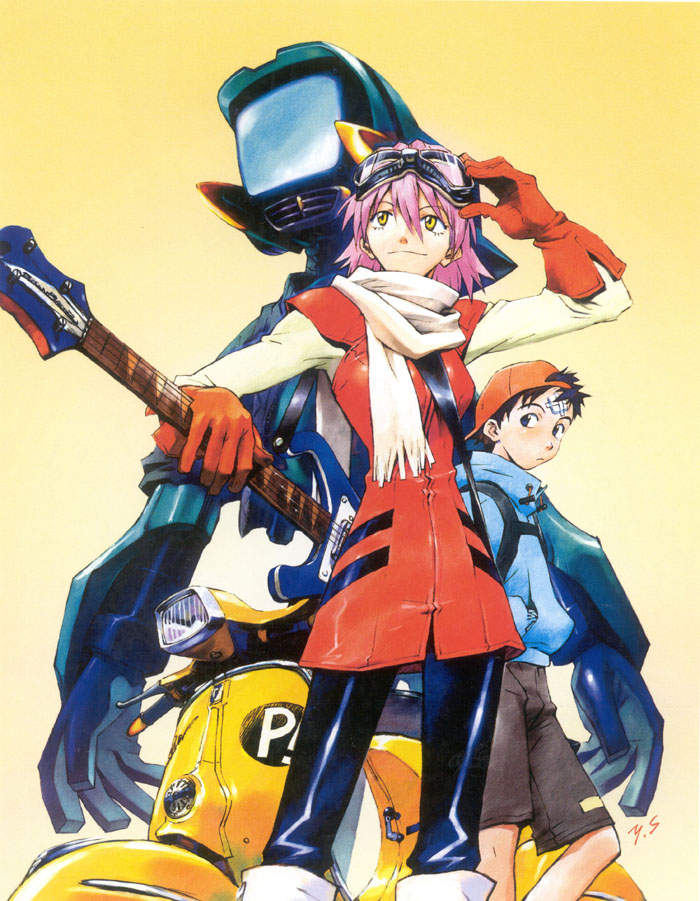
Naota is bored with his life and his hometown. As he puts it: “nothing amazing ever happens here.” That is until a strange girl with pink hair rides into town on a Vespa scooter and whacks Naota in the skull with her guitar. As unexpected as the intro is, it is both incredibly impactful and important in setting up the events that play out the entirety of FLCL (pronounced ‘Fooly Cooly’).

Naota is a fairly mellow middle school student who doesn’t understand why people get worked up over small things, and doesn’t exactly enjoy the company of his father. He thinks his classmates are too much to take and that his brother’s girlfriend Mamimi is too clingy. But Haruko, as annoying as he claims her to be, piques Naota’s interest more and more as FLCL progresses, and he learns from her how to be free-spirited and enjoy life.


Haruko is an alien who has been tracking down the power of the pirate king Atomsk. She attempts to use Naota’s head as a portal to reach Atomsk and his seemingly limitless power, but Naota’s head yields plenty of other troubles along the way. Each of the objects that erupt from Naota’s head plays a greater role in the end of the series, but for the first three episodes, they are passed off as being relatively unrelated. In order to keep tabs on Naota’s progress and the objects his head spits forth, Haruko convinces the boy’s father to hire her as a maid. Haruko constantly shows up to help Naota deal with the otherworldly creations of his otherwise empty mind, mixing stylized action with a plentiful helping of humor.

Mamimi plays a relatively minor role compared to Naota and Haruko, but is arguably still a main character. She was previously dating Naota’s elder brother, until he left to play baseball in the United States. Now she spends most of her time hanging out with Naota, teasing him about his supposed disinterest in girls. Underneath, however, Mamimi is lonely and doesn’t get along with her classmates well, so she confides in Naota as her only friend.

The other characters are not nearly as developed, but that's to be expected from a series this short. As such, most of them will likely become forgettable in the long run. Some viewers may find the main cast to fit certain anime stereotypes, such as Naota being borderline emo and Haruko being spontaneous in her attempts to accquire the power of Atomsk. This is largely true, and is one of the few weak points of the series as a whole.


Most of FLCL’s best jokes come from poking fun at other anime series, most notably Lupin the Third and Neon Genesis Evangelion. These are used in both more obvious and in-your-face instances, such as Naota’s father’s choice of suits, as well as more subtle references, such as the first major fight sequence atop the bridge drawing inspiration from Gundam and Evangelion. However, the parodies are not limited to anime, as the animators decided to try their hand at recreating South Park with “Mr. Eyebrows” ranting about his romantic problems. Even if viewers have not seen these constantly referenced series, they can still be assured plenty of laughs, from Haruko’s rock star outfit to the outrageous attitudes of Naota’s classmates, and my personal favorite, “Little Prince Curry Goes to New York”, a supposedly mild curry for children that burns Naota’s mouth, causes his grandpa to pass out in his bowl, and gives Ninamori diarrhea. The characters also break the fourth wall from time to time. Naota asks the audience if they are as confused as he is when Haruko begins ranting about famous rock stars, while his father has to cut a scene short because of its apparent high cost for the animators.

The soundtrack is absolutely brilliant, comprised exclusively of tracks from the band The Pillows. Some of their songs may feel a bit similar from time to time, but overall the soundtrack mixes things up enough to convey the moods of each scene quite well. If nothing else, the soundtrack is infectiously catchy. The art style, on the other hand, will probably make viewers pull a double-take to make sure this series was actually produced in 2000. In complete honesty, this series looks so much better than most present-day series. Granted it was only six episodes in length, so the animators had plenty of time to fine-tune things, but even so this is one of the best looking anime ever released, with bright and vibrant colors in the foreground playing off a watercolor-style background. This is one of a select few anime series where I actually prefer the English voice actors over the original Japanese cast, because of how fitting each voice is and how well the character’s emotions are conveyed.


Between the threat of a giant steam iron flattening out the wrinkles of all the brains on the planet, Naota’s grandpa complaining to robot Kanti that he “wanted the Hustler with the Anna Nicole centerfold”, Ninamori growing a giant spider-like alien out of her skull, and Haruko engaging Amarao in a John Woo-style shootout with the neck of her guitar, FLCL does an magnificent job of setting itself apart from the rest of the crowd. Far too often an anime will attempt to parody other series and end up throwing the story off course. FLCL manages to keep things on track, while still maintaining a heaping helping of action and humor. Though it is a short six episodes long, FLCL is one of the best anime of the decade and a major accomplishment for something that was more or less an experiment on Gainax’s part.

My Rating: 9.5 (out of 10)

Thursday, April 8, 2010

Anime review: Mobile Suit Gundam 0083: Stardust Memory


In 1991, artist Shoji Kawamori, best known for his mecha designs in Robotech: The Macross Saga, joined directors Mitsuko Kase and Takashi Imanishi to create a new chapter in the Mobile Suit Gundam saga, bridging the gap between the original Mobile Suit Gundam and Mobile Suit Zeta Gundam. The result was one of the most tense and realistic Gundam series ever released.

Mobile Suit Gundam 0083: Stardust Memory is built out of a similar formula to that of Mobile Suit Gundam: 08th MS Team. It consists of thirteen episodes, and begins with a flashback to the battle of A Baoa Qu during the One Year War. Anavel Gato, ace pilot of the Zeon forces is planning to go back out into battle when he is halted by his superior, Augille Delaz, who promises that they will have their revenge someday. The story then jumps ahead three years to an Earth Federation base in what is left of Australia. Kou Uraki and Chuck Keith, two rookie pilots are running training exercises when one of the Federation’s newest ships – the Albion – arrives to deliver two new prototype Gundams, one of which is equipped with a nuclear launcher. That night, Gato and a strike team infiltrate the base and manage to steal the nuclear-equipped Gundam GP-02. Without much thought, Kou tails them in the Gundam GP-01, but the Zeons manage to escape after a brief skirmish.


The Albion gives chase across Africa for a while, until the Zeon forces manage to escape into space. Fearing the worst possible outcome now that the Zeon forces have control of a nuclear-equipped Gundam, the Albion launches in space, with Kou, Chuck, their superior officer Lieutenant Burning, and designer of the prototype Gundams Nina Purpleton onboard with Commander Synapse and his crew.

While all of this is going on, Delaz and Gato are becoming increasingly suspicious of Cima Garahau, another Zeon commander who seems to be hiding information from them. Nonetheless, Delaz and Gato continue forth with Operation: Stardust and gather as many Zeon remnants as possible before attacking the Federation forces at Solomon and carrying out their plans. The series deals with a large amount of deception on both sides of the conflict. The constant mystery that envelops the true nature of Operation: Stardust puts a tense air about the whole series.

Kou Uraki plays a role similar to Amuro Ray, though he is arguably more mature and quick to action. This is a good thing, as the series is only thirteen episodes in total and too much hesitation would likely result in boredom for viewers. That said, some viewers may find Kou and Nina’s relationship to take too much focus, and perhaps thrown in just to create another underlying conflict in the series, albeit a minor one. Still, Nina and Kou’s relationship inevitably comes to a head in an intriguing plot twist in the final episode.

Anavel Gato plays opposite Kou as a sort of Char counterpart who is more concerned with the rebirth of Zeon than his own personal revenge against the Earth Federation. Gato believes his cause to be noble and necessary to the advancement of mankind, refusing to let himself lose sight of his ultimate goal amidst threats from the Earth Federation and his suspicion of Cima.


The series hits a brick wall, so to speak, about ¾ of the way through, just as the space battles become really heated and exciting. The Albion is forced to resupply on the Moon, and Kou spends most of this time exploring until he encounters a former Zeon pilot who wants to rebuild a mobile armor. Oddly enough, Kou decides to go along without much hesitation, as if he’s known the guy for years - a major break from his character’s attitude throughout the rest of the series. Granted, the ship is low on fuel and supplies, but they seem to take as long as possible to get back to the action. That, combined with the fact that Cima is there as well, scheming behind the scenes, makes this portion of the show by far the slowest, weakest and rather corny.

When the action is heated, however, Stardust Memory delivers some of the most brilliantly orchestrated fight sequences in any Gundam series. The fact that nearly two thirds of the series takes place in outer space gave the animators a lot more freedom with this aspect, and they utilized it to the fullest. The battles do not feel repetitive, however. The total body count at the end of the series is massive, which largely fuels the push for the creation of the Titans forces in Mobile Suit Zeta Gundam.


As with most Gundam series, the Japanese and English voice acting are both superb. The soundtrack is decent enough and fits each sequence, but there are only a few songs that stand out as being more memorable than others. The animation is nearly flawless, rivaling the quality of some of the more recent Gundam series.

Even with its shortcomings, Stardust Memory is one series that every Gundam fan should give a try. It’s a very tense and serious take on the Gundam universe, but delivers some impressive storytelling and beautiful animated sequences. The characters may not be every viewer’s cup of tea and the mobile suit designs are largely rehashes of those from previous series. But aside from one major hitch, the action builds until an absolutely spectacular finale.

My Rating: 8 (out of 10)

Wednesday, April 7, 2010

Anime review: Neon Genesis Evangelion


It has been a little over a year now since my big reintroduction to anime began. While a large part of that was my re-watching various Gundam series, I give the most credit of keeping me interested in the medium to Neon Genesis Evangelion. It’s true that my watching Evangelion for the first time last March was light-years behind the general anime public. But I can honestly say that, despite some confusion I felt while watching it, it is by far my favorite anime series ever conceived.


[WARNING: potential minor spoilers ahead.]


For those not familiar with Neon Genesis Evangelion (as I’m sure there are others like myself who are a bit behind with the times), it takes place in the year 2015, a time when mankind is utilizing NERV’s EVA units to fight off other-worldly creatures known as Angels. Shinji Ikari, the son of NERV head Gendo Ikari, is asked to come to Tokyo-III in order to pilot EVA Unit 01 and fight the Angels. Shinji has not seen his father since he was three years old, and as such, Shinji initially refuses to aid his father, until he sees the severe wounds fellow pilot Rei Ayanami has received from battling the third Angel. Understanding that Gendo plans to send Rei out to fight in this condition, Shinji changes his mind and pilots EVA Unit 01. Shortly after he begins fighting with the Angel, Shinji blacks out after EVA Unit 01 sustains too much damage. We are then given a peek into Shinji’s future relationships with his roommate Misato Katsuragi and fellow pilot Rei Ayanami, as well as the frustration Shinji harbors towards his father. Humurous sequences are sprinkled throughout, a distinct contrast to the otherwise serious and somewhat dark nature of the first two episodes. After the prospects of Shinji’s new life in Tokyo-III are covered, the focus shifts back to the events of the Angel battle, and we see that EVA Unit 01 reactivated without manual override, and entered a “berserker” mode, in which it tore the Angel apart before surviving the Angels’ self-destruction.


The aforementioned is an overview of the first two episodes. As the series progresses things become not only far more complex, but also increasingly dark in subject matter. The religious symbolism becomes more and more frequent, and the true nature of the Angels and NERV are not revealed until near the end of the series. Around the middle of the series, Kaji’s secret investigation teases at what might be, but in the end the truths behind NERV, SELEE, the Angels, and the EVAs are executed as some of the most carefully orchestrated plot twists in any television series.

The characters in Evangelion are all brilliantly portrayed. Around the middle of the series, it becomes obvious that creator Hideaki Anno put plenty of time into developing each and every one of them. A large part of that stems from the fact that there are three main characters, about a dozen secondary characters, and a handful of tertiary characters (depending on how you look at the characters, your interpretation may differ).

Shinji recieves the largest focus, and every so often viewers will get a look into his thought processes from directly inside his head. These sequences often come on without any sort of warning and can be rather trippy, but they are incredibly important to the eventual outcome of the series. As the show progresses, Shinji sort of travels two paths at the same time. One is making him stronger by proving himself in battle through EVA Unit 01, while the other has him questioning what he is fighting for and his increasing distrust and dislike of those around him.

Some fans have expressed a dislike towards the character of Shinji, arguing that he comes off as too cowardly and depressed. While there is a large amount of truth to this, he is fourteen years old and dealing with raging hormones. That combined with the fact that he has never had a good relationship with his father, never had much of a chance to get to know his mother, is thrust into the care of a woman whom he barely knows and who isn't entirely sure of her own parenting abilities, and both figuratively and literally carries the weight of the world on his shoulders, it's not much of a surprise that Shinji acts the way he does. While Shinji may not be the most likeable lead character in any given anime, Anno and his team did a near-perfect job on portratying the realistic effects of that sort of pressure on a teenager.


Asuka Langely Soryu is the pilot of EVA Unit 02, and hails from Germany. She is incredibly determined to prove herself, usually appearing hot-headed and egotistical to her peers. She constantly competes with Shinji to be known as the greatest EVA pilot, a challenge to which Shinji doesn’t much understand nor care her reasoning for. All of this is a façade, however, as it is revealed later on in the series that Asuka and her mother have a very dark past.

Rei Ayanami, pilot of EVA Unit 00, is far more limited in her view of the world. A large part of this is due to the fact that she is not a normal human being, and as such does not fully comprehend the ideas of human emotion, attachments, and questioning others. Rei’s story is mostly of self-discovery and of the understanding of human nature, all from the perspective of an outsider looking in.

Every single character in Evangelion has some sort of psychological or social issue to cope with, some of which are not resolved by the finale. Between the psychological breakdown of the characters and the constant Judeo-Christian symbolism, the series hides a lot more under its surface than the first few episodes imply. As the Angels the pilots are combating become more difficult, their psychological statuses degrade and their relationships with one another strain. Although the giant EVAs and Angels are not exactly applicable to everyday life, the issues and confrontations that the characters face are easy to relate to. For better or for worse, Evangelion will likely be a massive mind trip for many viewers.


The soundtrack of Evangelion is incredibly varied, borrowing from jazz and rock influences, while combining this with traditional orchestral pieces, including Handel’s “Hallelujah” and Pachelbel’s “Canon in D”. Constant reprises of original pieces including “The Beast”, “Thanatos”, and “Borderline Case” will serve as the various themes to the major events in Evangelion, and ultimately fit their respective sequences perfectly. The opening theme of “A Cruel Angel’s Thesis” and closing theme of “Fly Me to the Moon” flow with the series fittingly, even if their sounds do differ a fair amount from the rest of the soundtrack.

Every sequence is animated beautifully, and the team at Gainax should be commended for that, considering their constantly dwindling funds as the series progressed. That said, the Angel fight sequences become less spectacular near the finale, and many animated sequences were repeated in order to save money. Even so, the repetition is effective, especially when used in segments where viewers get a look inside Rei, Asuka, and Shinj’s minds.


I could go on for days about the different theories of Evangelion, the mythology therein, the great debate over which conclusion is the true ending, etc. But whether or not you enjoy the anime will largely depend on how you as a viewer perceive the show’s events. To have someone try and tell you the exact science of Evangelion is a fallacy in and of itself – Hideaki Anno explicitly expressed that some aspects of the show are meant to be open-ended and wholly up to the viewers' interpretation. While this review may be rather vague, it is done as such deliberately. Neon Genesis Evangelion is an incredibly complex anime, and even after the first viewing, I wasn’t convinced I had completely understood everything. Part of me doubts I ever will. As for the acting, the Japanese voice actors do a splendid job in conveying the emotions of their characters, while the English dub is decent enough, but still could have used some fine-tuning. The ending has stirred up a huge amount of controversy among the anime subculture, and I personally prefer the End of Evangelion film ending as opposed to the finale at episodes 25 and 26 of the original series, though I won’t discredit what Anno accomplished with the show’s conclusion. All in all, the series is what you perceive it to be – some people will love it and others will hate it. There is no denying the impact is has had on anime and sci-fi entertainment over the past fifteen years, though, and although I feel there is no such thing as a perfect anime, Neon Genesis Evangelion is about as close as it gets.

My Rating: 10 (out of 10)

Sunday, April 4, 2010

Anime review: Turn A Gundam


Easily one of the strangest yet most creative Gundam series released to date, Turn A Gundam takes place in a timeline known as the Correct Century. The series takes place thousands of years in the future after all of the galaxy’s technology has been wiped out. After much labor, the humans living on Earth have managed to achieve a level of technology similar to that around the time of World War I.

However, there is a society of humans living on the moon who wish to return to planet Earth. To make certain that a return to Earth is even feasible, queen Dianna Soriel sends three spies down to the planet. Fran Doll, Keith Laijie, and Loran Cehack secretly become a part of the Earth population, taking up the roles of a news photographer, baker, and personal assistant respectively. Loran finds himself the assistant of the rich Heim family, and spends much of his time with their two daughters Sochie and Kihel. Sochie and Loran play off of each other as a quarreling brother-sister type duo, but Kihel seems constantly distanced from them, as if her mind is focused on something else.

After a few years, Sochie and Loran are both old enough to participate in a coming of age ceremony in front of a statue known as White Doll. As the ceremony commences, Guin Lineford is in the nearby city of Nocis, explaining to Kihel that some of the earth-dwellers have been in talks with the moonrace for years about their return, though no agreement has been reached. Suddenly, a number of mobile suits attack Nocis. In the heat of the battle, White Doll crumbles, revealing a mobile suit inside, known as the Turn A Gundam. Loran and Sochie jump inside the cockpit and head towards the city to try and fight off the invaders.


Following a brief skirmish, a ceasefire is ordered, and Guin Lineford and Dianna Soriel sit down to talk about allocating a portion of the Earth for a moonrace-exclusive nation. Shortly thereafter, Dianna Soriel and Kihel decide it would be entertaining if they were to switch roles for the day. However, the two get more than either bargained for, as Dianna is requested to return to her ship. Kihel is then whisked away, with the moonrace under the impression that she is in fact their queen Dianna Soriel.

As the series progresses, more information is revealed about the dark history that preceded the events of Turn A Gundam. Countless mobile suits are uncovered in the mountains near Nocis and other areas across the Earth, the majority of these being Kapools and Borjarnon. Many of the mobile suits that appear in the series are nods to mecha from previous Gundam series, including the original Mobile Suit Gundam and ZZ Gundam. Others, such as the Turn A Gundam, WaDom, and Mahiroo are completely new mobile suit designs. A first (and so far only) occurrence in a Gundam series, many of the mobile suits were designed by Syd Mead, an American industrial designer who previously worked on the films Tron, Blade Runner, and Short Circuit.


Clocking in at fifty episodes, Turn A Gundam does a brilliant job of filling the time allotted with exciting battle sequences and plenty of plot development Though the series can be a bit slow going at first, it pays off in the end. There are no “filler” episodes in Turn A Gundam, a welcome break from some of its brethren series. Every event that occurs has a purpose in the overarching story. Towards the end of the series, there are a few major plot twists that send the story in a completely unexpected direction, but prevents things from being totally thrown off course. The finale is very fitting, albeit the fact that it is somewhat bittersweet for the characters.

The single aspect in which Turn A Gundam best surpasses other Gundam and mecha series is the character development. Loran Cehack is possibly the most multi-layered Gundam pilot to date, constantly wrestling with his moonrace heritage and duty to the Earth militia. Loran manages to keep his cool, only releasing his anger and frustration when in battle. Though still relatively young in comparison to most of the other characters in the series, Loran carries himself as one of the most mature and understanding characters in Gundam history.

Likewise, Dianna Soriel comes to terms with her past while posing as Kihel. During her travels with Loran and Sochie, Dianna gains a greater respect for the common folk. She witnesses first-hand the destruction that the mobile suits can cause, and spends much of the first 25 episodes re-evaluating herself as a leader.


Even Gym Gingham, who does not appear until late in the series, breaks the mold of the traditional lead villain. Though he does become a bit power-hungry near the finale, Gingham does an excellent job of carefully calculating his plan of attack and his methods of persuasion. He comes very close to overthrowing Dianna Soriel’s regime, going so far as to plant agents on Earth to both spy on her, as well as create sympathy for his own movement.

From Guin Lineford and Harry Ord, to Lieutenant Poe and Agripp Maintainer, no character is included without an important role. Although there are a few such as Bruno and Jacob who fit more traditional and arguably stereotypical roles, they are still involved enough in the story that they do not come across as boring.

The art style of Turn A Gundam is full of bright colors and detailed environments. Everything from the forests of Earth to the artificial ocean on the moon breathes life. There are fewer battle sequences than in most Gundam series, but when they do occur the animation is flawless and the fights themselves are both creative and brilliantly executed. The soundtrack of Turn A Gundam is beautifully orchestrated and each piece fits perfectly to its respective scene. The opening theme may be a bit silly by today’s standards, but both ending theme songs, “Aura” and “Moon” are nothing shy of epic.

Turn A Gundam is a far cry from most other Gundam series. It has fewer battle sequences and the tense air is absent for a large portion of the series. However, it makes up for these by putting greater emphasis on complex characters and brilliant storytelling. The positive mood that the series conveys puts a large focus on the theme of growing up and of hope for a peaceful future. Although not one of the most popular Gundam series, Turn A Gundam is easily one of the most creative and - in my opinion - one of the best mecha series ever conceived.

My Rating: 9.75 (out of 10)
Related Posts Plugin for WordPress, Blogger...