.
Showing posts with label drama. Show all posts
Sunday, May 22, 2016
Comic Book review: Tokyo Ghost, Volume One: The Atomic Garden
Despite cover art that might evoke thoughts of Akira and Mad Max, Tokyo Ghost falls nearer to the themes explored in Ghost in the Shell, with a presentation that teeters towards Tank Girl and Robocop. It is an extremist vision of a future controlled by one corporation, a world run into the ground with pollution and technological addictions. At the center of this story are Debbie, one of the few citizens of mega-city Los Angeles who has remained clean, and her boyfriend, constable Led Dent, a tech junkie who is known as feared as the most effective of enforcers in L.A.
Led Dent frequently tracks down those who have tried to cheat his employer out of money, or those who seek to upset the twisted dystopian order of the city. And Led carries out many of his jobs with extreme prejudice, destroying mechanical and organic obstacles alike. Debbie, meanwhile, does not think so highly of L.A., nor does she care much for Led’s employer, but she sees the jobs as a necessary evil, a means of escape from this world drowning in its own addictions and misery. While Led’s hulking form and beast of a motorbike play into much of the series visual ‘pop’, Debbie’s bright pink and purple color scheme denotes her livelihood, her hopes for a better tomorrow, and the fact that – even in such a rotten city – her soul is still filled with love for Led.
The series explains that, many years prior, Led Dent was a kid named Teddy. Debbie and Teddy fell in love, but as the world went to hell in a hand basket around them, Teddy felt weak, unable to protect Debbie, or himself, for that matter. Teddy subjected himself to a number of implants in order to become the gargantuan and fearsome Led Dent, but in doing so, sacrificed his soul and much of his free will. Seeing Led constantly jacked in to a series of radio and television feeds as he carries out his missions, Debbie is determined to get him clean, to bring back the boy she fell in love with, by escaping to Japan, rumored to be the last country on the planet devoid of technology.
The environments in Tokyo Ghost display and absurd attention to detail. Many signs and company names can be picked out from any single one of Tokyo Ghost’s cityscape panoramas, while the lush greenery, tranquil waterfalls, and feudal buildings of Japan present a stark contrast. It is a series that rides on the wilder side, with the gore and sex often being gratuitous to further drive home the notion that this future is controlled by selfish individuals whose concerns are not with the common folk. For those who grew up during the boom of cyberpunk anime and films, Tokyo Ghost may be worth a look. This first volume ends on a note that may leave readers a tad puzzled, even caught off guard. With that in mind, I feel it is worth stating that this is but the first act of Tokyo Ghost, and there is plentiful opportunity for the story to be elaborated upon in later volumes.
My rating: 8 (out of 10)
Sunday, March 6, 2016
Anime review: Berserk: The Golden Age Arc
A retelling of the 1990s anime, Berserk: The Golden Age Arc consolidates those events into three films to convey the most well-known narrative involving Guts, Griffith, and Casca. It’s the most obvious jumping off-point for newcomers to the Berserk story, and would seem an appropriate first step in setting the stage for everything else within the Berserk storyline, though, until very recently, no plans to adapt the remaining volumes of the manga were apparent. As is sometimes the case with condensing series into a set of films, the pacing is not the same across the board, which might not be a major point of discussion, were it not for the fact that this element significantly impacts the quality of each of the three entries in the Golden Age Arc.
The first film does a solid job of setting the stage and introducing all of the key players. The supporting cast is shown to be a plucky bunch, with a couple of them being young and naïve, and one in particular being a bit more greedy and self-serving, but they all display a great deal of respect towards Griffith, leader of the Band of the Hawk. Due to his legacy having already been established before the first film even begins, Griffith come across as the most well-rounded and interesting character for this first of three chapters. Guts, meanwhile is given just enough development as a strong-willed warrior lacking any real direction in his life to allow viewers to latch on to him as the trilogy’s main hero, though most of his meaningful maturation will follow in the later films. Casca, meanwhile, first appears as something of a snotty spoiled brat, who, like her comrades, is also highly devoted to her comrades, but seems to bear a grudge against Guts from their earliest meeting.
A medieval setting is established, as well as how the Band of the Hawk are effectively mercenaries for hire, though tales of their victories have spread far and wide, and many of the trilogy’s villains recognize their record of success. There are mythical fantasy elements at play in Berserk, though these are not met in full force until the final film in the series. When Guts encounters one such beast at the end of the first film, it provides not only a test of his strength, but also offers an omen of events to come. This is the first in a series of key events, where the darkest of settings and most intimidating of encounters offer Guts greater insight into the nature of the world around him.
The first film does a solid job of putting all of the pieces in their rightful places, and though it does feel like it wanders from the straight and narrow on a couple of occasions, its pacing is overall appropriate – a far cry from the second film, whose bookends offer the only substantial moments of development for Guts, Casca, and Griffith. Mind you, when these events do come to pass, they are of great importance to the larger tale being woven between these three films. But the hour-long battle they sandwich is neither visually exciting, nor of significant importance to the narrative. The second film does well to take a step back from Griffith a bit, in order to better establish Guts’ ideals and ambitions, as well as prove that there is much more to Casca than meets the eye. This second entry ends on a high note for both of these characters, while still allowing them both plenty of development in the third and final entry, but the absurd span of empty fight scenes not only makes it a dull watch, it also leads the third film to feel rushed.
The Golden Age Arc is my first proper viewing of Berserk, though I’ve been familiar with Griffith’s endgame for many years. For those not aware of how the Golden Age Arc concludes, I will warn that some spoilers regarding the film’s most infamous of moments lie ahead.
The final film dives into some very dark territory, and sees Guts and Griffith part ways as anything but comrades and friends. For many years, I was under the impression that Griffith’s actions in the third film resulted from some tragic fall from glory, that he lost sight of who he was as a leader and hero to so many. Instead, it is a simple matter of him becoming upset over Guts trying to choose his own path in life, and Griffith not having complete influence over his actions that leads him to perform some horrendous atrocities. The climax for a character who proved so compelling during the previous two films ends up being an unsatisfying reveal of pathetic motivations.
And therein lies what is perhaps the greatest downfall of the Golden Age Arc – character motivations on the whole are either incredibly poor, unclear, or wholly nonexistent. Casca is the one major exception to this, offering the most human and believable reasons for joining the Band of the Hawk, for allying with Griffith, and for ultimately turning to Guts as her ally and lover. Guts, meanwhile, sees establishment as the main hero of the Berserk saga by the time the third film comes to its conclusion, but nothing beyond that is achieved. This trilogy feels like the first act of something larger, which may be fine for anyone wishing to carry on with the manga thereafter. There are elements of greatness at play in the Golden Age Arc, but the second and third films constantly deny these to become part of a more cohesive experience. The Golden Age Arc lacks any noteworthy resolution, and leaves viewers with an unsatisfying set of hanging plot threads.
Fans of the 1990s anime might not be so greatly bothered by these shortcomings. Guts, Griffith, Casca, and the remaining members of the Band of the Hawk are rendered with strong animation, while environments look equal parts gorgeous and haunting. Cel-shaded 3D models of knights in armor look a tad clunky and dated, but are generally not present outside of battle scenes, so they do not distract from the remaining visual appeal too greatly. If this trilogy is in fact the jumping off point for someone looking to continue indulging in Berserk by reading the manga, they may find decent value here – the films offer a handful of teases of characters and events that play important roles later on. But as a standalone trilogy, they feel like odd shoehorns. The fact that Guts does not fully come into his own as lead protagonist by the trilogy’s conclusion further sours the experience.
My rating: 6 (out of 10)
Sunday, November 15, 2015
Comic Book review: Age of Apocalypse, Volume One
Considered by some to be one of the best Marvel event series of the 1990s, X-Men: Age of Apocalypse tells the story of an alternate history where Charles Xavier was killed by his psychotic son Legion decades before his school for gifted children could provide a safe haven for troubled youth, and before the legendary X-Men could become a fighting force for good among mutant and humans alike. Instead, Xavier’s death provides Apocalypse and his loyal horsemen a clear path to launch a campaign against humankind, keeping with the all-powerful mutant’s beliefs in ‘survival of the fittest’. Born of Apocalypse’s conquest is a dire future, where humans are corralled into pens like cattle, where mutants are hunted to either be hired into Apocalypse’s ranks or killed for opposing him, and where one Erik Lensherr champions the causes of his old friend Xavier and forms his own team of X-Men.
What is so captivating about the Age of Apocalypse story is the manner in which it takes familiar characters, partnerships, and rivalries, and turns them on their heads. Magneto is now a hero, an icon among those mutants who would dare to stand against Apocalypse and strike back at his dystopian regime. Rogue is Magneto’s wife, and together they have a child whom they name after the late Charles Xavier. Logan is still survivor of the Weapon X program, but is never referred to as Wolverine, and loses one of his hands in a battle with Cyclops, the latter of whom works for Apocalypse under Sinister as one of their most trusted officers. Nate Grey, the X-Man, is a highly powered telekinetic who travels with a band of misfit performers including Toad, Sauron, and Forge, while Sabretooth, Wild Child, Blink, Iceman, and Morph round out Magento’s team of X-Men.
It’s a dark, gritty vision of the X-Men, but rarely feels like it is pushing an ‘edginess’ simply for the sake of selling to older teenage audience. The dialogue is appropriate to the setting, while remaining overall friendly to readers of a broad age range. Character and environment artwork maintain a consistent direction throughout, though each artist does add their own slight spins on these faces and places with which readers will spend many hours.
What is unusual about this first numbered volume in the Age of Apocalypse series is that it gathers a strangely disjointed collection of issues together. Unlike the later volumes, the span of time that is passing across the issues collected in this first trade paperback is hard to pin down. Likewise, it would appear that certain events from issues placed toward the back of this volume actually occur simultaneous or even before issues that are placed near the front. Some of the storylines in this first volume lend a significant amount to establishing the characters and state of the world in Age of Apocalypse. Others, like Blink’s solo romp through the Negative Zone wherein she loses her memories and is caught up in a power struggle between Blastaar and Annihilus’ loyalists, add very little to the core plot, acting as largely uninteresting (sometimes annoying) distractions.
Still, Age of Apocalypse is a wildly engrossing story, and even with its shortcomings, this first collected volume offers some genuinely enjoyable subplots. Its disorganized nature simply falls a bit short of the quality of the later volumes. For those who enjoyed the Prelude or random issues of the later Age of Apocalypse tale, I can assure you that the series only gets better from here.
My rating: 7.5 (out of 10)
Friday, October 23, 2015
Comic Book review: Thanos Rising
A limited five-issue series, Thanos Rising steps back in time to the formative years of the Mad Titan. The story displays his birth, his youth, his teenage years, and the eventual murderous streak that would leave him obsessed with death – both the act and the mystical character of the same name. The art throughout is superb, highlighting bright, metallic surfaces on Thanos’ home moon of Titan, while damp caverns are displayed through rugged inking and the ruins of annihilated worlds convey a haunting air.
Thanos is born into a society that knows no war, no conflict. They are a people of science, and despite Thanos’ unusual purple skin and dark eyes, his father, Mentor, takes to him just as he would his other son, Eros. Thanos’ mother, on the other hand, is immediately horrified by the sight of her child, believing there is something very wrong within him, and attempts to kill him with a knife. She is stopped, and spends many of her years institutionalized. During this time, Thanos grows into a curious, incredibly intelligent child. He seeks to make friends with other students his age, and grows queasy at the idea of dissecting lizards for his studies – a far cry from the cosmic villain he will eventually become.
One girl in particular catches Thanos’ attention, and continues to over the years. She is, in many ways, his enabler, convincing him even at a young age to carry out acts that will result in bloodshed, beginning with a group of lizards who attacked his friends during their exploration of one of Titan’s otherwise-off-limits caves. Thanos Rising has excellent pacing throughout, as each chapter jumps ahead years at a time to the most pivotal moments of the Mad Titan’s rise to infamy. Each section slows down to highlight Thanos as a character – his motives and personality, as well as his gradual embrace of murder, first justifying it as a means to try and discover that which sets beings of higher intelligence apart from animals. But when Thanos receives no answers from his gruesome handiwork, he comes to admit that he finds murder an enjoyable task.
As an adult, Thanos leaves his legacy on many a planet, fathering children with seemingly countless females of varying races. Thanos also makes his mark by joining a crew of space pirates and daring to challenge their leader. For Thanos is not content with mere pillage and plunder – he would see worlds break before him. Thanos Rising presents compelling and appropriate justifications for how would come to earn his reputation and title as ‘The Mad Titan’. His estrangement from his father does not come to pass until the final chapter, but it bears significant weight on the narrative of Thanos Rising, as well as the many conquests Thanos will ultimately carry out. The only oversight in Thanos Rising is the decision to not incorporate Thanos’ brother Eros into his development – he is mentioned once or twice, but never makes a physical appearance, and given how well the late-story clash between Thanos and his father played out, it could have raised the quality of this story even more.
My rating: 9 (out of 10)
Thursday, October 1, 2015
Comic Book review: Angela: Asgard’s Assassin, Volume One: Priceless
When Marvel acquired the rights to Angela, formerly a character from Image’s Spawn comics, they chose to place her in the company of the Guardians of the Galaxy. It was a bold move, to be sure, but she felt right at home in that cosmic setting. Angela was hell on legs, able to best most of the Guardians in battle before befriending them, and carrying on a flirtatious rivalry with Gamora. It was a gamble that paid off in spades, as Angela was able to flourish in her own identity, playing off the Guardians wonderfully, while still feeling as though there was plenty of potential for development down the road.
Enter Angela: Asgard’s Assassin, a series wherein Angela is the main character, rediscovering her Asgardian roots, and quickly finding herself on the run from her long-lost brothers Odinson and Loki. Her crime? Stealing her younger sister, eventual heir to the Asgardian throne, and leaping through the nine realms with the baby in tow. Also in Angela’s company is Sera, a former angel who lived not unlike a monk among the few male angels before leaving on her adventures with Angela. At some point before the start of this first volume, Sera was killed, only to be mysteriously resurrected, and Angela’s desire to know why and how Sera returned to the land of the living serves as a secondary mystery.
There is a lot going on in this first trade paperback volume – too much, in fact. While Odinson and Loki are shown as the initial pursuers, some of the forces of Hel also chase after Angela, Sera, and the baby, while the story flashes back every so often to Asgard to explore Odin and his views on this very complicated family reunion. Yet, there is actually quite a limited amount of time spent in Heven. Only during the last couple of chapters do Angela and Sera actually enter the realm of the Angels, a place which boasts more future-tech than myth and magic. Given how significant a change-up to the previously-established nine realms this new tenth one is, Marvel could have easily devoted an entire trade paperback volume solely to Angela’s roots and the history of the angels.
Angela’s portrayal sees an odd reversal from how she was depicted in the Guardians of the Galaxy comics. She’s still willing to cut down anyone who challenges her, but has lost much of the ferocity she was once known and feared for. Instead, she preaches the system of repayment that the angels apparently base all of their actions around – if someone asks her for a favor, Angela will oblige, but only after reminding them that they must eventually offer her something of a similar value (whether said offering is a physical object or action). It’s an interesting concept, but one that wholly contradicts her presentation in the Guardians comics.
Angela: Asgard’s Assassin is quite heavily steeped in the mythos of the Thor comics, and current events from Odinson’s life. The Thor comics have long existed within their own sphere, to a certain degree, separate from the more closely-interwoven storylines of Avengers members, the X-Men, and most of the other Earth-based heroes. The same can be said of cosmic Marvel – much as Nova, Captain Marvel, and the Guardians of the Galaxy might cross paths with one another, Asgardians tend to stick to the realm of might and magic, save for Thor’s frequent team-ups with Captain America, Iron Man, Hulk, and the other core Avengers members. Nine times out of ten, there is so much lore at play in the Thor comics that it is difficult, even discouraging for newcomers to jump on board, and while Angela: Asgard’s Assassin is not quite as explicit an offender in this regard, there is still a decent portion of backstory that is barely even glossed over, with the assumption that readers are up to speed on recent Asgardian history.
Angela does earn herself a radical new outfit by the end of this trade paperback collection, and the action sequences are plenty exciting to look at. But as a character, Angela performs best when she receives the spotlight for more than just violent actions. Future storylines centered around this fallen angel will prove far better if their narratives are not so restricted to the current events of the Asgardians.
My rating: 6 (out of 10)
Tuesday, September 29, 2015
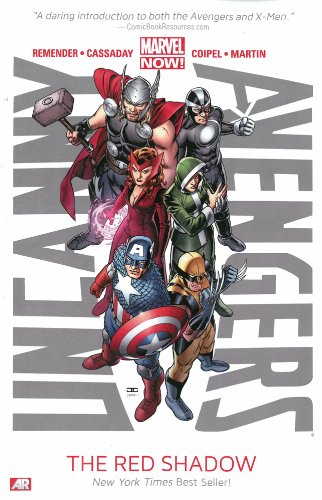
Comic Book review: Uncanny Avengers, Volume One: The Red Shadow
As part of the Marvel NOW! movement, Uncanny Avengers sees a new Avengers team, dubbed the Avengers Unity Squad, emerge from the recent death of Charles Xavier, a crippling loss to both the superhuman and mutant communities alike. The first issue opens with Wolverine delivering a speech at Xavier’s memorial service, reminiscing on how Xavier saw so much potential in him and every other student that came through his school’s doors, and that despite their efforts, Wolverine does not feel that believers in Charles Xavier’s ideals have managed to properly make it a reality. It’s Wolverine at perhaps his most likeable – a straight-shooter who doesn’t soften his blows, but at the same time does not go out of his way to pick fights with others if they simply disagree with him, and refrains from his once-feral tendencies.
The story then cuts to Havok, who is visiting his brother Cyclops in a S.H.I.E.L.D. maximum security cell, as Cyclops was apparently the one directly responsible for Xavier’s death. While this first volume of Uncanny Avengers does well to set the stage for future conflicts, this scene presents one oversight where new readers are not given enough context to understand the full series of events that led to Cyclops killing Xavier, only that Cyclops doesn’t seem to be all too upset by his actions, while Havok believes the human-mutant relationship is at risk for being further strained. It is not long after that Havok is visited by Captain America and Thor, with the red, white, and blue icon asking Havok if he would like to join the Avengers as the leader of a new team.
The pacing that this first trade paperback of Uncanny Avengers adopts is notably slower than other first entries in the Marvel NOW! lineup. By the time the fifth and final issue in this collection comes to a conclusion, the team has still not fully formed, as certain members are reluctant to get along with one another – more specifically, Rogue and Scarlet Witch, with the former holding a grudge over the later for the ‘No More Mutants’ event. Scarlet Witch, meanwhile, maintains that there are greater things at play than Rogue can perceive, and is even painted as more of an antagonist early on, before she is faced with a greater threat facing the Avengers and the community of Marvel heroes at large. Even Captain America has to be reminded of the fact that Havok is the man in charge on a couple of occasions.
Red Skull is this volume’s primary villain, and his Nazi roots resurface in spades as he attempts to influence the masses of New York into spilling one another’s blood in order to wipe out the 'mutant menace'. With Charles Xavier dead, Red Skull has extracted the psychic brain of the famous X-Men leader, and fused it to his own, granting him incredible powers of persuasion and deception over the Avengers Unity Team. He is able to penetrate Captain America’s mind briefly, leading to an argument in the heat of battle between the star-spangled Avenger and Havok. Perhaps even more threatening are the similarly persuasive abilities of one of Red Skull's henchmen, Honest John, who influences Thor to do battle with his former friends and allies.
The other minor villains that Red Skull employs are considerably less memorable, and appear in a limited number of panels. Almost half of this first volume is devoted to the Avengers’ battle with Red Skull, and the press conference that follows, wherein Havok feels that transparency will be their best option if they hope to convince the public that Charles Xavier’s vision lives on, and that they can put their faith in a mutant-superhuman team like the Avengers Unity Squad. Red Skull is cunning and devious a villain as ever, while the dialogue between all of the major characters in Uncanny Avengers properly reflects the team's growing pains. That said, it would have been nice for this story to cover a little more ground, because even though it has the makings of a strong origin for this new Avengers team, it feels like merely the first half of said origin story. All of which is made doubly odd, considering how much later portions of the story tease events to come, specifically from the events of Marvel’s AXIS crossover event.
My rating: 7.25
Sunday, September 20, 2015
Comic Book review: Saga, Volume 5
It’s now been multiple years since Alana and Marko began their life on the run from the many factions that view their hybrid child Hazel as a bargaining chip or threat to galactic stability. As the fourth volume saw Alana, her mother, and Hazel forcibly separated from Marko thanks to the actions of one misguided and extreme janitor, this fifth volume bounces back and forth between the ferocity with which Alana will defend her daughter and the uneasy alliance forged between Marko, the now-exiled Prince Robot IV, coastal rancher Ghus, and thespian/drug addict Yuma. There is a also, a secondary plot concerning The Brand, Sophie, Lying Cat, and Gwendolyn, as they search for a means to revitalize The Will, who is still out of commission.
This fifth volume of Saga does well to focus the spotlight back on Alana and Marko more so than the previous two volumes did, but it does teeter back and forth in uncertainty as to whether or not it wants to redeem these two main protagonists. While they may be worlds apart from each other for the majority of this most recent volume, their thoughts of one another do weigh heavily, as their last interaction before they were torn apart was one of confrontation and hurtful words. And yet, while Alana does appear to bear some degree of regret over her exchange with Marko, her cunning and maternal defensiveness are somewhat undercut by the fact that she doesn’t seem to give a rat’s ass about anyone other than her own family. Marko, meanwhile, decides to turn to the drugs he so abhorred to escape his feelings of guilt over losing track of his family, and even displays a savage nature from seemingly out of nowhere.
While not nearly as overwhelmed in its attempts to juggle multiple story threads as the previous volume, this latest entry still feels a bit thinly stretch as more characters are introduced to the already burgeoning cast. Many of these newcomers see their stage exits by the end of this fifth volume, but it’s still almost too much on the plate when you consider the number of characters who have held minimal importance on the larger plot for the past two volumes. And at the end of this collection, there’s merely more cliffhangers and open-ended threads, with not but a few subplots being resolved by this trade paperback’s conclusion.
While Saga’s adult language and ‘edgier’ presentation factor were amusing early on, they have since become obnoxious elements of its identity. The series tries too hard to jam vulgarities into every other sentence, and the sexual imagery is largely without purpose – it’s perfectly acceptable to explore the relationship Marko and Alana forged during or even prior to Hazel’s conception, but it’s wholly unnecessary to show the act of a dragon fellating itself for a cheap laugh or ‘shock value’. While not as sour an entry as the fourth trade paperback, this fifth volume of Saga only does so much to return the series to the spark of imagination and intrigue, as well as the focused path that were so prominent in its first two collected volumes. As much as I wanted to continue enjoying Saga, I feel these most recent releases have turned me off to the series enough that I can confidently state that this is the end of my investment in Brian K. Vaughan's space opera.
My rating: 5.5 (out of 10)
Thursday, September 17, 2015
Comic Book review: Age of Ultron vs. Marvel Zombies
Among the wilder concepts to come of Marvel’s 2015 Secret Wars event is the four-part Age of Ultron vs. Marvel Zombies. On the far edge of Battleworld, a giant wall has been constructed to keep the more problematic creations from Marvel’s comic history quarantined – those problems, of course, being the undead hordes of Marvel Zombies fame and the ever-evolving rage-filled A.I. known as Ultron. The Zombies wish only to devour those individuals who are tossed into their so-called Deadlands as punishment by the Thors for breaking God Emperor Doom’s laws, while Ultron seeks to eradicate the zombies and their impure nature in his quest to perfect this no-man’s land.
While this is certainly a curious pairing, it would prove a tiring conflict very quickly were a third party not introduced. At the start of this limited series, a version of Hank Pym from the wild west town of Timely is banished to the Deadlands. With little to defend himself and limited knowledge of the Battleworld realms beyond Timely, Hank would most certainly be a goner, were it not for the arrival of Vision, Simon Williams, and Jim Hammond. The trio rescues Hank Pym, bringing him to their makeshift fortress/home in the middle of this desolate region, with the hopes that he might be able to create a counter to Ultron and his devious machinations.
This stranger-in-a-strange-land Hank Pym is, naturally, taken aback, having practically zero knowledge of their modern technology. But he did manage to partially construct a clockwork equivalent of Ultron once upon a time, and, after some convincing, agrees to aid these three synthetic men. Vision, Simon Williams, and Jim Hammond, are not the only three whose lives are factored into Pym’s decision, as there are many other survivors living in their shielded community – most notably, the love interests of these three heroes.
What lends Age of Ultron vs. Marvel Zombies to be a more compelling tale than the cover art might let on is the juxtaposition of this bleak environment and its terrifying armies with a focus on classic Marvel heroes, all of whom have previously struggled with the concept of what it means to be a man versus what it means to be a machine, and where they fall in that spectrum. Hank Pym, meanwhile, is more so the tether that binds the story together.
There are some more frequently vocal members of the undead hordes, which lends the zombies some personality beyond shambling, starving husks. And the situation becomes even more so dire when Ultron proposes a plan that could unleash both armies on the rest of Battleworld. At four issues in length, Age of Ultron vs. Marvel Zombies has nearly-perfect pacing. It incorporates daring science projects, golden age heroism, and a nicely varied but appropriately-contained cast. It has fun with its diverse roots, embracing its oddities and weaving an entertaining and well-rounded narrative.
My rating: 7.5 (out of 10)
Labels:
action,
Age of Ultron,
Age of Ultron vs. Marvel Zombies,
Battleworld,
comic book,
comic book review,
drama,
graphic novel,
horror,
Marvel,
Marvel Zombies,
romance,
sci-fi,
Secret Wars,
superhero,
thriller
Saturday, September 5, 2015
Comic Book review: X-Men: Age of Apocalypse Prelude
Before Age of Apocalypse’s wildly different vision of the X-Men universe properly came into its own, Charles Xavier’s insane son Legion awoke from his long coma to find he had gained some degree of control over the multiple personalities swimming around in his head – enough control, that is, to formulate a plan to travel back in time to kill Magneto and alter the present day, but enough foresight to consider the ramifications of such a major rewriting of mutant history. The buildup to Legion actually putting his plan into action is something of a slow burn, but an effective one just the same. Seeing all of the major X-Men and a handful of both their allies and enemies as they are most well-known makes the transition to their dystopian Age of Apocalypse counterparts all the more powerful, as the contrasts between these are often drastic. Similarly, it offers better context to readers not as intimately familiar with the X-Men legacy.
There are two prominent points in history that this Prelude volume covers: the ‘present day’ before Legion’s actions cause a rewrite of the history of the X-Men readers once knew, and the past when Charles Xavier and Erik Lehnsherr (aka Magneto) shared a newly-forged friendship and were only just becoming familiar with the emergence of mutants around the globe. It is both insightful and amusing to see the relationship these two prominent leaders shared in their younger days, with Charles exhibiting more aggressive and impulsive behavior at times, and Magneto questioning the extent of the power other mutants could possess. While it is clear that these two do not share a perfectly matching view on the world and the struggles that it might one day face, there is a mutual respect that serves to shape Magneto’s ideologies in the later volumes of Age of Apocalypse.
Given how dark and desperate the world has become by the time volumes one through four of Age of Apocalypse roll around, it should come as no surprise that the X-Men, despite their best efforts, fail to stop Legion’s plans. However, these events do not play out in a predictable manner, as Mystique is the first to attempt to kill Legion in his comatose state, only to be thwarted by the members of X-Factor. The fact that different parties of mutants spend enough of their time squaring off against one another as opposed to focusing solely on Legion, as well as the fact that the extent of Legion’s powers are largely unknown until late in this Prelude, are what grant him the upper hand.
The X-Men throw nearly every plan that can scramble together on such short notice once the past becomes threatened by Legion’s intent to kill Magneto and alter the present. Cable and Domino are called upon, and both Charles and Jean attempt to maintain a psychic link with the mutants in the past. When the final hour is upon these heroes, they share a few somber, yet appropriately intimate exchanges with one another, before an awe and terror-inspiring wave wipes over the Earth, erasing the world as it once was and putting the Age of Apocalypse in its place.
My rating: 9 (out of 10)
Sunday, August 30, 2015
Anime review: Jojo's Bizarre Adventure: Stardust Crusaders - Battle in Egypt
Picking up directly where the mid-season break left off, the Egypt arc of Jojo’s Bizarre Adventure sees Jotaro Kujo and the rest of the Stardust Crusaders facing down the last remaining loyal followers of Dio. Most notable among these foes are the Nine Egyptian Gods, foes whose Stands prove among the most intimidating and powerful the heroes have encountered yet. And at the end of the journey, in mansion deep within the heart of Cairo, awaits the main villain himself, Dio Brando. Yet, the Stardust Crusaders have a few cards up their sleeve, revealing clever and previously unseen applications of their Stands, a few assists from the Speedwagon Foundation, and a new ally in the form of the temperamental and selfish Iggy, a scrappy dog who wields the Stand known as The Fool.
This second half of the Stardust Crusaders anime feels more tightly-wound, its narrative more focused. From the moment the heroes set foot in the Egyptian desert, there is a sense of urgency about their journey that was no so prevalent in the first season. The stakes are also higher, with these new villains challenging Jotaro and company in battles of wits or other indirect means, while those that do fight them outright play host to some of the series’ stranger but more memorable Stands.
The voice work is superb, all around. While the core has the obvious task of carrying the show from one episode to the next, the villains who appear for only two episodes at a time leave a lasting, often humorous impression. As is only appropriate, Dio’s presence commands as much attention as they show can offer Stardust Crusaders chief villain. The final confrontation between Jotaro and Dio is among the most intense and rewarding endgame battles in any anime of this episode count I’ve come across.
Meanwhile, the vast majority of Dio’s loyal henchmen and women receive ample screen time as well. Some of the fights feel perhaps a bit more drawn out than necessary, but by and large, it is to the series’ benefit, as practically zero of the finer details are left out from the manga version, and the battles are not resolved in too quick a time frame that would negate the drama and intensity. Each member of the main cast undergoes significant maturation since the outset of their journey, and it’s wonderful to see just how naturally this is conveyed. Later episodes play at viewer’s emotions with masterful technique, as there are callbacks to the earliest moments of the Stardust Crusaders’ quest, as well as a severe gravity of present events as they unfold.
The animation budget seems to have received a considerable boost since the first half aired, which in and of itself gradually improved in quality from the airing of its first episode to its twenty-fourth. While most characters stick to a particular color palette for their clothing, scenes where the Stand fights become especially intense warp to more psychedelic colors, a nice nod to manga author Hirohiko Araki’s tendency to present variations on the previously-established appearances of characters. The soundtrack is catchy, moody, and always appropriate, with rock influences playing in subtly as Stands clash and the Stardust Crusaders scour Egyptian streets for any clues that might lead them to Dio.
Stardust Crusaders does offer a definitive conclusion to its own arc, and does provide a satisfying endgame for the three story arcs thus far. However, there is still plenty of money to be made by David Production should they choose to animate Diamond is Unbreakable and other later arcs of the manga, and I have no doubt they would do a similarly stellar job adapting the stories of Josuke Higashikata, Giorno Giovanna, Jolyne Kujo, and so on. It has been many years since an anime left as strong an impact on me as Stardust Crusaders has managed, but I believe it is safe to say that David Production has made one of the greatest adapted anime series of all time. In so far as I am concerned, Stardust Crusaders has earned its place among the company of Neon Genesis Evangelion, Fullmetal Alchemist: Brotherhood, and Unicorn Gundam as one of the most impressive works of its medium.
My rating: 9.75 (out of 10)
My rating for the Stardust Crusaders series as a whole: 10 (out of 10)
Monday, August 17, 2015
Comic Book review: Divinity
Divinity is my first exposure in any capacity to Valiant comics, and while I typically don’t tread too far from Marvel and the occasional Image series, I found its premise of a Soviet cosmonaut returning after a thirty-year mission with godlike powers to be compelling enough to gamble on a purchase. It is clear from the outset that, while we as readers are being fed the background information regarding the Soviet Union’s role in the space race and their advanced engineering methods, narrator and main character Abram Adams no longer perceives these events in a set sequence as his fellow earthlings do. From the first page, Divinity provides a very strong showing of the defining traits of its pivotal character and his impressive powers, as he rescues a man from injury in the Australian outback, and transforms other individuals into their true selves, whether these new forms involve regaining their youth or becoming wild animals.
Abram Adams has the power to create and manipulate – as well as, presumably, destroy – in the blink of an eye, and the events between the beginning of his training for the bold 1960s journey to the stars and his sudden return to modern day Earth are sprinkled in at a gradual but appropriate pace. Even with fringe science designs for both the rocket and space suit, the wonder and terror of what lies unknown far beyond our own blue planet is weaves a compelling plot that is quite convincing within this fictional retelling of history. There are difficult choices to be made, even before the mission begins, and – for better or worse – the ramifications of these will stay with Abram for the rest of his days.
Where Divinity's quality falls short is through its insistence on shoehorning other Valiant heroes into what was otherwise a great standalone origin story. Perhaps if Abram had a brief encounter with one of the heroes, it would have served its purpose in assimilating him into Valiant’s preexisting comic book universe more smoothly. Instead, the entire second half of this graphic novel sees Abrams portrayal shift from main character to primary objective of X-O Manowar, Ninjak, and couple of other previously established heroes who act as anything but in their attempt to contain Abram after no obvious threat was posed from him. These characters invade the narrative in as harsh a manner possible, and from that point on, the story is about their first encounter with Abram, their perceptions of him as an inexplicable danger, which robs the second act of nearly all the aspects that made the previous half such an enjoyable read.
I understand that any comic label that is larger and has more budget to work with than the indie scene wants to bring all of their properties together and coexist within the same space of fiction. But an origin story needs to be just that – the origin of one important character or team. Divinity has a truly commendable first two chapters, but manages to get so steeped in the much during the latter half that it simply loses its fun factor. It’s true that the Marvel Now! properties did feature cameos by Tony Stark and Beta Ray Bill early on in their runs of Guardians of the Galaxy and Nova respectively, but these inclusions never warped the entire presentation or focus of their stories in the way that Divinity’s invasion of heroes does. Despite an open ending with the possibility for many more stories involving Abram and the people he impacted in the Australian outback, the conclusion of his story for this first trade paperback collection is, bluntly put, lazy and unsatisfying.
My rating: 6 (out of 10)
Tuesday, May 5, 2015
Comic Book review: Black Science, Volume Two: Welcome, Nowhere
My review of Black Science, Volume Two: Welcome, Nowhere. Written by Rick Remender, illustrated by Matteo Scalera.
My rating: 9 (out of 10)
Sunday, April 12, 2015
Comic Book review: Guardians of the Galaxy by Abnett and Lanning: The Complete Collection
My review of Guardians of the Galaxy by Abnett and Lanning: The Complete Collection. Written by Dan Abnett and Andy Lanning, illustrated by Paul Pelletier, Brad Walker, Carlos Magno, and Wes Craig.
My rating: 9.75 (out of 10)
Saturday, April 11, 2015
Comic Book review: The Infinity Gauntlet
My review of The Infinity Gauntlet. Written by Jim Starlin, illustrated by George Perez and Ron Lim.
Monday, March 30, 2015
Comic Book review: Moon Knight: The Death of Marc Spector
My review of Moon Knight: The Death of Marc Spector. Written by Mike Benson and Peter Milligan, illustrated by Mark Texeira, Javier Saltares, and Laurence Campbell.
My rating: 8 (out of 10)
Sunday, March 29, 2015
Comic Book review: Thanos: The Infinity Revelation
My review of Thanos: The Infinity Revelation. Written and illustrated by Jim Starlin, additional illustrations by Andy Smith and Frank D'Armata.
My rating: 7 (out of 10)
Comic Book review: Y: The Last Man, Volumes Nine and Ten
My review of the ninth and tenth volumes of Y: The Last Man. Written by Brian K. Vaughan, illustrated by Pia Guerra.
Volume Nine: Motherland
Volume Ten: Whys and Wherefores
Volume Nine: Motherland
Volume Ten: Whys and Wherefores
Thursday, March 26, 2015
Comic Book review: Saga, Volumes Three and Four
My review of the third and fourth volumes Saga. Written by Brian K. Vaughan, illustrated by Fiona Staples.
My rating for volume three: 7 (out of 10)
My rating for volume four: 3.5 (out of 10)
My rating for volume three: 7 (out of 10)
My rating for volume four: 3.5 (out of 10)
Monday, March 23, 2015
Comic Book review: War of Kings
My review of Marvel's War of Kings event comic. Written by Dan Abnett and Andy Lanning, illustrated by Paul Pelletier and Bong Dazo.
My rating: 9.25 (out of 10)
Comic Book review: Y: The Last Man, Volumes Six through Eight
My review of Y: The Last Man, volumes six, seven, and eight. Written by Brian K. Vaughan, illustrated by Pia Guerra.
Volume Six: Girl on Girl
Volume Seven: Paper Dolls
Volume Eight: Kimono Dragons
Volume Six: Girl on Girl
Volume Seven: Paper Dolls
Volume Eight: Kimono Dragons
Subscribe to:
Posts (Atom)